You get into bed at a sensible hour, tired, and then lie there — eyes open, mind replaying the day, sleep refusing to arrive. There are many reasons for poor sleep, but one of the most fixable is glowing quietly above your head: the bedroom’s own lighting. A bright white ceiling light used until the moment you switch it off is, biologically speaking, a signal that it is still daytime. Your body believes it, and stays awake accordingly.
Bedrooms are usually lit like every other room — one strong overhead fitting, cool bulbs, no dimming — when they should be lit like the opposite of an office. This guide explains how light talks to your sleep system, and how to redesign bedroom lighting so the room itself winds you down in the evening and wakes you gently in the morning.
Quick Answer
Bedroom light keeps you awake when it is bright, blue-leaning and overhead in the last hour or two before bed, because that light suppresses melatonin, the hormone that makes you sleepy. The sleep-friendly setup: low, warm lamps at 2700K or below (amber-toned is better still), on dimmers or low-wattage bulbs, placed below eye level beside the bed and around the room’s edges; the ceiling light off for the last hour before sleep; and blackout curtains against street light. In the morning, reverse it: bright light as soon as you wake anchors the whole cycle.
How Light Talks to Your Sleep System
Your body runs on a roughly 24-hour clock, and light is the clock’s main setting signal. Special cells in the eye report brightness and colour directly to the brain: bright, blue-rich light (daylight, and anything resembling it) says “daytime — stay alert” and suppresses melatonin. Dim, warm, low light says “evening” and lets melatonin rise, which is the chemical beginning of feeling sleepy. This is why the hour before bed matters so much: light choices then are effectively instructions to your own chemistry.
Three properties decide how wakeful a light is. Brightness — a dim warm lamp and a bright warm lamp are not the same signal. Colour — blue-rich light (4000K and above, plus most screens at full brightness) is far more alerting than amber light at the same brightness. And position — light entering the eye from above, like daylight from the sky, reads as “day” more strongly than low light at lamp height. The typical bedroom ceiling fitting fails on all three counts at once, right up to the moment of lights-out.
The Evening Setup: Low, Warm and Layered Down
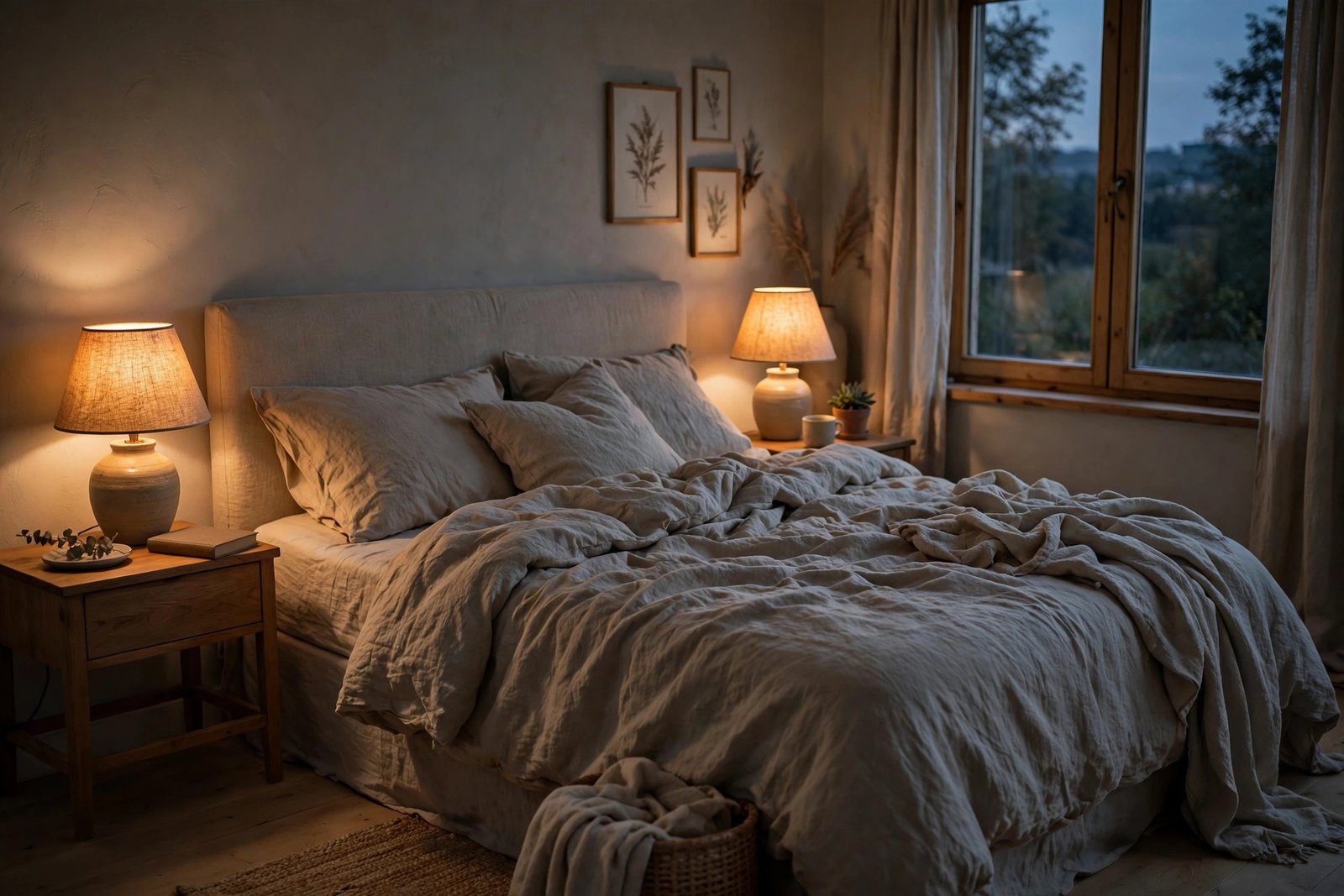
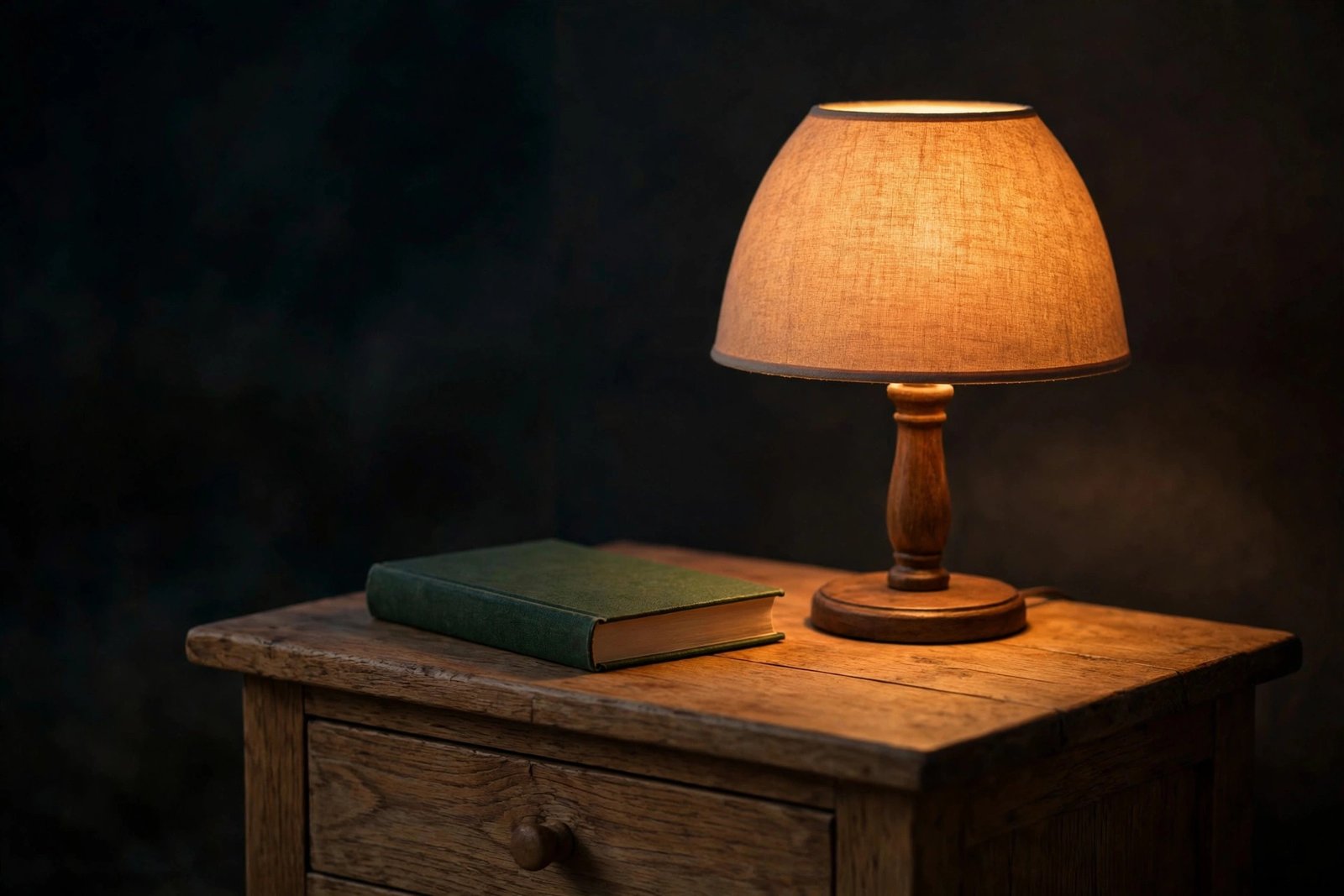
Design the bedroom’s evening light the way you would a campfire: low, warm, and around you rather than above you. The core of the setup is bedside lamps with fabric shades and warm bulbs — 2700K as a ceiling, and for the last hour, bulbs labelled 2200K or “amber” give an even more candle-like signal. Put them on dimmers or choose low-lumen bulbs (200–400 lumens is plenty for winding down), and make sure the shade hides the bulb from your eyes when you are lying down; a visible bare bulb at close range is a tiny sun.
Add one or two supporting sources at low level: a small lamp on a dresser, a warm strip behind the headboard washing the wall softly, or a shaded floor lamp in a corner. The aim is a room you can move around in safely and read in comfortably, where no single source is bright and nothing shines down from the ceiling. This is layering used in reverse — the same three-layer thinking from our guide to layering light for a softer feel, but tuned down: ambient kept minimal, task light local and warm, accent light doing the mood.
Then make it a routine, because the clock responds to patterns. Ceiling light off at a set time each evening — an hour before bed is a good rule — lamps only after that. The repetition teaches your body that lamp-light means the day is ending, and the transition starts to work on its own.
Reading in Bed Without Waking Your Partner (or Yourself)
The bedside lamp has two jobs that pull in opposite directions: bright enough to read by, dim enough not to disturb. Solve it with direction, not power. A lamp with a shade that directs light down onto the page, positioned just behind and beside your shoulder, lights the book while the rest of the bed stays in shadow. Dedicated clip-on book lights in warm tones do this even more precisely — a small pool on the page, almost no spill.
Height matters: the bottom of the shade should sit roughly at shoulder level when you are propped up in bed, so light lands on the book and not in your partner’s eyes or your own. If one of you reads much later than the other, a directional lamp on that side plus a warm book light is the combination that keeps the peace. And keep the reading light warm — a cool-white book light quietly undoes the evening’s wind-down while you read about something relaxing.
Morning: the Other Half of Sleep-Friendly Light
Sleep-friendly lighting is a 24-hour design, not just an evening one. Bright light soon after waking is the strongest daily signal that resets your clock, sharpening the contrast between day and night that makes evening sleepiness arrive on time. Open curtains the moment you get up — and if the bedroom faces away from the sun, that is one more reason to make the morning bathroom and kitchen bright instead.
If your bedroom is north-facing and mornings are grey, the warm-up strategies in our guide to a north-facing room that feels cold and grey — warm wall colours, warm textiles, layered lamps — make the room pleasant at waking time without needing alerting light inside the bedroom itself. For dark winter mornings, a wake-up light that brightens gradually before your alarm is a kinder tool than a phone torch or a slammed-on ceiling light.
Blackout, Screens and the Finishing Details
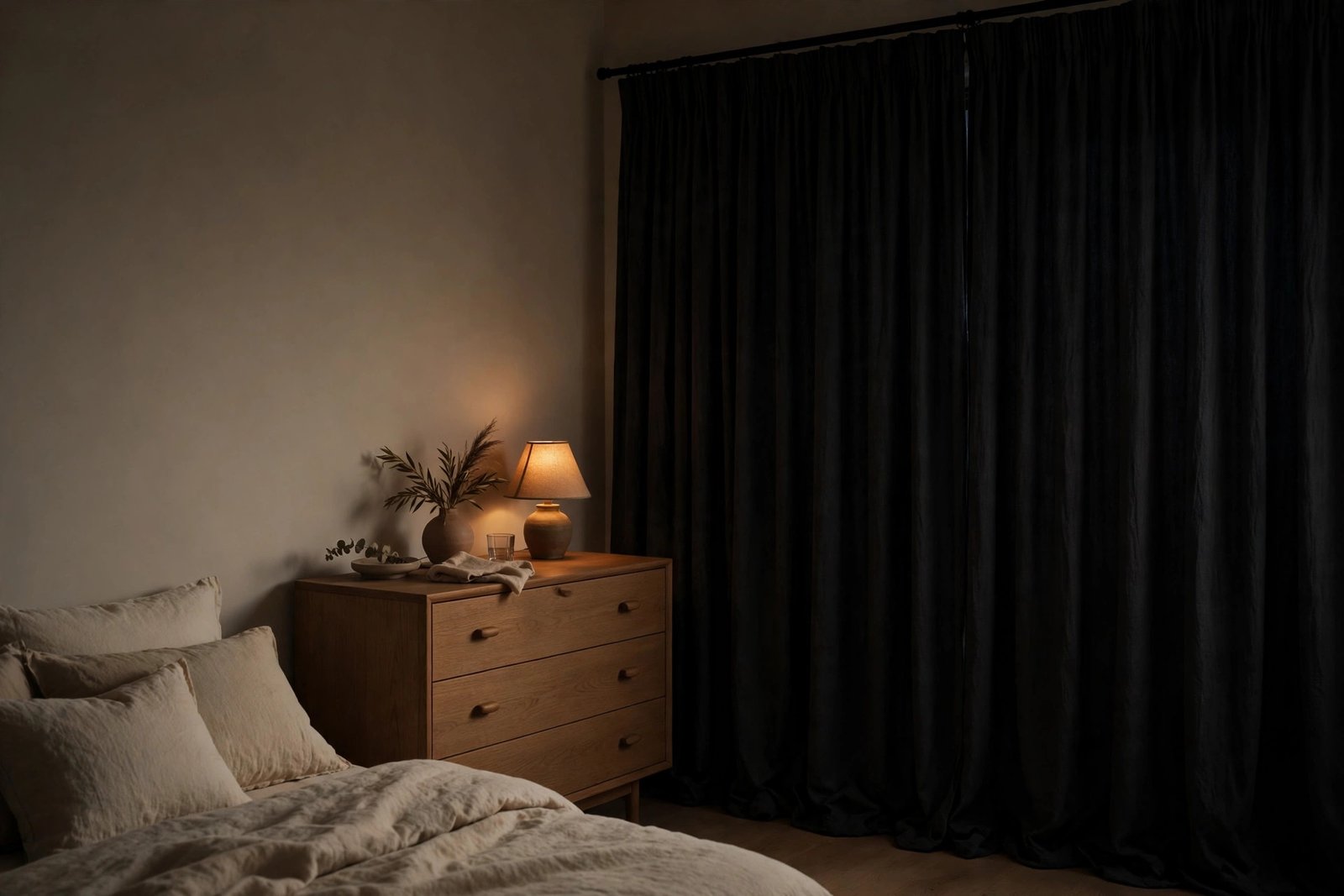
Even perfect lamps lose to a streetlight shining through thin curtains all night. Blackout curtains or a blackout blind behind your curtains keep the room properly dark during sleep, which matters most in summer and on bright streets; a small gap of light at the curtain edge is normal and harmless, a glowing orange window is not. Choose warm, muted wall colours while you are at it — soft, low-contrast colour schemes keep the room visually quiet, and the palette rules in our guide to paint colours that make a small room feel smaller (light-to-mid tones, trim matched to walls, no harsh contrast) produce exactly the calm envelope a bedroom wants.
Screens deserve an honest mention in a lighting guide, because the phone on the nightstand is now many people’s brightest “lamp”. Use the warm night mode in the evening, drop brightness as low as readable, and give the last half hour to a book where you can. If a hallway trip is part of your night, fit a low, warm night light at skirting level in the hall rather than switching on full bathroom brightness — one blast of bright light at 3 am can cost the rest of the night’s sleepiness.
Mistakes to Avoid
- Using the ceiling light until lights-out. Bright overhead light in the final hour is a “stay awake” order delivered nightly. Lamps only after a set evening time.
- Cool-white bulbs in bedside lamps. A 4000K bulb at pillow distance is daylight on the nightstand. 2700K maximum; amber for the last hour.
- Bare bulbs visible from the pillow. Glare at close range keeps eyes and brain alert. Every bedroom bulb belongs behind a shade.
- One lamp trying to do everything. A single bright bedside lamp for reading, dressing and winding down serves none of them well. Two or three small warm sources beat it.
- Thin curtains on a bright street. You cannot out-lamp a streetlight. Blackout lining is part of sleep lighting design, not an extra.
- Ignoring the morning. Dim evenings cannot fully fix a clock that never gets a bright morning signal. Light at waking is half the treatment.
Frequently Asked Questions
What colour temperature is best for bedroom lamps?
2700K is the warm standard and a good ceiling for bedtime lighting; for the last hour before sleep, 2200K or amber-toned bulbs are even gentler on melatonin. What matters most is avoiding 4000K and above anywhere in the bedroom’s evening lighting — that blue-rich range reads as daylight to your brain no matter how cosy the fitting looks.
Is a dimmer or a low-wattage bulb better for winding down?
Either works; a dimmer is more flexible because the same lamp can serve for dressing at full brightness and winding down at a glow. Smart warm bulbs are the renter-friendly version — dimmable, schedulable, and many can shift warmer as they dim, which is exactly the direction your body wants in the evening.
Can bedroom lighting really improve sleep, or is it minor?
It is one of the more powerful environmental levers, because light is the main signal that sets melatonin timing. People commonly notice falling asleep faster within days of switching the last hour to low, warm lamp light — especially if they were previously under a bright ceiling light or a cool-white lamp. It will not fix every sleep problem, but it removes a nightly instruction to stay awake.
What should I do about a partner who reads late?
Give the reader a directional light: a shaded lamp that throws its pool down on the page from behind the shoulder, or a warm clip-on book light. Keep the light warm and low, and let the non-reading side of the bed stay dark. It is a placement problem with a placement answer — brightness shared across the whole bed is what causes the argument.
The Bottom Line
Your bedroom light is a message your body reads every night, and most bedrooms are accidentally saying “midday”. Rewrite the message: warm, low, shaded lamps instead of the ceiling light for the last hour, blackout against the street, warm colour on the walls, and bright light saved for the morning where it belongs. The room will look softer — and more importantly, it will start working with your sleep instead of against it.
1 thought on “Bedroom Lighting Keeping You Awake? How to Design Calm, Sleep-Friendly Light”