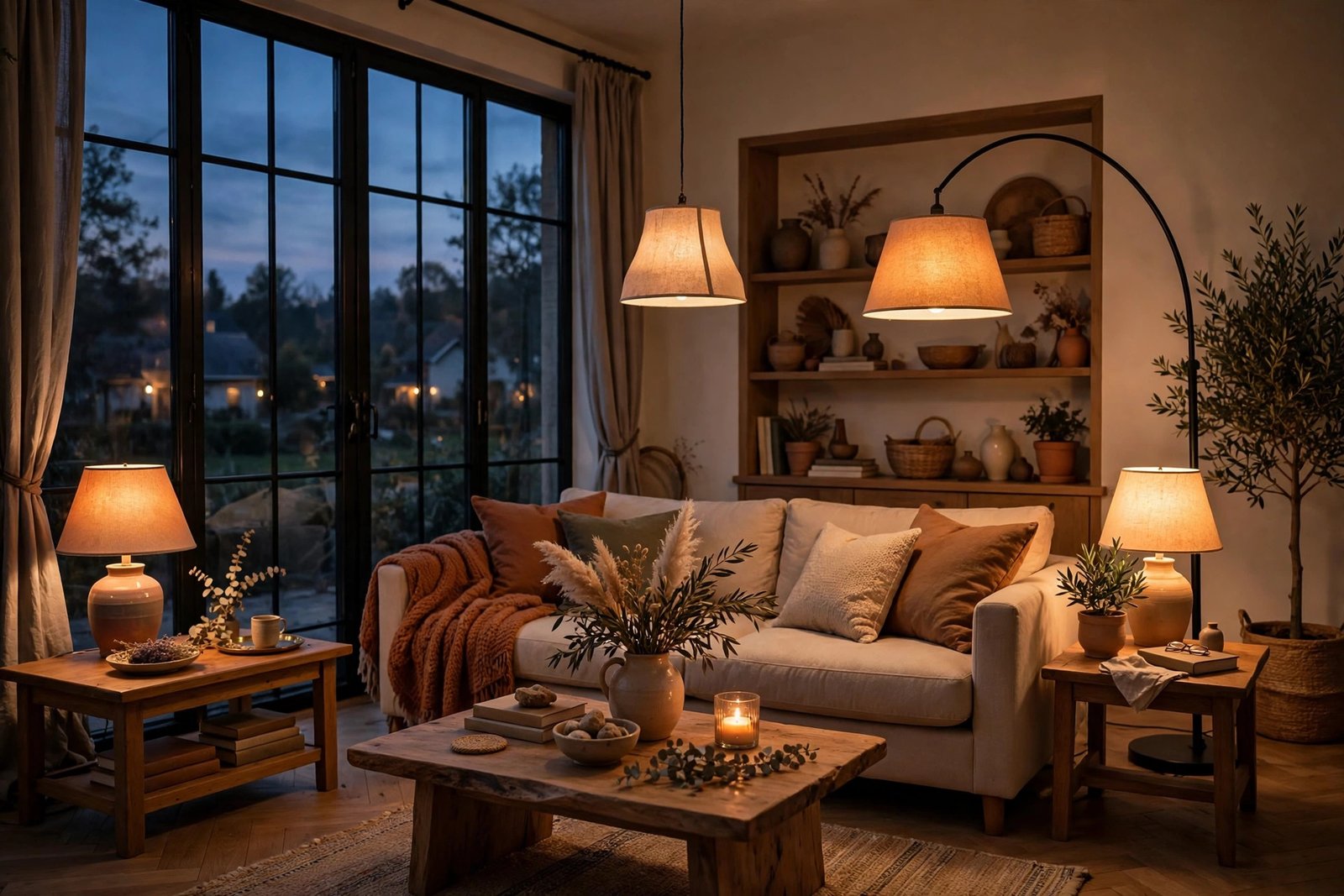
You sit down in the evening and squint. The living room is certainly bright — nobody could call it dark — but the light feels like a dentist’s office: flat, glaring, with hard shadows under every chin and a shine on the top of everyone’s head. Faces look tired, colours look washed out, and relaxing in the room feels oddly like hard work. That is harsh lighting, and it is a design problem, not a bulb problem.
Harshness almost always comes from the same setup: one strong light source, mounted high, shining straight down, with nothing else in the room to soften it. The cure is layering — several smaller, lower, warmer sources doing different jobs — and it can be done in most rooms in a single weekend, often without an electrician.
Quick Answer
Living room light feels harsh when it comes from one bright source above your head, especially with bare or cool-white bulbs. Fix it by building three layers: soft ambient light for general glow (ideally bounced off the ceiling), task light where you read or work, and low accent light that creates warm pools at eye level. Use 2700K bulbs, put shades on everything, add dimmers where you can, and aim for five to seven light sources in an average living room — none of them individually blinding.
Why One Ceiling Light Always Feels Harsh
A single overhead source creates maximum contrast: bright horizontal surfaces (the floor, the top of the coffee table, foreheads) and deep shadow everywhere else — under brows, chins, furniture. Our eyes read that contrast as glare, the same reason a single torch in a dark room is dazzling rather than cosy. Light from directly above is also the least flattering direction for faces, and since a living room is mostly a place for faces — conversation, television, guests — the room literally makes everyone in it look worse.
Bare bulbs make it worse still. A clear, unshaded bulb is a tiny point of extreme brightness in your field of view, and your pupils contract against it, making the rest of the room look darker by comparison — you get glare and gloom at the same time. Cool colour temperatures complete the effect: bulbs at 4000K and above push the light blue, which reads as institutional. None of this is fixed by a dimmer alone on the same single fitting; the shape of the light has to change, not just its strength.
The Three Layers, and What Each One Does
Ambient light is the room’s base glow — the light that lets you cross the room safely and see everything approximately. The softest ambient light is indirect: a pendant with a wide shade that throws light up as well as down, uplighting floor lamps that bounce light off the ceiling, or wall lights that wash the wall itself. The goal is light that seems to come from everywhere and nowhere.
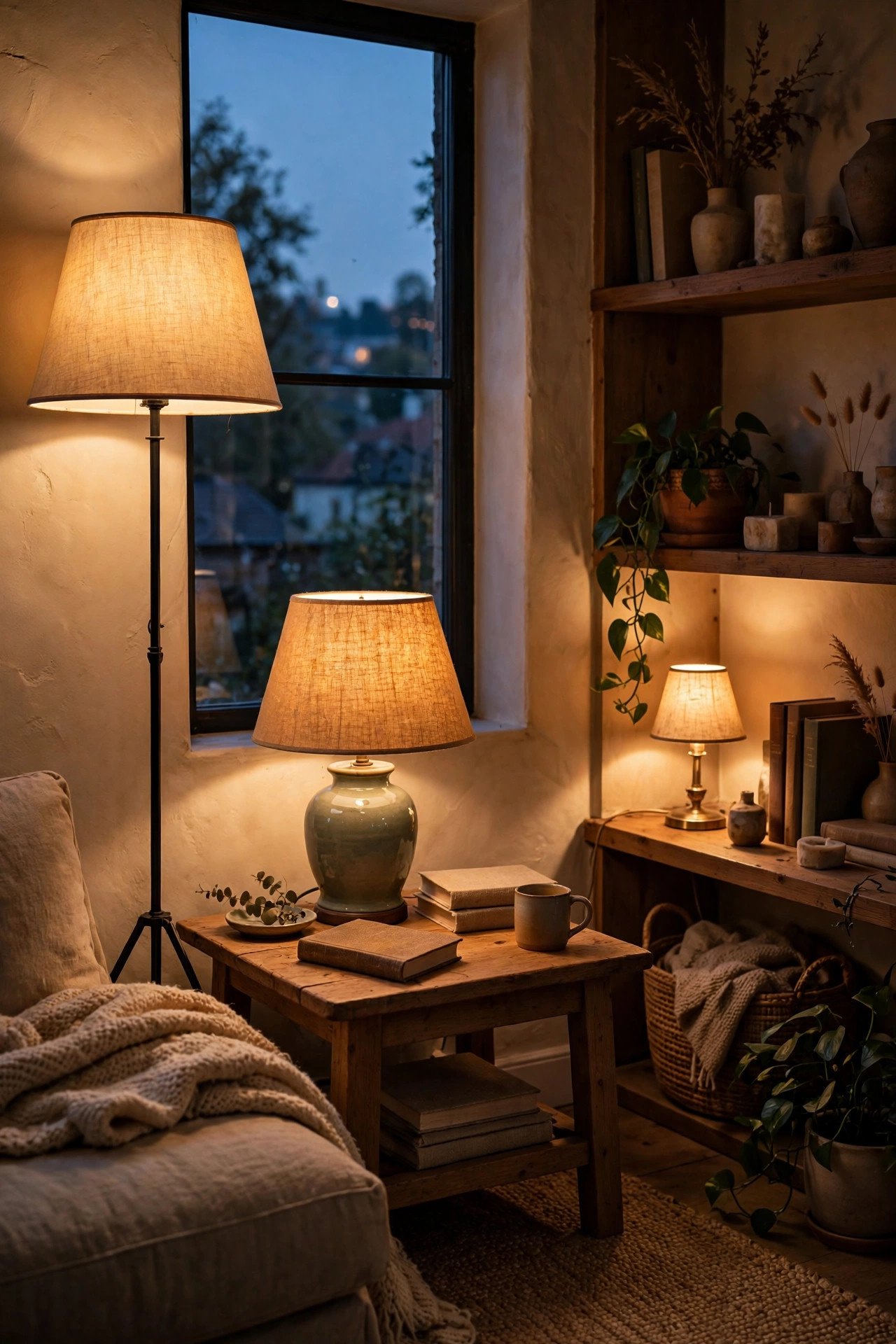
Task light serves an activity: a reading lamp beside the sofa with its shade at shoulder height when you are seated, throwing a focused pool onto the book and not into your eyes; a small lamp on a desk or side table. Task lights should be the brightest lights in the room, but only within their small pool.
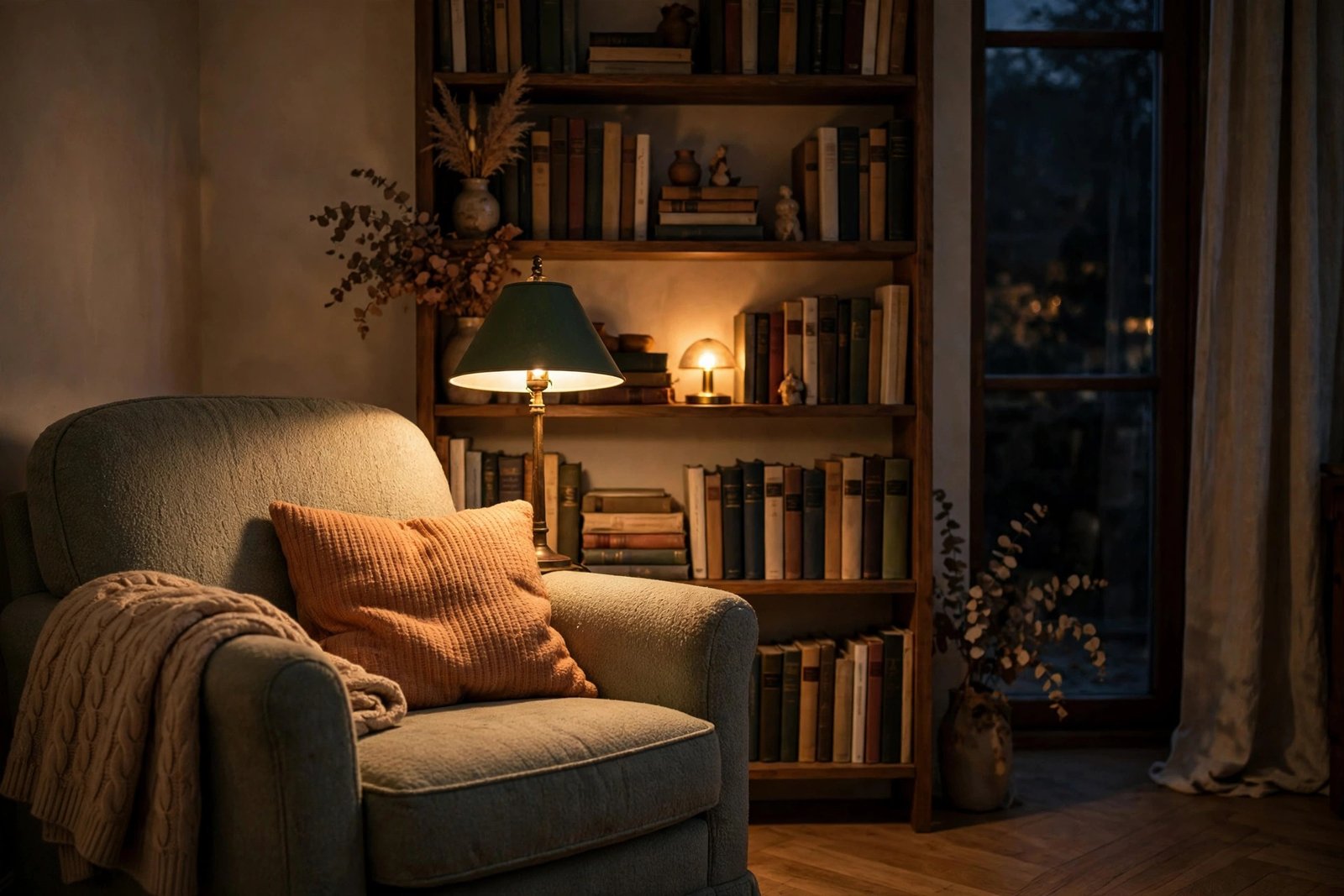
Accent light is the layer most rooms are missing entirely, and it is the one that creates softness. Table lamps on sideboards, a picture light over art, a small lamp inside a bookshelf, even candles: low, warm sources at or below eye level that create gentle pools around the room’s edges. Accent light gives your eyes somewhere restful to land, and it is what makes a room feel “evening” instead of “office”. If your room is harsh but also dark in the corners, the two problems share one cure — our guide to a room that feels dark even with the lights on covers the surface and reflectivity side of the same fix.
Bulbs, Shades and Dimmers: the Softness Toolkit
Standardise every bulb in the room at 2700K (a few 3000K in task lamps is fine). Mixed temperatures — one warm lamp, one blue-white ceiling bulb — make the room feel unsettled in a way people notice but cannot name. Choose frosted bulbs or, better, put every bulb behind a shade: fabric shades soften and warm the light, and the shade itself becomes a glowing object at eye level, which is exactly the effect you want.
Dimmers are the highest-value upgrade in lighting. A dimmed ambient layer plus full-strength lamps lets you tune the room from “cleaning” to “film night” in seconds. Where rewiring is not an option — rentals especially — plug-in dimmers, dimmable smart bulbs controlled from a phone, and simply switching some sources off achieve most of the same result. Also check brightness per source: a table lamp wants roughly 400–800 lumens, a reading lamp 450–800 in its pool, and the ambient layer the rest, spread out rather than concentrated.
Placement: Light the Edges, Lower the Height
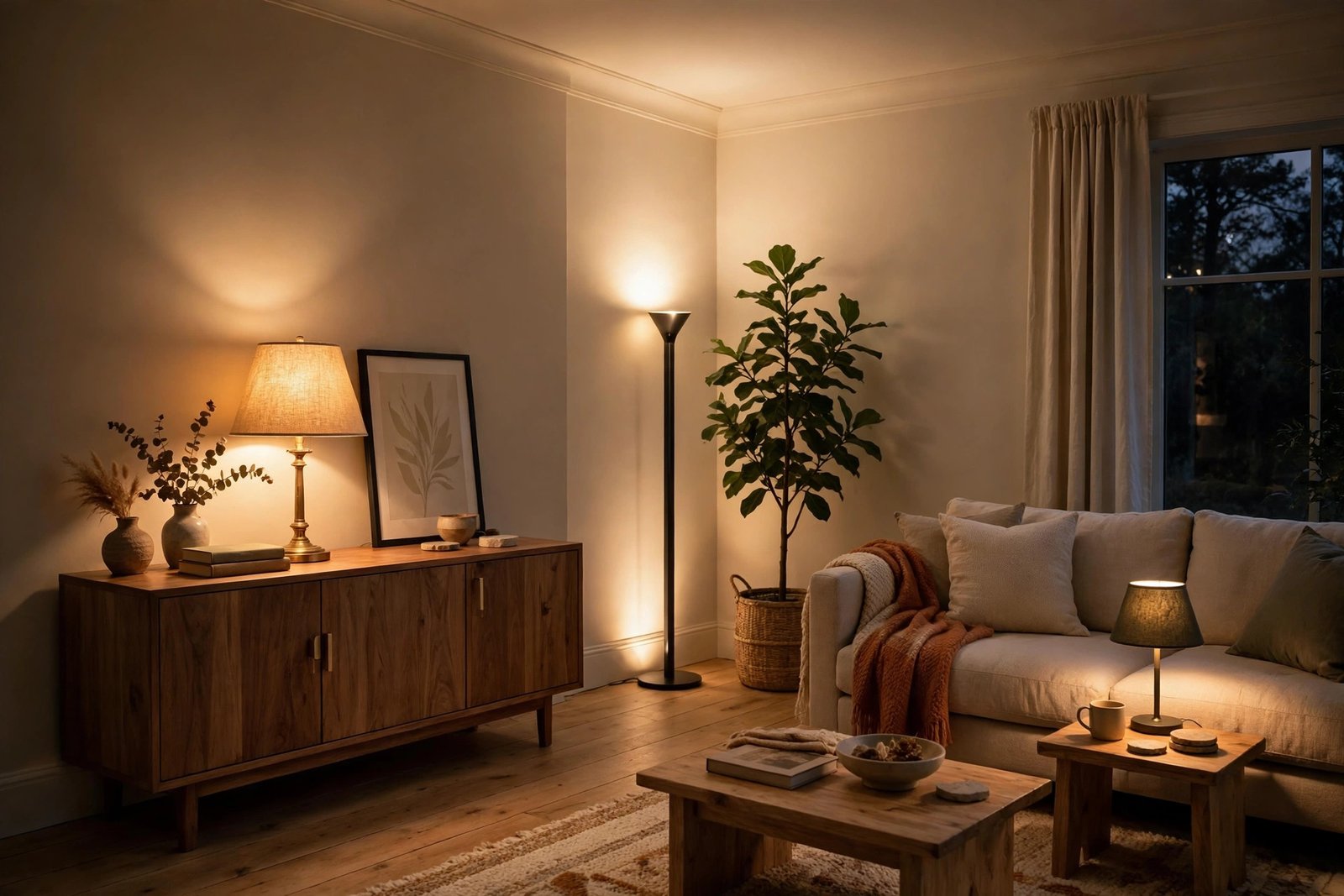
Two placement rules do most of the work. First, bring light down: in a seating area, most light sources should sit between seated waist height and just above seated eye level — table lamps on side tables, a floor lamp arching beside a chair — not on the ceiling. Faces lit from the side look soft; faces lit from above look haunted. Second, spread light to the perimeter. Lamps in the corners and along the walls push the room’s edges outward and erase the cave effect of a lit centre and dark borders. In a large or open-plan space, these separate pools of light also do layout work: as our guide to defining zones in an open-plan living room shows, each zone with its own pool of light reads as a room within the room — and the same pools, zoned deliberately, are how our guide to creating cosy zones in a large living room turns a cold, empty space warm.
A practical starting layout for an average living room: one soft ceiling or pendant source (ambient), a floor lamp behind or beside the main sofa, a table lamp on a sideboard or console, a reading lamp by the favourite chair, and one accent source — a small lamp or picture light — on the far side of the room. Five sources, no single one dominant, all warm: that is a layered room.
Mistakes to Avoid
- One bright ceiling light doing every job. It is the definition of harsh. Even adding a single table lamp and switching the ceiling light off transforms the feel.
- Bare or clear-glass bulbs in view. Unshaded bulbs glare no matter how warm their temperature. Frost them or shade them, always.
- Mixing colour temperatures in one room. A 2700K lamp beside a 5000K ceiling bulb makes both look wrong. Standardise at 2700K.
- Downlights aimed at the seats. Spotlights directly over the sofa put glare in eyes and shadows on faces. Aim fixed spots at walls and art, not at people.
- All the light at one height. A room lit only from the ceiling feels institutional; only from low lamps it feels murky. Spread sources from table height to ceiling.
- Buying brighter bulbs to fix a flat room. Flat is not dark. More power on the same layout means more glare, not more comfort.
Frequently Asked Questions
How many lamps does a living room actually need?
For an average room, five to seven sources in total usually feels right: one ambient ceiling source, two or three lamps around the seating, one reading light and one or two accent lights. A useful rule is at least three sources in the corners of an imaginary triangle around the room, so no side is left dark. Small rooms can manage with three or four if one is a good ambient uplight.
What colour temperature feels softest?
2700K is the classic warm white of old incandescent bulbs and the safest choice for living rooms — warm, flattering and relaxing. 3000K is slightly crisper and works in modern schemes. Anything at 4000K or above reads as office or clinical light in a home setting and is the single most common cause of a “harsh” feeling.
Are dimmers really worth installing?
Yes — they are the cheapest way to get several lighting moods from one installation. A dimmed ambient layer for evenings, full brightness for cleaning or games, in-between for guests. If you cannot rewire, dimmable smart bulbs or plug-in dimmer switches for lamps give you most of the same control without an electrician.
Can I fix harsh lighting in a rental without changing fittings?
Almost completely. Switch the existing bulbs to warm 2700K dimmable smart bulbs, add two or three plug-in lamps with fabric shades around the seating, and simply stop using the ceiling light as your main source in the evening. Add a plug-in uplighter in a corner for ambient bounce. Nothing is wired, everything leaves with you, and the room will feel unrecognisable.
The Bottom Line
Harsh light is a layout problem: too much light, from one place, at one height, in too cool a colour. Layer it instead — a soft ambient base, focused task light where life happens, and warm accent pools at eye level around the edges — all at 2700K, all shaded, dimmable where possible. The room will not be darker; it will finally be comfortable, because softness was never about less light, only about better-placed light.
3 thoughts on “Living Room Lighting Too Harsh? How to Layer Light for a Softer Feel”