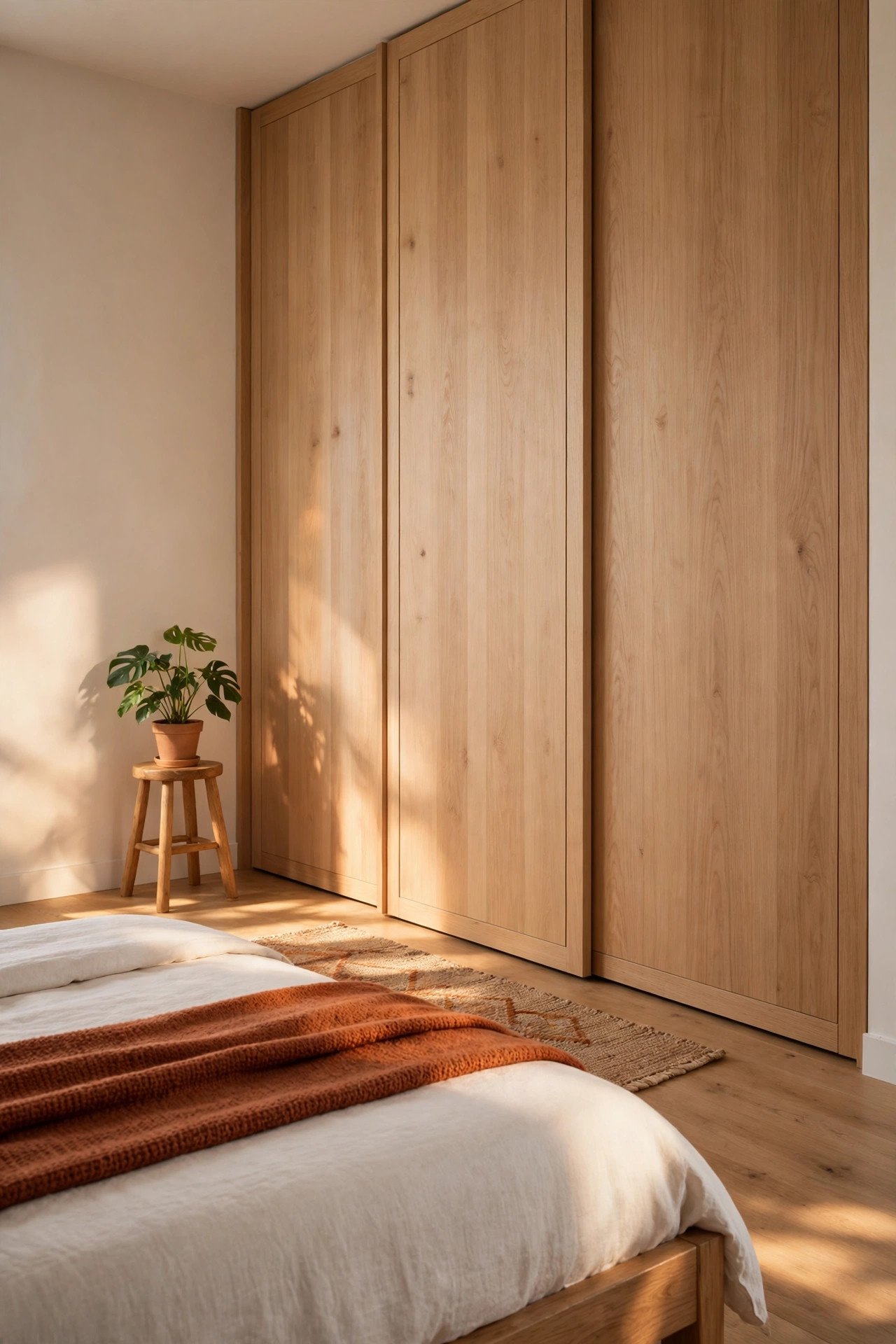
Few design mistakes announce themselves as honestly as a wardrobe door that hits the bed. Every morning starts with the same small negotiation: open the door halfway, reach in sideways, hook out a shirt, close the door before it bangs the bed frame again. The paint on both surfaces carries the scars. It feels like a problem you need a joiner to solve — but it is really a clearance problem, and clearance problems have a ladder of fixes, from free (move the bed) to modest (change the doors) to structural (change the wardrobe).
This guide climbs that ladder in order. You will measure the door’s swing properly, try the layout fixes that cost nothing, change the door type if the layout cannot give way, and only then consider replacing or rebuilding the wardrobe itself. Most bedrooms are fixed on the first or second rung.
Quick Answer
Wardrobe doors hit the bed when the gap between wardrobe and bed is smaller than the door’s width plus standing room — most hinged doors need their own width (40–60 cm) plus about 30 cm for you. Fix it in this order: move or rotate the bed to clear the swing, reduce what the doors must clear (lower bed frame, no footboard in the swing zone), then change the doors — sliding, bi-fold or bifold-track doors need little or no swing space, and removing the doors for a curtain or open front needs none. If you are replacing the wardrobe anyway, choose sliding doors or drawers and plan its position around the bed from the start.
Step 1: Measure the Swing Zone Honestly
Open the wardrobe door slowly until it touches the bed, and measure three things: the door’s width (that is its swing radius), the actual gap between the wardrobe front and the bed at the clash point, and how much of the door’s arc the bed interrupts. Then stand where you stand to dress and measure that too — a door that technically clears the bed by 2 cm still fails if you have to press yourself against the mattress to let it pass. The working target is the door’s full swing plus comfortable standing space in front of the open wardrobe, around 90 cm of total depth from the wardrobe front.
While measuring, check the sneaky contributors: a tall footboard or a thick bed frame can steal 10 cm of the gap; bedding draped over the foot adds more; a rug’s edge curling into the swing makes doors drag and jump. Sometimes the “door problem” is really a “footboard problem” — and footboards are removable in a way wardrobes are not.
Step 2: Layout Fixes — Move the Bed, Not the Wardrobe
The bed is heavy but movable; the wardrobe is fixed. So the first fixes all involve the bed. Shift it: even 15–20 cm sideways or towards the opposite wall can clear a swing entirely, as long as both sides stay usable. Rotate it: in a squarish room, putting the bed on the adjacent wall sometimes moves its foot out of the wardrobe’s arc completely — test the new wall against the placement rules in our guide to freeing up space in a bedroom that feels cramped, because a rotated bed that blocks a window or door has just traded problems. Shrink its footprint in the swing zone: remove the footboard, choose a lower, slimmer frame, or swap a chunky upholstered base for a simple slatted one.
Also consider moving the clash, not the furniture: if the wardrobe is freestanding rather than built in, shifting it along its wall — or to the wall’s other end — can take its doors out of the bed’s territory altogether. Freestanding wardrobes are rarely as fixed as they feel; they were placed once, by habit, and can be placed again with a tape measure involved this time.
Step 3: Change the Doors — Sliding, Bi-Fold or No Doors at All
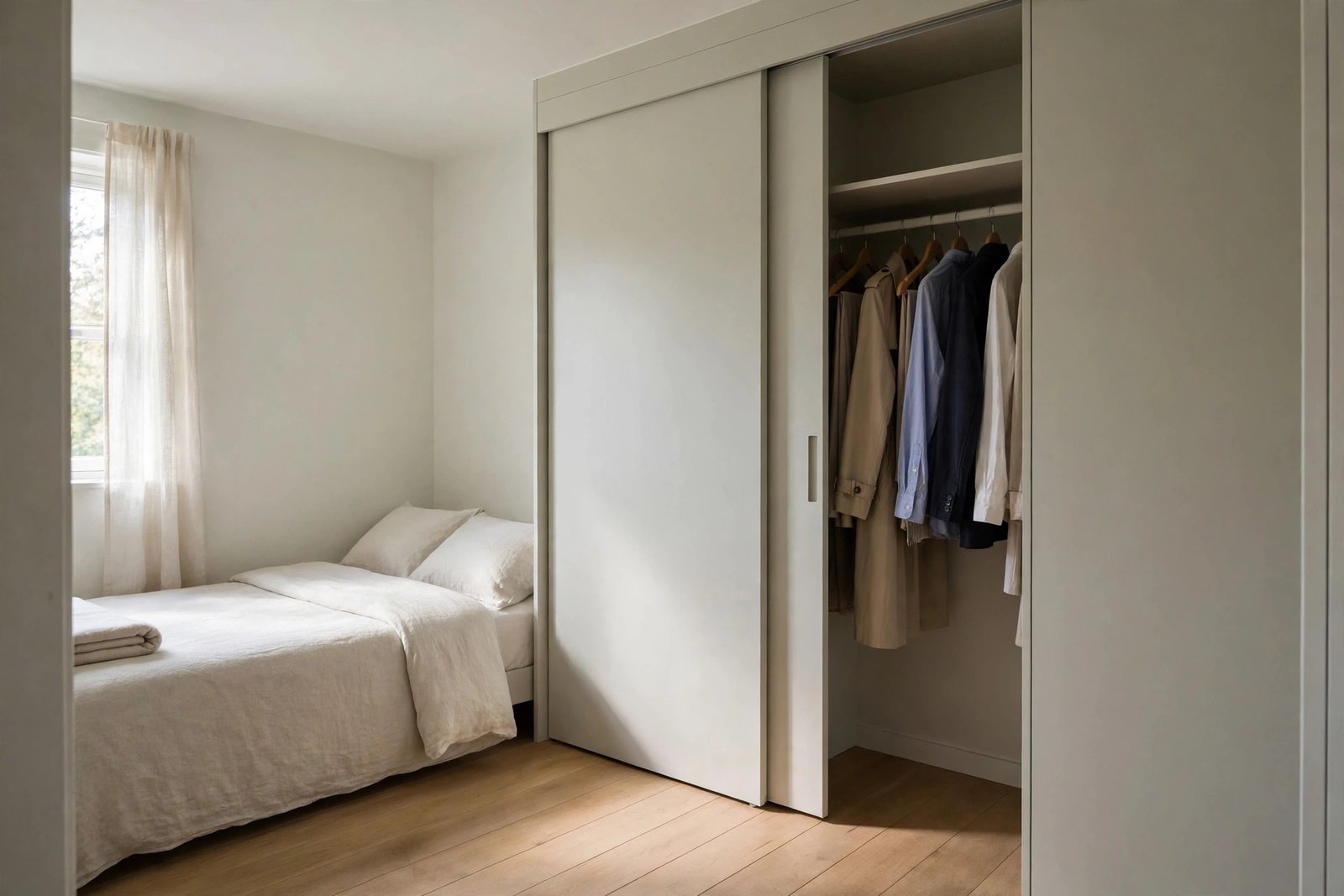
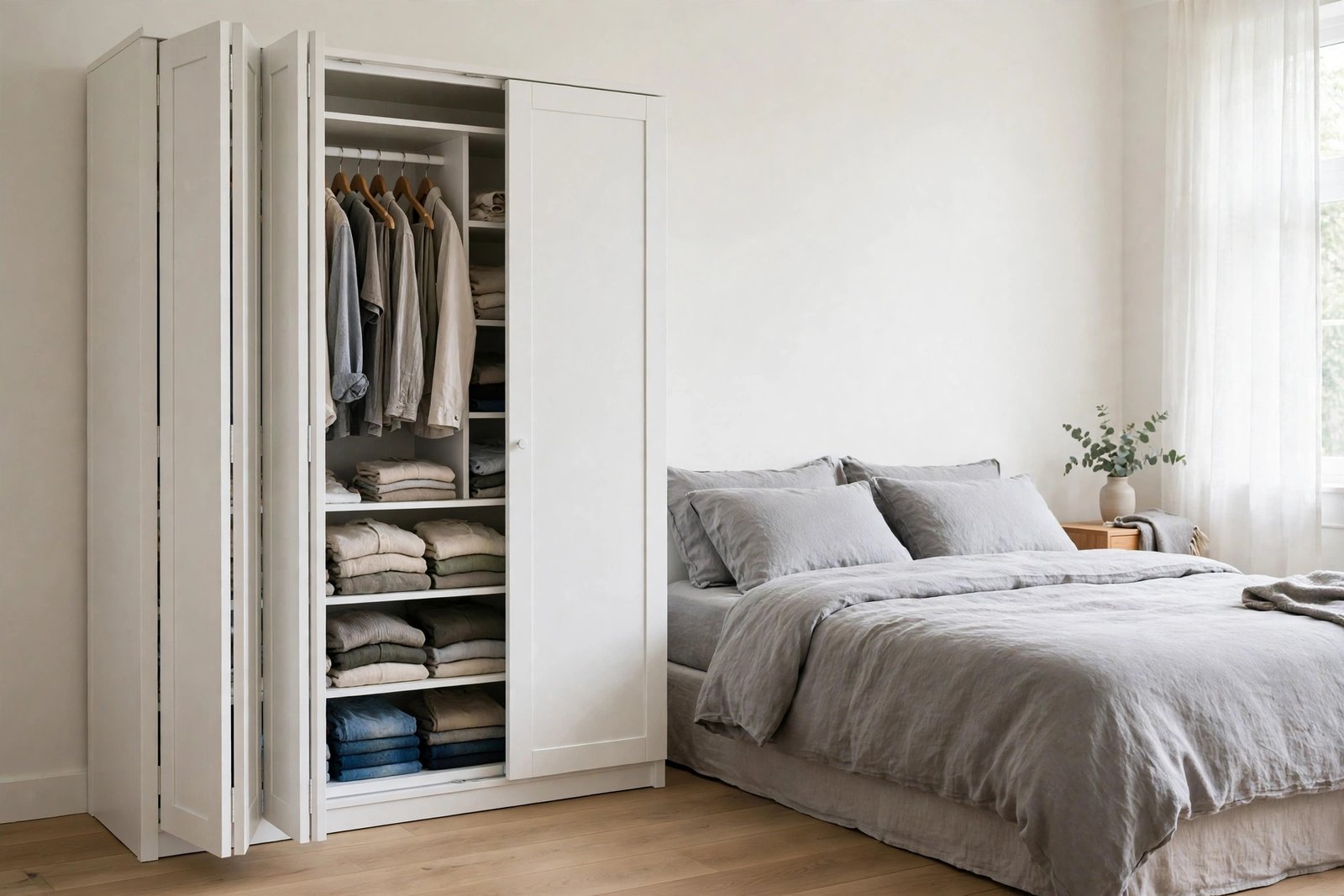
If the bed cannot move enough, change what the doors need. Sliding doors are the classic small-bedroom answer: they need zero swing space, only the depth of their tracks (about 8–10 cm added to the wardrobe front). Their trade-off is access — you can only open one half of the wardrobe at a time — which suits clothes stored in two logical halves and frustrates people who like to survey everything at once. Bi-fold doors fold back against themselves and need roughly a quarter of the swing of a full door; they keep full-width access and work well on standard wardrobe openings, though their tracks and pivots need occasional adjustment to stay smooth.
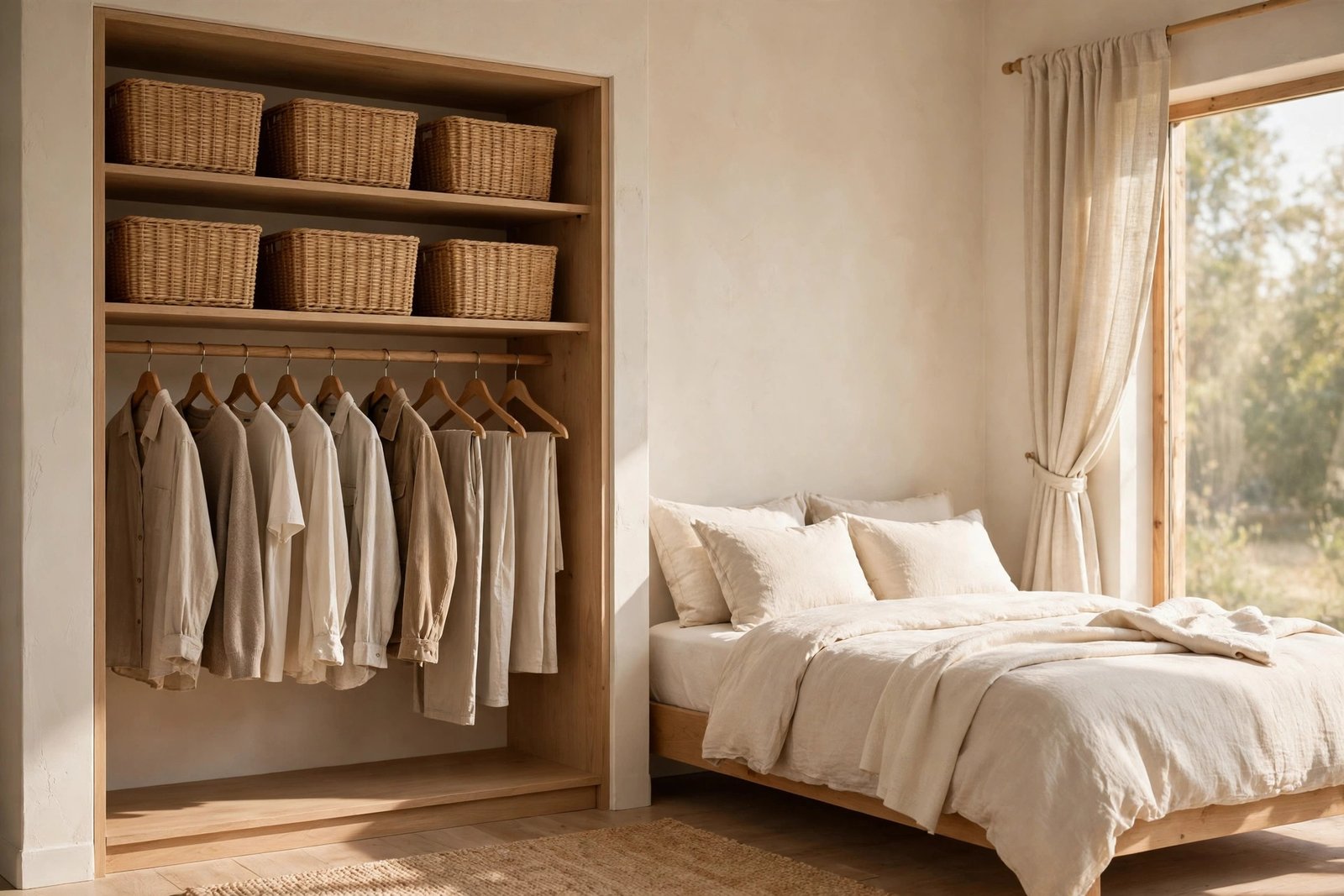
The zero-cost, zero-swing option is to remove the doors entirely: hang a curtain on a tension rod inside the frame, or leave the wardrobe open-fronted with everything in matching boxes and a tidy rail. An open wardrobe demands tidiness — it is storage on display — which is why it pairs naturally with the planning in our guide to planning wardrobe storage without a built-in closet: zones, uniform containers and a rail you are not embarrassed to look at. For renters, door removal is also fully reversible — keep the doors and hinges labelled in a safe place and the landlord never knows.
Step 4: Change the Wardrobe — Drawers, Narrower Units and Built-Ins
When a wardrobe is being replaced anyway, buy for the room you have. Drawers need no swing at all beyond their own extension (about 45–55 cm, which you stand inside of as you use them, unlike a door swing that excludes you). A chest of drawers plus a narrower wardrobe with sliding doors often stores more usable clothing than one wide hinged wardrobe that cannot open. Narrower wardrobes (100 cm instead of 150 cm) with shallower depth (55 cm instead of 60+) shrink the swing problem from both ends. And built-in wardrobes, planned with the bed’s position fixed first, let the joiner split doors so each leaf is narrower — two 40 cm leaves clash far less than one 60 cm leaf.
Before spending on any of this, make sure you know how much storage you actually need — wardrobes are often half full of clothes that would not survive an honest sort. Our step-by-step space audit for an overflowing bedroom measures what you own before you buy its container; plenty of door-clash problems have quietly ended with a smaller wardrobe bought after an audit, not a bigger fight with the bed.
Mistakes to Avoid
- Living with the half-open wardrobe. Reaching into a wardrobe sideways teaches you to wear the front 20 percent of your clothes. The clash is fixable at every budget — fix it.
- Padding the bed frame and calling it solved. Felt pads stop the paint damage; they do not give you back your wardrobe. Treat padding as a temporary truce while you arrange a real fix.
- Buying sliding doors without measuring access. Sliding doors halve your visible wardrobe at any moment. If your storage style needs full-width access, bi-folds or narrower hinged leaves are the better change.
- Forgetting handles and knobs in the clearance. Doors clash at their handles first. Low-profile or recessed handles can return 3–5 cm — sometimes the whole margin between banging and clearing.
- Moving the bed without checking the other swings. A bed shifted to clear the wardrobe can land in the bedroom door’s swing or across a radiator. Re-run the whole room’s clearances after any move.
- Replacing the wardrobe before auditing its contents. A smaller, better-chosen wardrobe after an honest clear-out beats a like-for-like replacement that re-inherits the clash.
Frequently Asked Questions
How much clearance do wardrobe doors need?
A hinged door sweeps an arc equal to its own width — typically 40–60 cm — and you need standing room inside that space too, so plan for roughly 90 cm of clear depth in front of a wardrobe for comfortable use. If the bed must sit closer, sliding doors (no swing) or bi-fold doors (about a quarter of the swing) are the standard solutions.
Are sliding wardrobe doors better for small bedrooms?
For clearance, unambiguously yes: they remove the swing problem entirely and let the bed sit as close as the wardrobe’s front allows. The costs are partial access (half the wardrobe at a time), slightly reduced internal depth for the tracks, and more hardware to maintain. In a room where doors currently hit the bed, those trade-offs are almost always worth it.
Can I just remove the wardrobe doors?
Yes — it is free, instant and reversible. Replace them with a curtain on a rod inside the frame if you want the clothes covered, or keep the wardrobe open with tidy, zoned storage and matching boxes. It works best when the wardrobe’s contents are edited and organised, because everything stays visible; a chaotic open wardrobe makes the whole bedroom feel messy.
What if the bed cannot move at all?
Then all the change happens at the wardrobe: convert to sliding or bi-fold doors, remove the doors, or slim the bed’s profile in the clash zone only (footboard off, low-profile handles on the doors). If the wardrobe is freestanding, moving it along the wall is usually possible even when the bed is not. One of the two pieces almost always has a move available — the trick is measuring before assuming neither does.
The Bottom Line
A wardrobe door hitting the bed is a measurement problem wearing a joinery costume. Measure the swing, then climb the ladder: shift or rotate the bed, slim its profile in the clash zone, change the doors to sliding or bi-fold, take the doors off entirely, and only replace the wardrobe — after an audit — if none of the cheaper rungs work. Most bedrooms are fixed free, with a tape measure and an afternoon. The reward is disproportionate: a wardrobe you can actually open, and a morning routine without the daily bang.