Every L-shaped and U-shaped kitchen has one: the corner cabinet, a deep dark cave where the slow cooker went in 2019 and has not been seen since. It is usually the biggest single cabinet in the kitchen and the least useful — a metre of depth you can only reach by kneeling on the floor with your head inside, feeling around like a vet delivering a calf. Things go into corner cupboards on a one-way trip, and the rest of the kitchen overflows while a third of a cubic metre sits wasted two steps away.
Corners fail for a simple geometric reason: the door is narrow and the box is deep and wide, so most of the volume sits out of reach and out of sight. But the volume is real, and there is a ladder of fixes — from free (bins that act as drawers) through moderate (turntables) to proper hardware (pull-out corner units and corner drawers) — that can turn the worst cabinet in the kitchen into honest storage. This guide helps you identify your corner type, choose the fix that matches it and your budget, and store the right things there once it works.
Quick Answer
To use a dead kitchen corner properly, first match the solution to the corner type: a blind corner (one door, cabinet running into the corner) suits pull-out tray units; an L-shaped corner with two doors suits a lazy Susan turntable or corner drawers. On any budget, start with the free fix — store items in open bins or trays you pull out like drawers, biggest and lightest at the back — and store by frequency: rarely used items deep, weekly items at the front. Measure the door opening and interior before buying any hardware, because corner units only work when they fit the actual opening, not the catalogue photo.
Step 1: Identify Your Corner Type and Measure It
Open the doors and look at what you actually have. A blind corner has one door on one run of cabinets, and the cabinet box extends sideways into the corner behind the adjacent run — half of it is hidden behind the neighbouring cabinet’s side, reachable only through that single door. An L-shaped corner has doors on both runs (or one wide angled/diagonal door) and a big square box you can partly see into. A diagonal corner has a single door set at 45 degrees across the corner, usually with a more accessible, angled interior.
Measure three things and write them down: the door opening width, the depth from the door to the back corner, and the usable height per shelf. Hardware for corners is sized by the opening, not by the cabinet’s outside dimensions — a pull-out that needs a 45 cm opening will not forgive a 40 cm one. While the cabinet is empty (empty it — this is the moment), give it the audit treatment used in our step-by-step space audit: everything in the corner gets sorted by frequency before anything goes back, because corners are where expired tins and duplicate gadgets go to hide, and no fitting fixes a cabinet full of things you do not use.
Step 2: The Free Fix — Bins That Act as Drawers
Before spending anything, try the fix that solves most of the problem: put the contents into sturdy open bins, trays or low boxes — one per category — and slide them in and out like drawers. The bin converts unreachable depth into a pull-out: you draw the whole category to you instead of reaching into the dark for one item. It works in blind corners and L-shaped corners alike, costs almost nothing, and immediately reveals how much of the corner’s contents never deserved the space.
Store by position inside the bins system: front bins hold weekly items, the deep back zone holds only big, light, rarely used things — the stock pot, the turkey roasting tin, spare baking trays stored vertically in a rack like files. Small loose items are banned from corners entirely; they migrate to the back and vanish. A battery LED strip or a stick-on light inside the door frame ends the cave effect for a few pounds and makes the bins system work twice as well, because storage you can see into is storage you will actually use.
Step 3: Turntables — the Lazy Susan and Its Limits
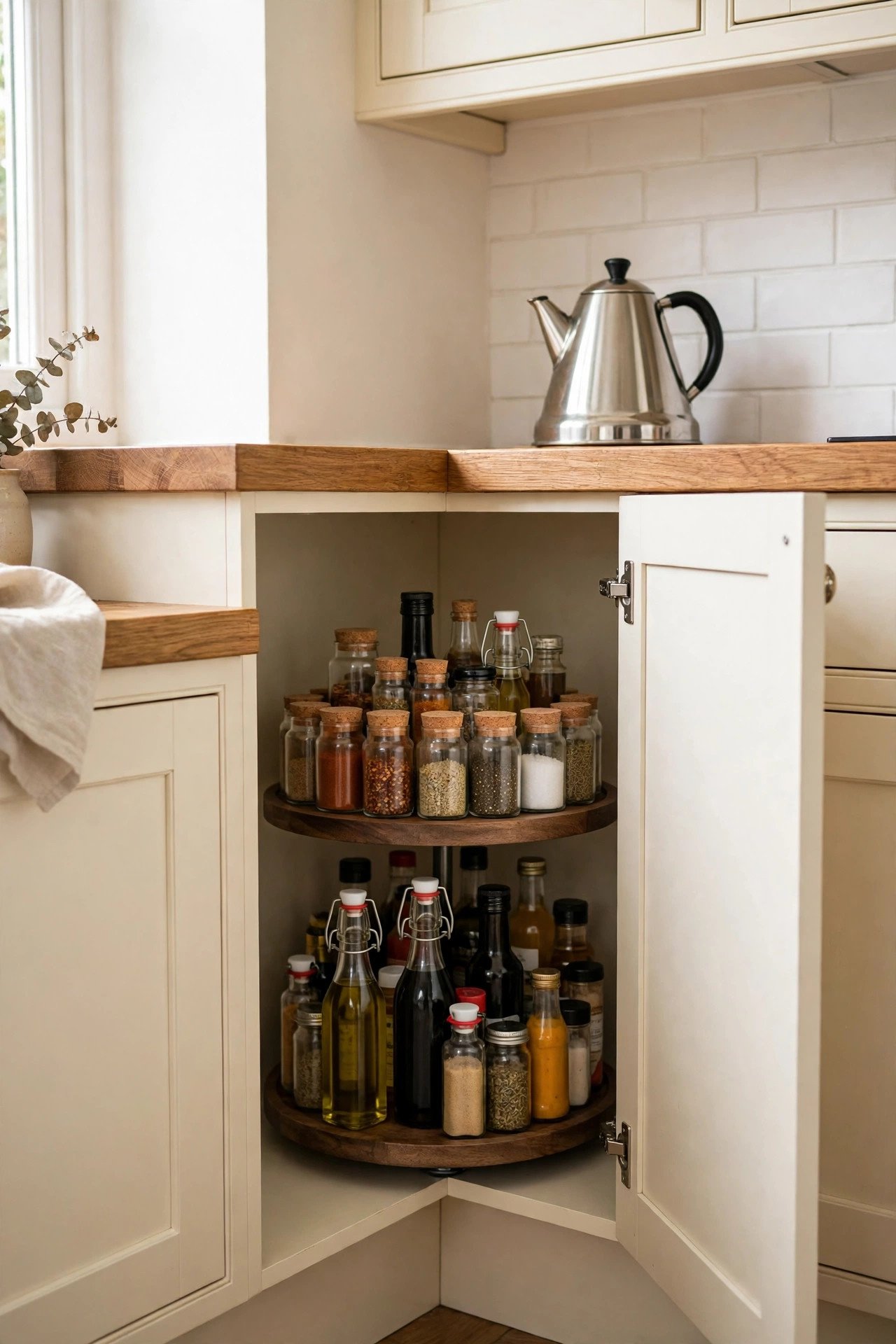
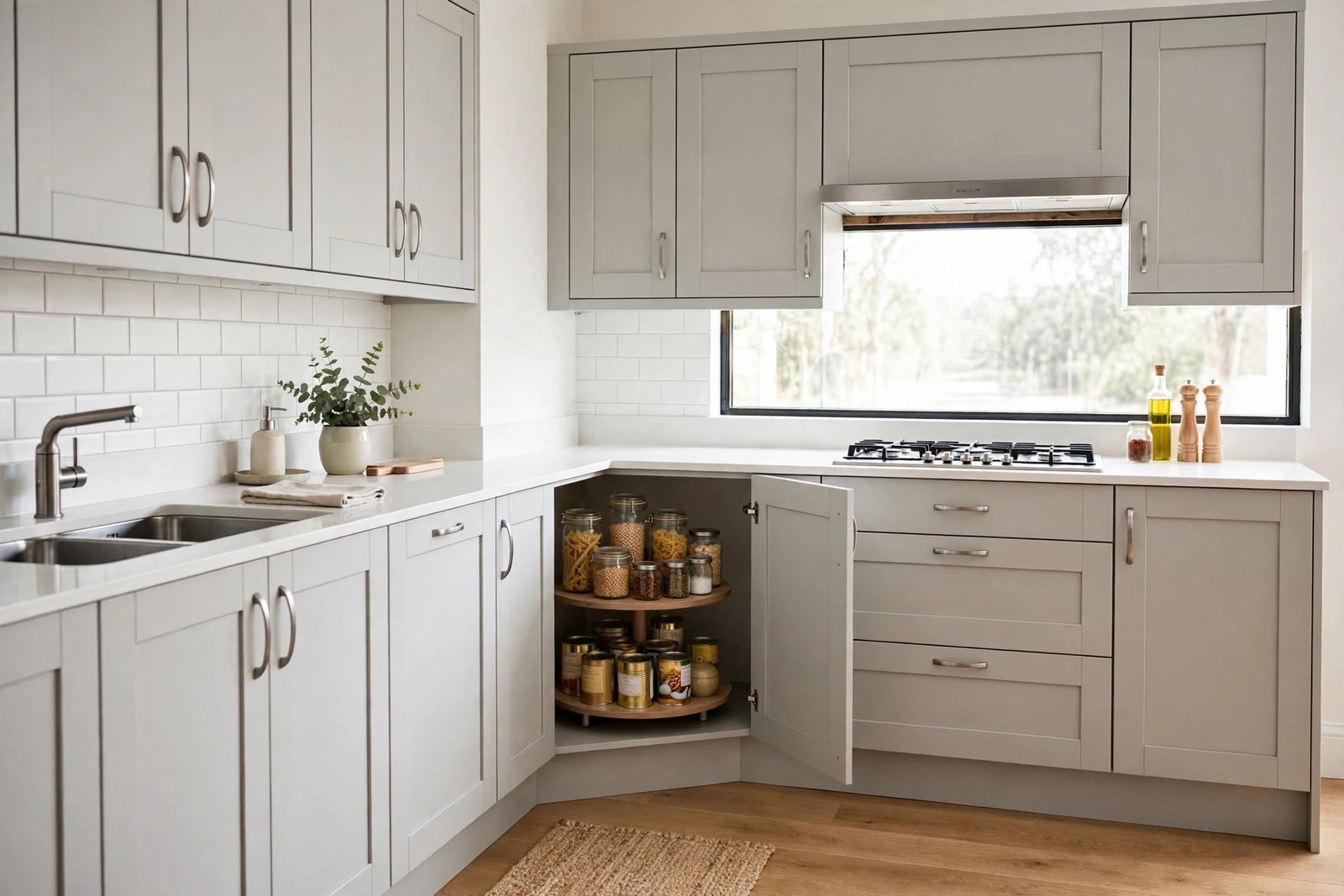
For L-shaped corners, the classic upgrade is the lazy Susan: one or two round or kidney-shaped turntables that rotate the contents to the door. Kidney-shaped shelves suit cabinets whose doors open across the corner; full-round turntables suit diagonal doors. A good turntable genuinely fixes the reach problem for bottles, tins, jars and small appliances, and two tiers roughly double the usable corner.
Know its limits before you buy. A circle inside a square wastes the corners of the box — you trade volume for access, which is usually the right trade, but large square items (big serving boards, the bread maker) may no longer fit. Turntables also have weight limits, and small items can topple into the mechanism’s dead zone at the back. Best use: a crowd of similar mid-size items you reach for weekly. Worst use: heavy cast iron and a jumble of shapes. Measure your door opening and interior diameter precisely; a turntable 2 cm too wide is a return journey, not a solution.
Step 4: Pull-Outs and Corner Drawers — the Full Fix
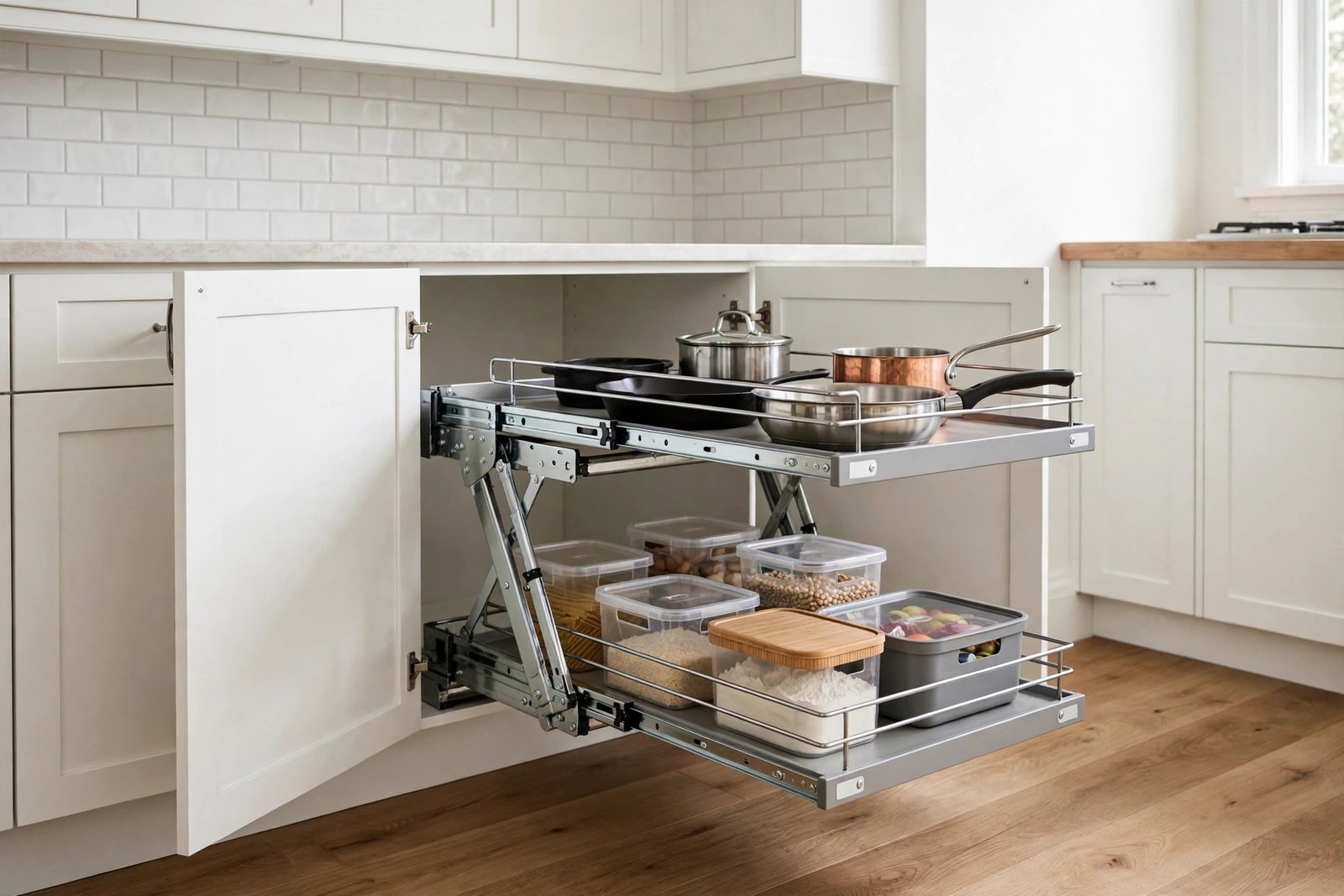
For blind corners, the proper hardware answer is a pull-out corner unit: articulated trays (often called a magic corner or swing-out system) that slide out and sideways, bringing the hidden half of the cabinet into the room in front of you. They recover nearly all of the blind corner’s volume — the only solution that does — and turn it into two or four reachable shelves. They cost real money and need exact fitting, but for a kitchen whose only big cabinet is a blind corner, they are the difference between storage and a cave.
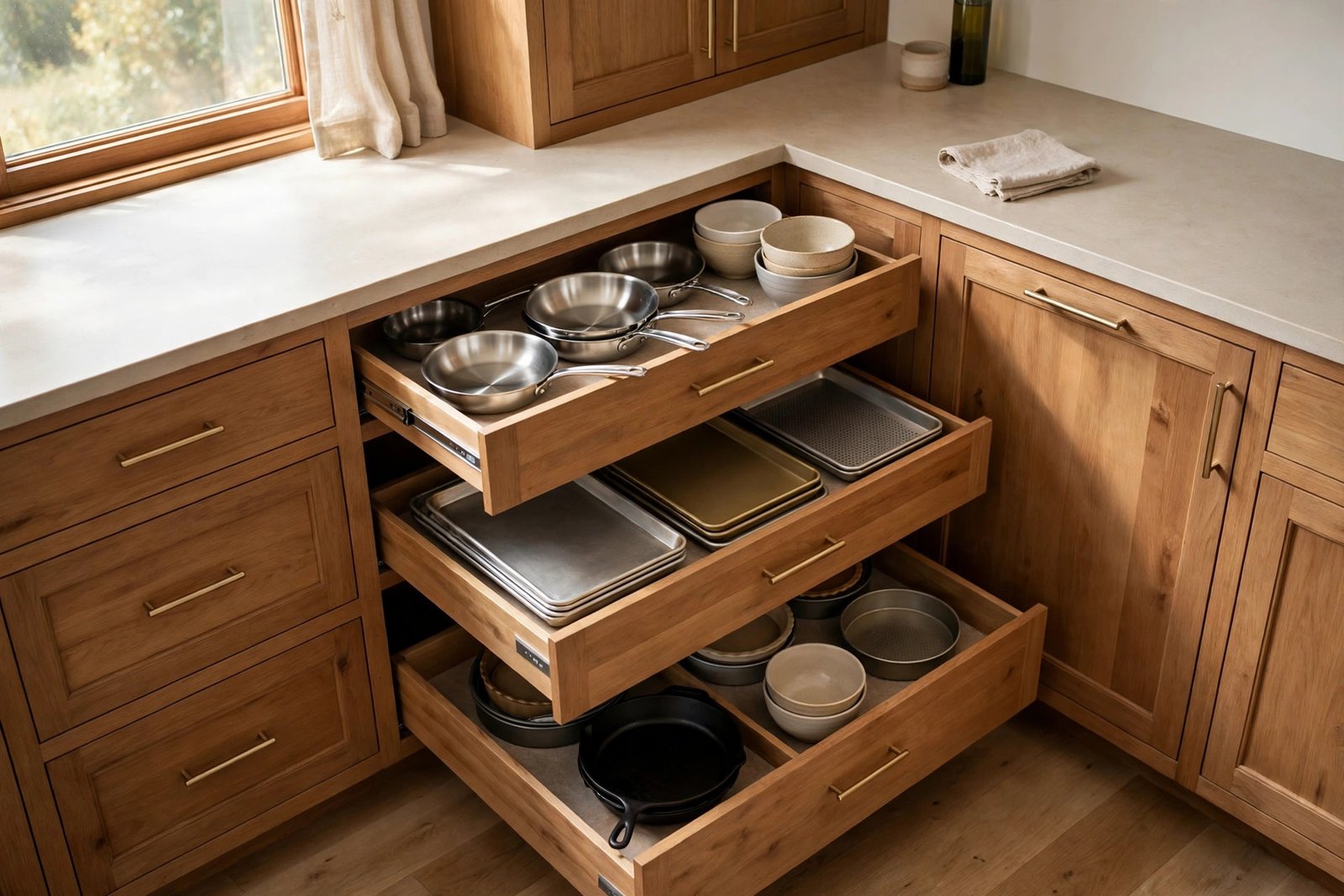
For L-shaped corners in a refit, corner drawers are the connoisseur’s choice: deep angled drawers that pull the full corner out in one movement, with every item visible from above — no kneeling, no reaching, no dark. They are the most expensive option and need to be planned when cabinets are made, which is why they belong in the same conversation as the wider cabinet decisions in our guide to kitchen cabinets that are too dark or too high. If you are keeping your cabinets, the bins system plus one pull-out or turntable in the worst corner delivers most of the benefit for a fraction of the cost — and the whole scheme works best when the corner joins a zoned plan for the kitchen’s storage as a whole, like the one in our guide to a small kitchen with no pantry.
Mistakes to Avoid
- Buying corner hardware before measuring the opening. Corner units are sized by door opening and internal dimensions, and returns are painful. Measure, then check the product’s minimum opening twice.
- Storing small loose items in a corner. Lids, gadgets and packets migrate to the unreachable back within a month. Small things live in bins or in other cabinets — corners are for the big and the binned.
- Overloading a turntable. Heavy pans and cast iron strain the bearing, make spinning a grunt, and topple lighter items into the dead zone. Turntables are for mid-weight crowds of bottles and tins.
- Letting a corner sink eat the cabinet. A sink centred on the corner wastes the box beneath on plumbing angles. If refitting, keep the sink on a straight run and let the corner be storage.
- Forgetting the corner above the counter too. Wall-cabinet corners go just as dead. A diagonal wall unit, open corner shelves or simply keeping that corner for the kettle and daily mugs beats another cave at eye level.
- Filling the fixed corner with daily clutter. A working corner tempts you to store everything in it. Keep the frequency zoning: the corner is deep storage by nature, so weekly-at-most is its natural population.
Frequently Asked Questions
What is the best solution for a blind corner cabinet?
A pull-out corner unit with swing-out trays, because it is the only fitting that retrieves the hidden half of the cabinet — the part behind the adjacent run. If the budget will not stretch, the bins-as-drawers system is the strong second: two or three sturdy trays you pull fully out, with the biggest, lightest, rarest items committed to the hidden zone where they rarely need retrieving.
Lazy Susan or pull-out: which is better?
They suit different corners. A lazy Susan fits L-shaped and diagonal corners and excels at bottles, tins and jars you want to rotate into view. Pull-outs fit blind corners and excel at heavier, bulkier items because the trays come to you in a straight line. Choose by your corner type first, your contents second — and in both cases, access beats raw volume.
What should I store in a corner cabinet if I buy no hardware?
Big, light and rarely used: the stock pot, roasting tins, the slow cooker, large mixing bowls, baking trays filed vertically, and backup supplies in labelled bins. The rules are that everything sits in a bin or as one grab-able object, nothing small travels loose, and the most-used items sit at the front. A stick-on light inside makes the whole arrangement honest.
Are corner drawers worth the cost?
In a refit where the corner is a main storage cabinet, yes — they offer the best access of any corner solution, with full visibility and no wasted mechanism space, and they get used daily for decades. As a retrofit into existing cabinets they are rarely practical. If you are not refitting, a pull-out unit or turntable plus disciplined bins gets you most of the same daily benefit.
The Bottom Line
A dead corner is not dead space — it is badly accessed space, and access can be fixed at every budget. Empty and audit it, identify the corner type, start with bins that pull out like drawers and light that lets you see, then upgrade the worst corner with a turntable or a pull-out unit sized to your real measurements. Store big, light and rarely used at the back, weekly at the front, and nothing small and loose anywhere. The biggest cabinet in the kitchen will finally earn its footprint.