Some bedrooms simply have no closet. Older houses were built before built-in wardrobes were standard, small flats trade the closet for a few extra centimetres of floor, and rental rooms often offer nothing but four bare walls and a door. The result is painfully familiar: a chair buried under clothes, shoes multiplying along the skirting board, and a permanent low-level stress every time you get dressed, because nothing you own has a proper home.
The way out is not a single magical product. It is a plan: audit what you actually own, divide it by how often you wear it, and then build a wardrobe out of separate pieces — a rail, a chest, vertical storage and hidden storage — each doing the job a built-in closet would have split between its shelves, drawers and hanging space. This guide walks through that plan in order, so a room with no closet ends up with clothing storage that works daily and still looks like a bedroom.
Quick Answer
To create wardrobe storage without a built-in closet, plan for four zones: hanging space (an open rail or a freestanding armoire for the clothes you wear weekly), folded storage (a chest of drawers for knitwear, T-shirts and underwear), vertical and door storage (high shelves and hooks for bags, scarves and hats), and hidden storage (under-bed boxes for out-of-season clothes and shoes). Start by measuring your clothes — most people need only 100–150 cm of rail for weekly wear — and place the rail on the wall where it blocks nothing, screened by a curtain or room divider if you want it out of sight.

Step 1: Audit and Measure Before You Buy Anything
Every no-closet plan goes wrong the same way: buying storage first and discovering it is the wrong size, the wrong type, or simply not needed. Begin with an honest audit. Take everything out of the chair-drobe and the bags, and sort clothes into three piles: worn weekly, worn monthly, and seasonal or rare (occasion wear, heavy winter coats in summer). Most people find the weekly pile is a third of what they own — and it is the only pile that needs prime, arm’s-reach storage.
Now measure, because rails and drawers are sold by the centimetre. Weekly hanging clothes, measured on their hangers, usually take 100–150 cm of rail. Folded clothes stack at roughly 30 cm of drawer width per category. Count your shoes in pairs. These three numbers are your design brief; every piece of furniture you consider from here either answers one of them or it does not come home. This audit-first discipline also prevents the classic failure addressed in our guide to a small living room with too much furniture — buying pieces before knowing what they must hold is how rooms fill up with storage that stores nothing well.
Step 2: Hanging Space — Rail, Armoire or Curtain Corner
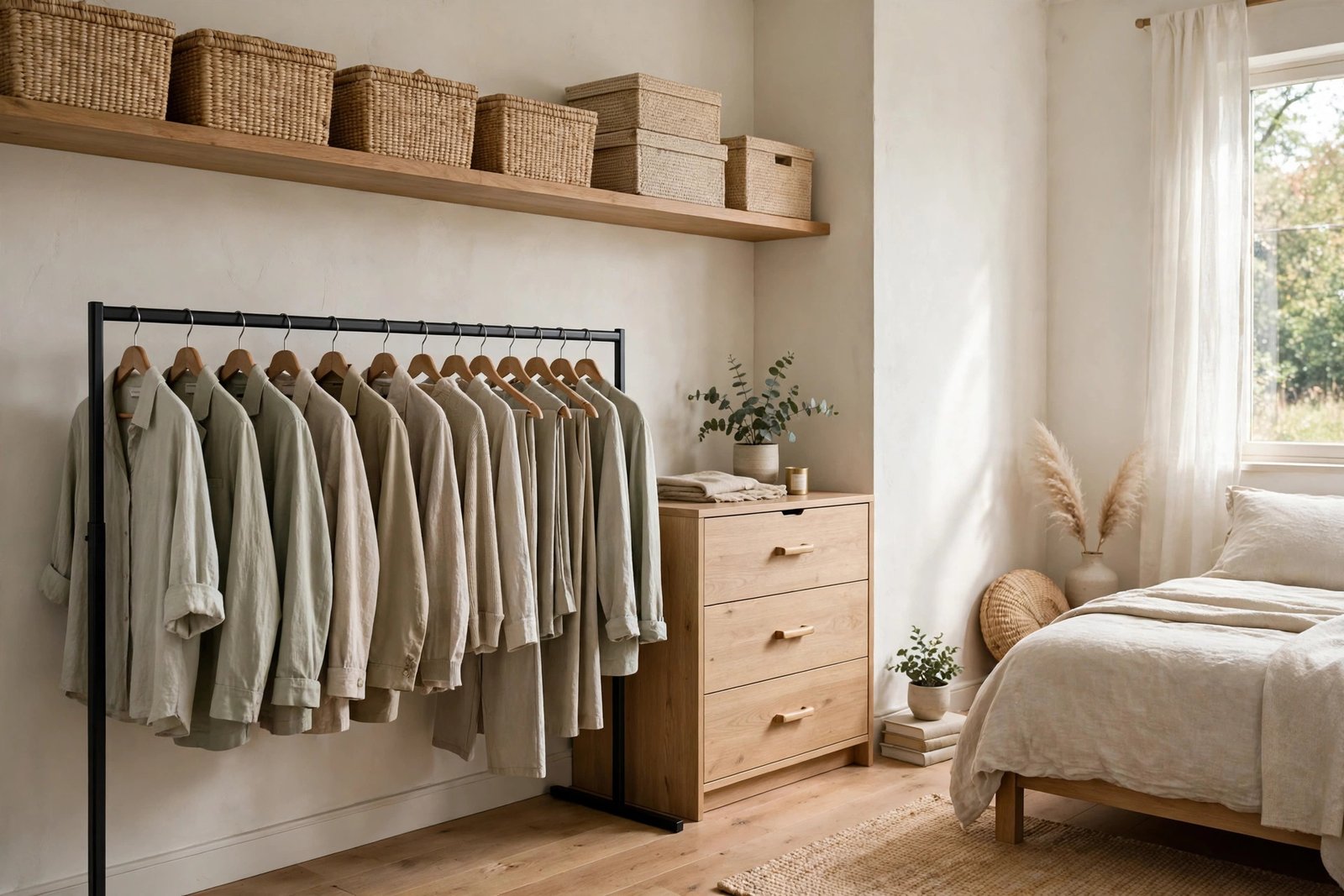
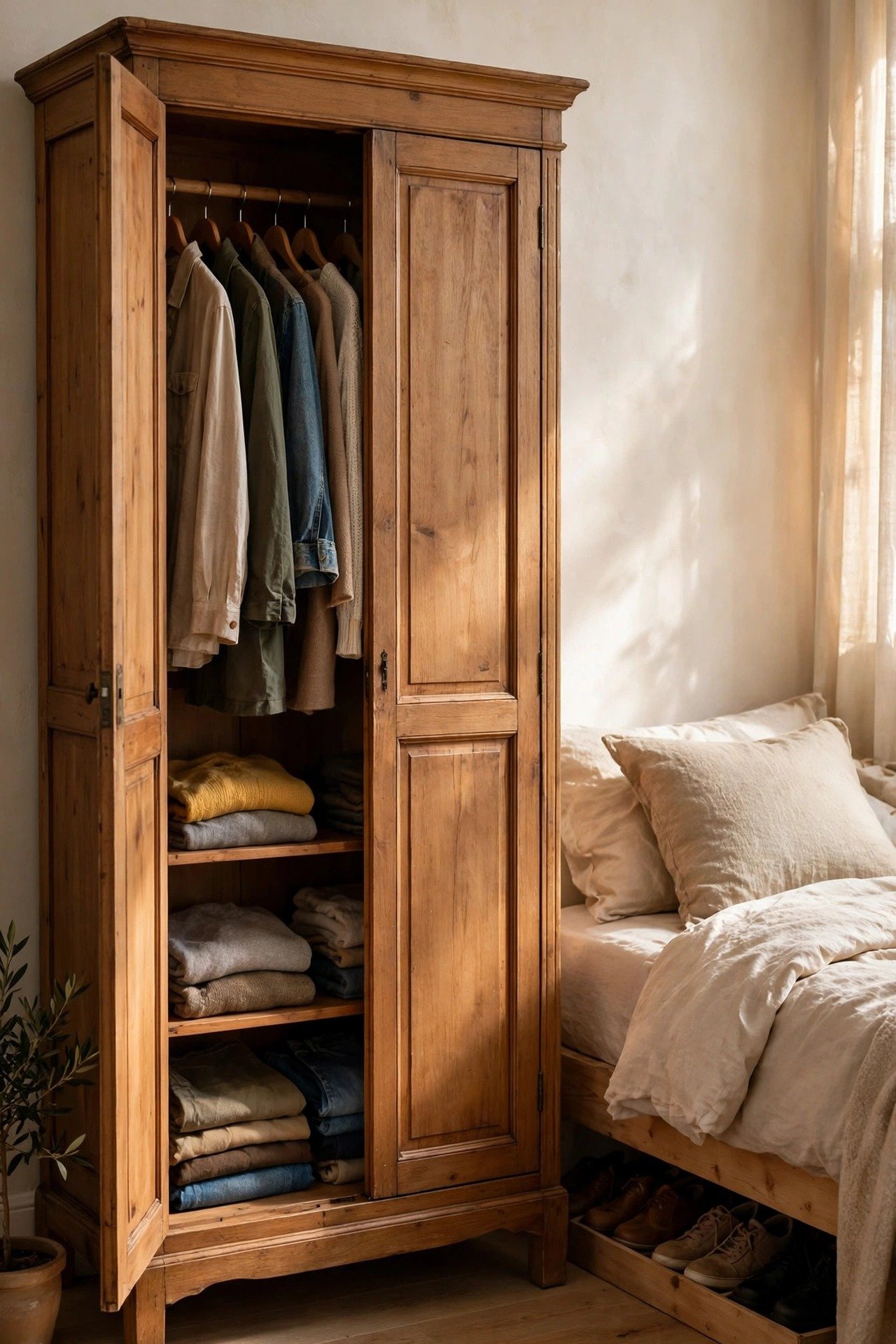
Hanging clothes need air, visibility and roughly 60 cm of depth from the wall. You have three main options, in rising order of cost and tidiness. A freestanding garment rail (ideally a sturdy one with a lower shoe rack and wheels that lock) is the cheapest and most flexible; it suits renters and anyone whose room layout may change. An open rail fixed to the wall, with a shelf above it, looks more deliberate and frees the floor underneath for boxes or shoes. A freestanding armoire or wardrobe cabinet hides everything behind doors and reads as real furniture — the best choice when the bedroom doubles as a guest room or you simply hate seeing clothes.
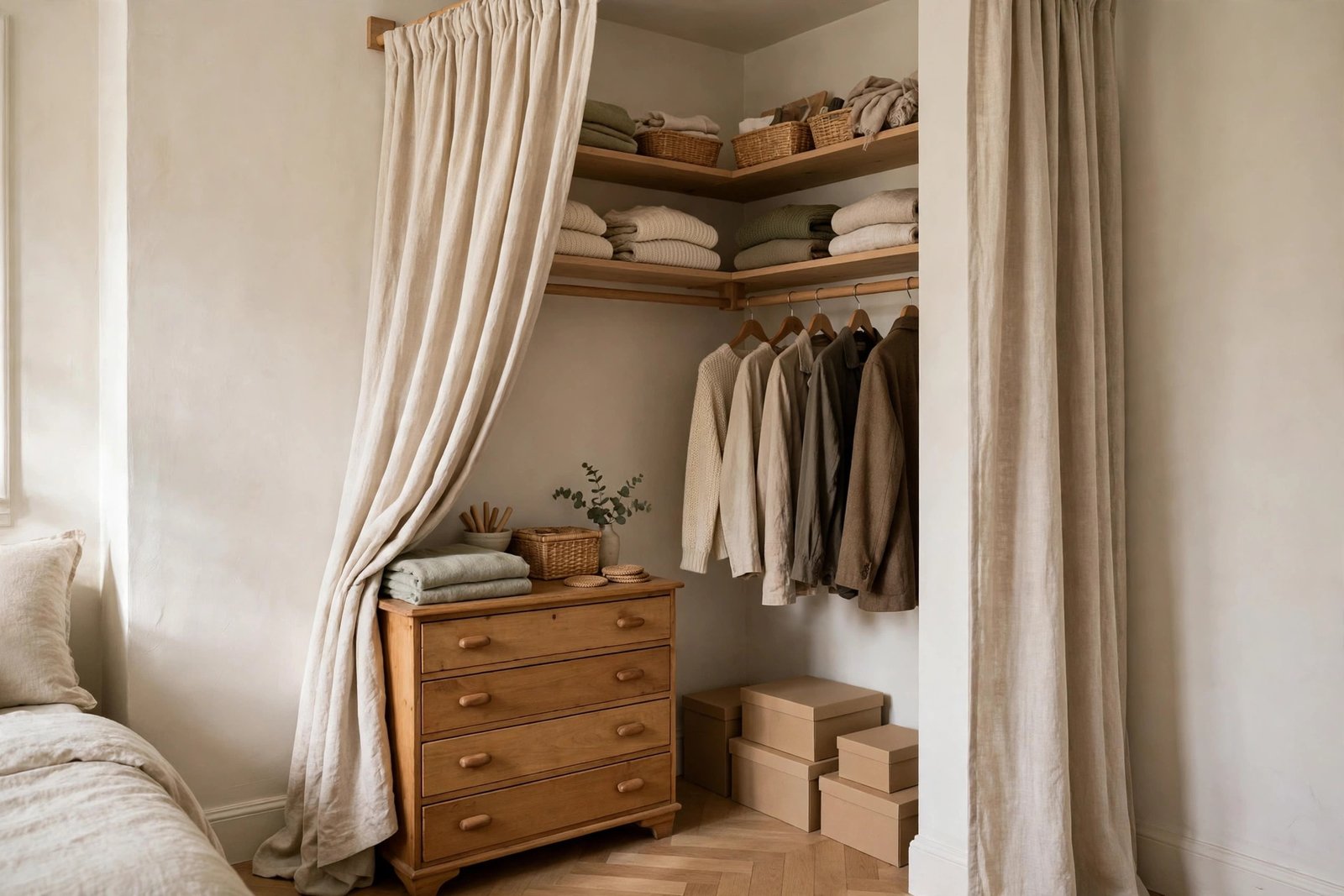
The fourth option is the clever one for awkward rooms: claim a corner. A rail or shelving unit fitted across a corner, fronted by a ceiling-mounted curtain, becomes a walk-in-wardrobe illusion — clothes hidden, corner used, and no door swing to fight. Whichever you choose, keep the hanging zone to weekly clothes only. A rail stuffed with everything you own sags, wrinkles the clothes and recreates the mess in a new shape; seasonal pieces belong in the hidden zone described below.
Step 3: Folded, Small and Vertical Storage
Folded clothes belong in drawers, not on shelves in a no-closet room, because stacks on open shelves collapse into heaps within a week. A chest of drawers sized to your audit — typically one drawer each for underwear and socks, tops, bottoms, and knitwear or nightwear — is the workhorse of the system, and its top surface doubles as a dressing area for a mirror, a tray and daily items. If floor space is too tight for a chest, a tall, narrow drawer tower takes the same clothes up instead of out.
Then use the vertical space the closet would have used. A high shelf running above the rail holds the monthly pile in matching boxes: bags, hats, spare bedding. Hooks or a peg rail on the back of the door or a spare stretch of wall take scarves, belts, dressing gowns and tomorrow’s outfit. The principle behind all of this — walls and doors are storage surfaces, not just boundaries — is the same one that rescues the most wasted strip in the house in our guide to hallway wasted space and storage for narrow corridors: depth of 15–25 cm, used deliberately, holds a surprising share of a home’s clutter.
Step 4: Hidden Storage — Under the Bed and Out of Season
The space under a standard bed is roughly the size of a wardrobe’s lower half, and in a no-closet room it is too valuable to waste on dust. Use low, lidded boxes or drawers on wheels (measure your bed’s clearance first; most frames give 15–30 cm) for the seasonal pile: out-of-season clothes in one or two boxes, spare shoes in another, occasion wear in a flat garment bag. Lids matter — open boxes become dust traps, and wheels matter because a box you cannot pull out easily is a box you will stop using.
Round the system out with a laundry basket with a lid placed where you undress, and a small “in-between” spot — one hook or one chair cushion’s worth — for clothes worn once and not yet wash-ready. That last detail sounds trivial, but the famous chair-drobe is what happens when a room has no sanctioned in-between spot. Give the category a home and the chair returns to being a chair. Keep the whole room’s visual load low while you are at it: open storage everywhere can make a small bedroom feel busy, and the light, low-contrast surfaces from our guide to making a small apartment feel bigger without buying new furniture — clear floor, grouped belongings, unblocked light — are what stop a storage-filled room from feeling like a stockroom.
Mistakes to Avoid
- Buying an armoire before measuring your clothes. A beautiful wardrobe that holds 80 cm of rail is a failure if you own 140 cm of hanging clothes. Audit first, furniture second — always in that order.
- One giant rail for everything. Weekly, monthly and seasonal clothes crammed together make the daily clothes impossible to see or reach. Zone by frequency, and the daily zone stays small and calm.
- Open shelves for folded clothes. Stacks slump, edges fray visually, and within weeks the shelf is a jumble. Drawers or lidded boxes keep folded clothes folded.
- Ignoring the back of the door. A door is a square metre of free storage surface. Hooks or an over-door organiser there can hold everything from scarves to shoes.
- Cheap, wobbly rails. A loaded rail holds 20 kg or more. A flimsy one bows, then collapses at 3 am. Buy the sturdiest rail you can, and anchor wall-fixed rails into studs or solid fixings.
- Leaving the seasonal pile in prime space. Winter coats in July are renting the best storage in the room for free. Under the bed or on the highest shelf — seasonal always yields to weekly.
Frequently Asked Questions
How much rail space do I actually need?
Less than you fear. Measured honestly, most people’s weekly hanging clothes take 100–150 cm of rail — roughly one standard garment rail. The shock usually comes from the audit: coats for another season, occasion dresses and “just in case” pieces often account for half the hanging volume, and all of them can live in garment bags on a short secondary rail, in a corner, or under the bed instead.
Open rail or armoire — which looks tidier?
An armoire, because doors hide everything including visual noise. But an open rail can look deliberate and calm if you edit it: weekly clothes only, hangers that match, similar colours grouped, and nothing draped over the ends. If visual calm matters most and the budget allows, choose the armoire; if flexibility and cost matter most, choose the rail and keep it edited like a shop display.
Can I create closet space in a rental without drilling?
Yes. A freestanding rail, a drawer tower, over-door hooks and under-bed boxes need no fixings at all. For a screened corner, a tension-mounted curtain rod or a freestanding room divider hides the rail zone without touching the walls. Everything on that list leaves with you and leaves no holes — it is a fully reversible wardrobe.
Where do shoes go if there is no closet?
Daily pairs — two or three at most — live on the rail’s lower rack, a small shoe rack by the door, or in a row under the dresser. The rest go in a lidded under-bed box or in their boxes stacked on the high shelf. The rule is the same as for clothes: prime space for the pairs in weekly rotation, hidden space for everything else, and nothing breeding along the skirting board.
The Bottom Line
A room without a closet is not a room without wardrobe storage — it is a room where the closet has to be planned instead of inherited. Audit what you own, split it by how often you wear it, then give each group its zone: a rail or armoire for weekly hanging clothes, drawers for folded things, walls and doors for the small stuff, and lidded boxes under the bed for everything seasonal. Do it in that order and the clothes chair retires, mornings get faster, and the bedroom looks like a bedroom again.
2 thoughts on “No Closet Space? How to Plan Wardrobe Storage Without a Built-In Closet”