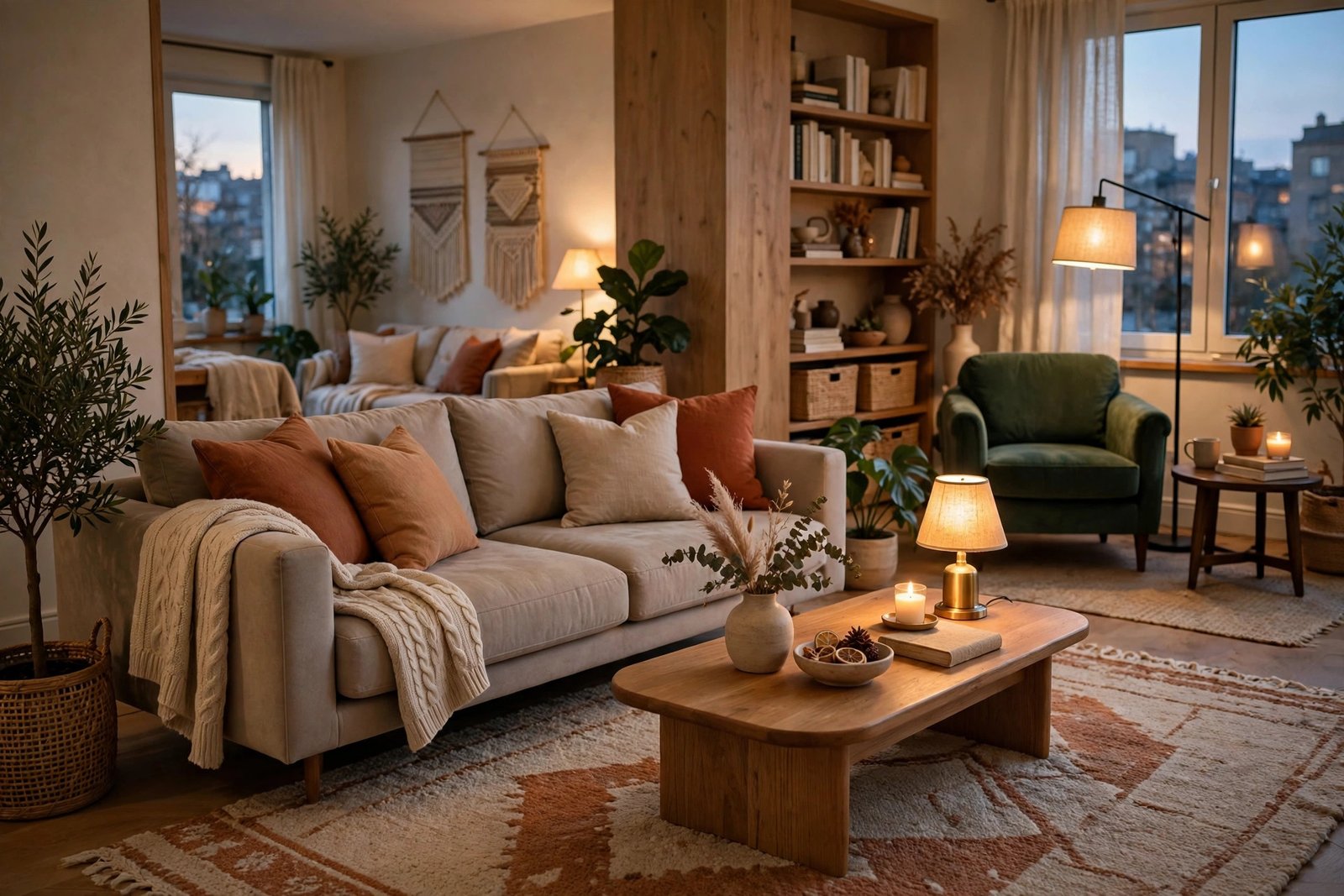
A big living room is supposed to be the dream. Then you move in, place your furniture, and the room feels like a hotel lobby: voices echo a little, the seating huddles in one corner of a vast floor, and the far end sits empty and faintly chilly no matter how long the heating runs. Guests admire the space and then cluster in the kitchen.
Large rooms feel cold for the opposite reason small rooms feel cramped — not too little space, but too little definition. One big undifferentiated room asks a single group of furniture to do the work of three. The fix is zoning: dividing the space into smaller, purposeful areas. This guide shows how to plan the zones, anchor them, and warm the whole room up without building a single wall.
Quick Answer
To make a large living room feel cosy, stop treating it as one room and divide it into two or three zones — a main seating group, plus a reading corner, a work or games spot, or a second smaller conversation area. Anchor each zone with its own rug, pull the furniture away from the walls into groups sized for people (seats within about 2.5 metres of each other), give every zone its own lamp at seated height, and use the backs of sofas, shelves, and console tables as soft borders between zones. Echo and chill drop as soon as the room has edges, layers, and low light in several places instead of one bright, empty middle.
Why Big Rooms Feel Cold — and It Is Not the Heating
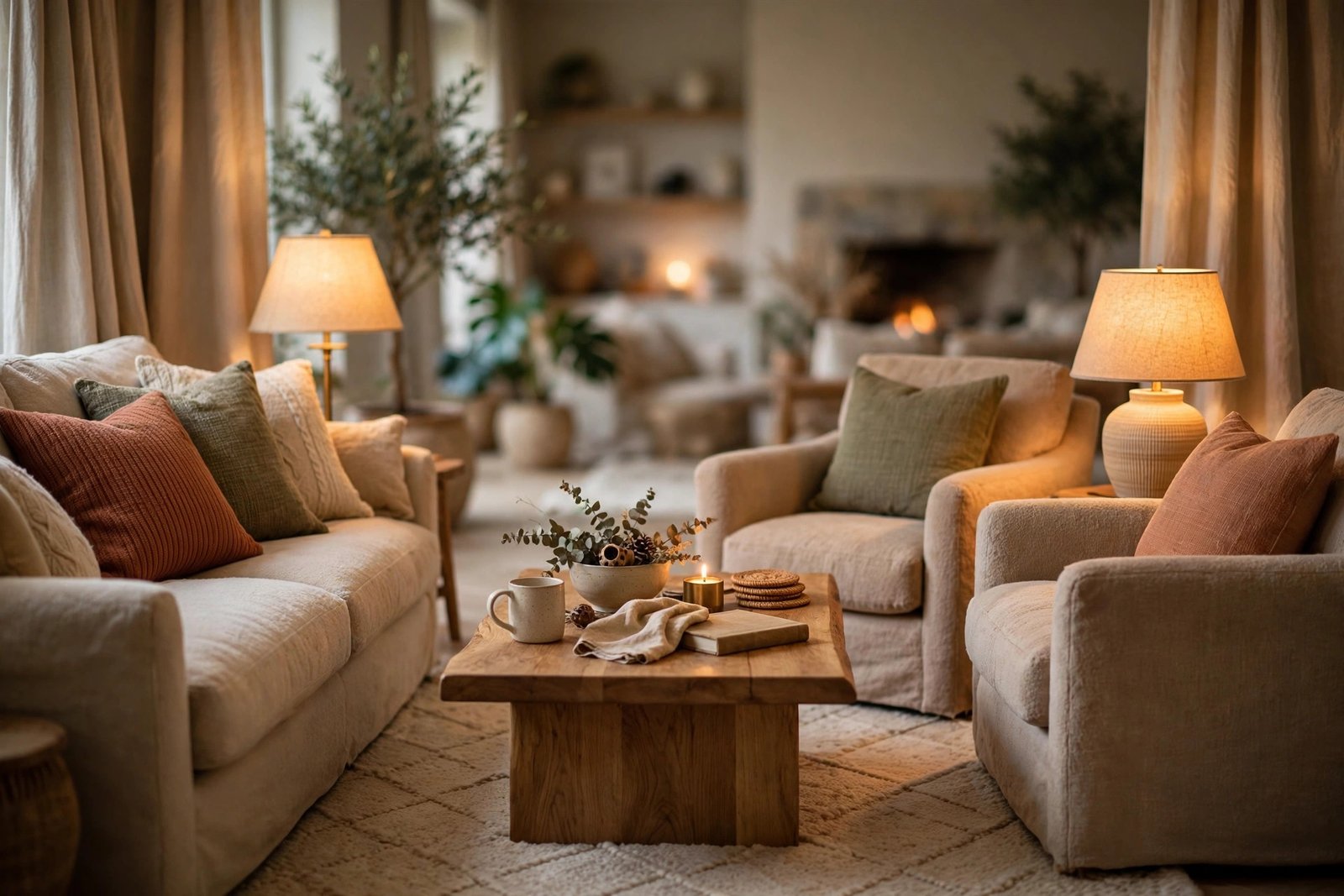
Three things make a large room feel unwelcoming, and only one of them is temperature. The first is distance: when seats are more than about 3 metres apart, conversation requires raised voices, so people unconsciously avoid the room for talking. The second is echo: large, bare floors and walls bounce sound, and that slight hollowness reads to our brains as “empty public space” rather than “home”. The third is light spread thin — one ceiling light in the middle of a big room leaves the edges in gloom and the centre over-lit.
There is a fourth, quieter cause: in a big room people push all the furniture to the edges, because the middle feels exposed. The result is a dance floor nobody dances on, ringed by furniture. Every fix below works against one of these four causes, which is why zoning succeeds where simply buying a bigger sofa fails.
Step 1: Decide Your Zones Before You Move Anything
Walk the room and ask what it should actually contain. Most large living rooms settle into some combination of: a main seating zone (sofa, chairs, TV or fireplace), a quiet zone (reading chair, lamp, small bookcase), a social second zone (a pair of chairs and a small table for tea, games, or a drink away from the TV), and sometimes a work or hobby zone (a desk, a piano, a craft table). Two zones suit most rooms; three suit a genuinely large one.
Place the main zone first, around the room’s natural focal point — the fireplace, the best window, or the TV wall. Put the quiet zone in the corner with the least traffic, and any second social zone where it catches light without blocking a path. Sketch it roughly if that helps; each zone needs a purpose and a rough territory before a single piece moves. This is the same zoning logic that makes a studio apartment work, scaled up — our guide to a studio layout that creates separate living zones uses the identical method at the opposite end of the size scale.
Step 2: Anchor Each Zone With a Rug and Real Distances
A zone exists when the floor says so. Each seating zone needs its own rug, big enough that at least the front legs of every seat sit on it — in a large room, err bigger: a rug that floats like a postage stamp in the middle of the zone undoes the effect. The rug is the zone’s boundary line and its warmth at once, softening echo underfoot.
Inside the zone, use conversation distances, not room distances: seats facing each other about 1.2–2.5 metres apart edge to edge, a coffee table 40–45 cm from the sofa, side tables within reach of every seat. This is where most large rooms go wrong — the furniture is sized and spaced for the room’s dimensions rather than for people. Pull the group in until it would look right in a room half the size, and let the leftover space become the gaps between zones.

Step 3: Float the Furniture and Build Soft Borders
Zoning a large room almost always means floating the sofa. Pulled into the room with space behind it, the sofa becomes the main zone’s back wall, and the area behind it becomes a natural border — a console table with lamps, a low bookcase, or simply a clear walkway. Our guide to sofa against the wall or floating explains when a room has the depth to do this well; large rooms almost always do.
Other borders that work without walls: an open-backed bookcase between zones (storage from both sides, light passes through), a pair of armchairs with their backs to the next zone, a change of lighting level, or a large plant grouping in the gap. Keep the borders low and partial — you are suggesting edges, not building rooms. And protect the circulation: a path of about 90 cm should run between the zones and around them, so moving through the room never means crossing someone’s conversation.
Step 4: Light in Layers, at Human Height, in Every Zone
If you change only one thing, change the light. Turn off the single central ceiling light as your main source and give each zone its own lamp or two at seated height — table lamps on side tables and consoles, a floor lamp beside the reading chair, perhaps a shaded lamp behind the floated sofa on its console. Pools of warm, low light are what the brain reads as “cosy”; a single bright overhead is what it reads as “office”.
Aim for at least two light sources per zone at different heights, and keep the colour warm. The gaps between zones can stay dimmer — that contrast is precisely what makes each lit zone feel like a place. A corner fireplace, if your large room has one, counts as a zone’s light and focus in the evening; if the fireplace sits awkwardly in a corner and fights the zoning, our guide to corner fireplace furniture placement solutions shows how to fold it into a zone of its own instead of letting it fight the whole layout.
Step 5: Kill the Echo and Warm the Surfaces
Sound is the last layer. A large room with hard floors, bare walls, and one group of furniture will echo, and echo feels cold. The remedies are the soft things a zoned room naturally accumulates: the rugs under each zone, curtains at the windows (full-length, even if the window is small), upholstered pieces rather than all hard chairs, cushions and a throw on the sofa, and one or two large soft wall pieces — a tapestry, a big canvas, bookshelves full of books.
Work zone by zone rather than trying to deaden the whole room at once. Sit in the main zone and clap once: if you hear a flutter of echo, that zone needs more soft surface — usually the rug is too small or the wall behind the sofa is bare. You are aiming for the sound of a furnished home, where a voice stays in its zone and dies there, kindly.
Mistakes to Avoid
- Pushing all the furniture against the walls. It maximises the empty middle and the echo, and strands every seat too far from the next. In a large room, the walls are the last place furniture belongs.
- Buying one enormous rug and calling it a zone. A single huge rug under everything just recreates one big room on a carpet. Each zone needs its own anchor.
- Spacing the seating to fill the room. Seats spread to “use the space” end up beyond conversation distance. Group for people; let the gaps fall where they fall.
- Relying on the central ceiling light. One bright overhead over a large floor is the coldest lighting there is. Lamps per zone, at seated height, warm colour.
- Creating too many tiny zones. Four or five chopped-up areas feel like a furniture showroom. Two or three generous zones feel like a home.
- Blocking the paths between zones. Zoning that forces a obstacle course between the sofa and the kitchen has traded calm for cosiness. Keep a 90 cm route around and between zones.
Frequently Asked Questions
How do I divide a large living room without walls?
Use rugs to mark each zone’s floor, the backs of sofas and open shelves as low borders, and separate lamp pools to give each zone its own light. These three signals — floor, border, light — are enough for the brain to read one big space as several comfortable places.
What size rug does a large living room zone need?
Big enough for the front legs of every seat in the zone to rest on it, which usually means at least 230 × 160 cm for a sofa group and often larger. In big rooms the common error is a rug that is too small; when in doubt, size up.
How many zones should a large living room have?
Usually two or three: a main seating zone, plus a reading corner and/or a small second conversation or work zone. Let the number follow the room’s uses, not its size alone — a big room used only for TV and guests may need just one strong main zone and one quiet corner.
Why does my large living room echo, and how do I stop it?
Echo comes from hard, parallel surfaces and empty floor. Add soft mass zone by zone: proper-sized rugs, curtains, upholstered seating, cushions, and full bookshelves. You do not need to cover every surface — softening each zone where people actually sit makes the biggest difference.
The Bottom Line
A large living room feels empty and cold because it is one undefined space doing nothing in particular, lit from a single point and echoing off bare surfaces. Give it a plan instead: two or three zones with real jobs, each anchored by its own rug, furnished at human distances, bordered softly by sofa backs and shelves, and lit by its own low, warm lamps. The room will not lose its grandeur — it will gain rooms within the room, and people will finally settle into it.
