There is a particular kind of living room chaos that only parents know. The floor is a minefield of bricks and puzzle pieces, the sofa has a toy kitchen behind it, and every surface carries a small, brightly coloured object that belongs to no category you can name. Tidying feels pointless — within an hour of any cleanup, the room looks exactly as it did before. The problem is usually blamed on the children. It almost never is. It is a storage plan problem.
Toys spread because they have no geography. When everything lives everywhere, play happens everywhere, and tidy-up means carrying objects to random boxes in random rooms — a job no child (or adult) will do consistently. Zoned storage fixes the geography instead: one defined play zone, storage a child can work alone, a rotation system that keeps most toys out of the room, and a reset ritual that takes five minutes. This guide plans it zone by zone.
Quick Answer
To stop toys taking over the living room, give play one defined zone — a corner, a rug area, one end of the room — and put all toy storage inside that zone, at child height, in open-topped boxes or low shelves the child can reach and refill alone. Keep only a curated selection in the room and store the rest in rotation boxes elsewhere, swapping weekly or monthly. Add one closed piece of storage (a bench, ottoman or sideboard section) so the evening reset hides everything, and make tidy-up a five-minute daily ritual with a fixed finish line: everything in its box, boxes in the zone, floor clear.
Step 1: Draw the Zones — Play, Adults, and the Route Between
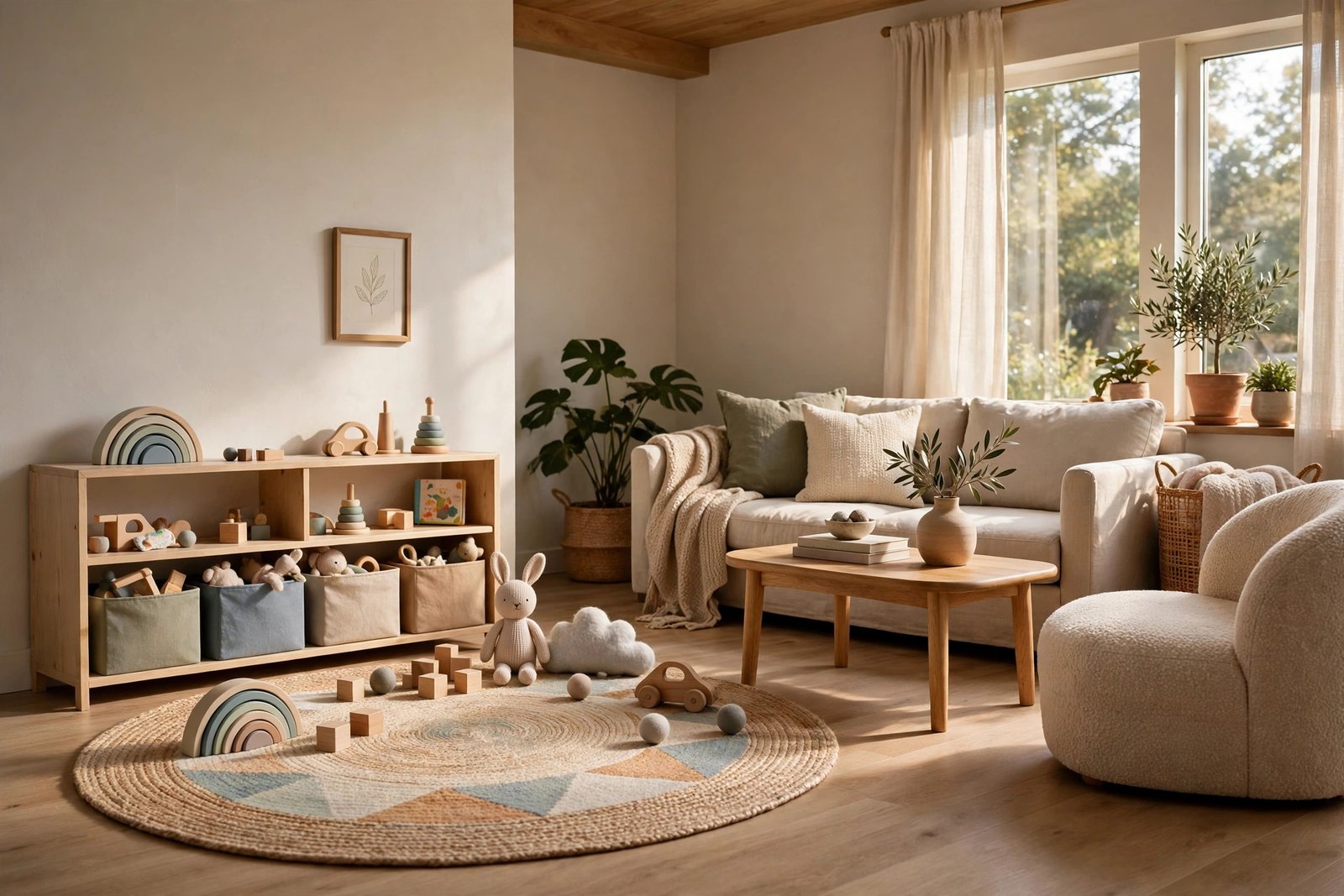
Start by deciding where play is allowed to live. In most living rooms the honest answer is one corner or one end: behind the sofa, the bay window end, the space along one wall. Mark it physically — a rug is the classic boundary because even a three-year-old can learn “toys stay on the mat” — and accept that inside the zone, a degree of visible play is normal and fine. The war is not against toys being visible at 4 p.m.; it is against toys being everywhere at 9 p.m.
Outside the zone, the adult areas get a clear rule: no toy storage, no toy parking. This only works if the zone is genuinely big enough and genuinely attractive — near the family, not exiled to a cold corner nobody sits in. Children play where the people are. If the play zone is the far end of the room from every chair, the toys will migrate to the chairs, and they will be right to. It is the same define-the-zone thinking that rescues any messy open-plan living room: a zone is a promise the room makes, and it only holds if the zone actually serves the people using it.
Step 2: Storage at Child Height, Workable by a Child Alone
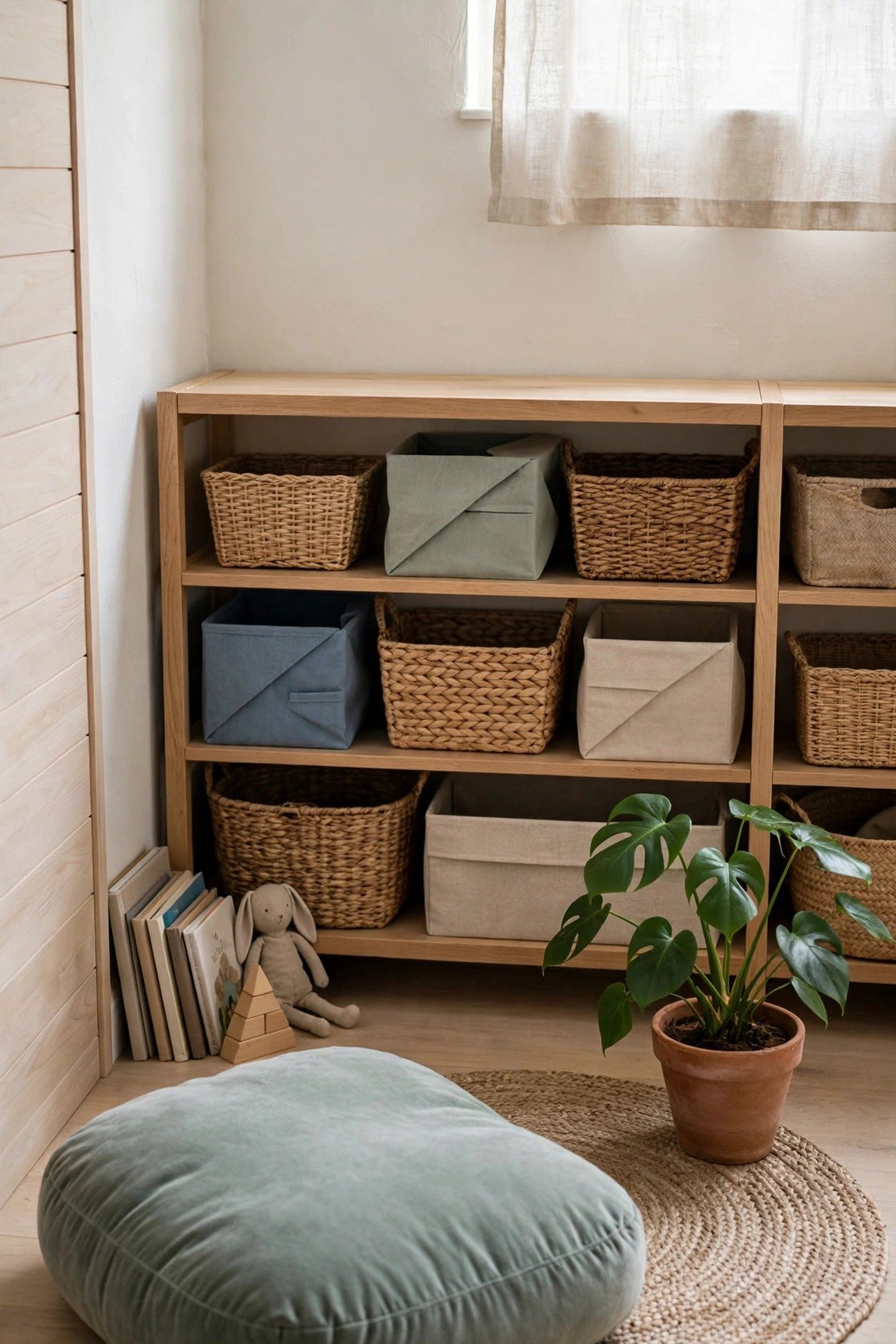
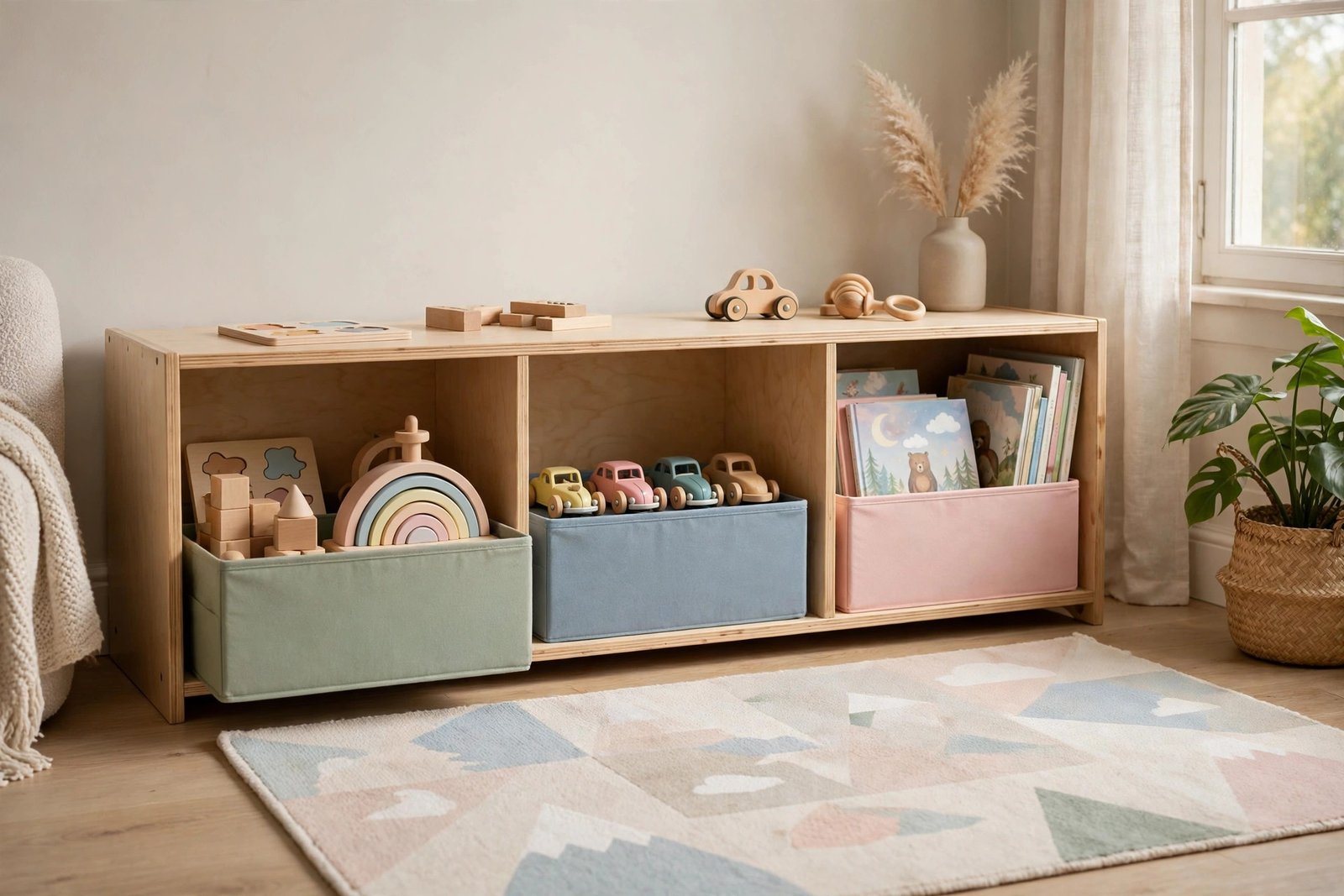
The storage inside the zone decides whether the system lives or dies, and the test is simple: can the youngest player put everything away, alone, without asking where things go? That means low, open storage: a shelf unit lying at child height, open-topped boxes or baskets, one box per category — bricks in one, cars in one, dolls and soft toys in one, art supplies in one. Lids that need two hands, boxes stacked three deep, and cupboards with doors are adult storage wearing a costume; children will not fight them at tidy-up time, they will simply not tidy.
Picture labels on the boxes (a drawing or photo of the contents) turn “tidy your toys” into a matching game a pre-reader can win. Keep the number of categories small — five or six boxes beat fifteen — and keep each box only two-thirds full, because a box that has to be packed like a suitcase will be left unpacked. This is the family version of the principle behind living room storage that does not look like storage: every category gets one home, near where it is used — except here the homes are designed to be opened by small hands fifty times a day.
Step 3: The Rotation System — Most Toys Live Somewhere Else
Here is the step that changes everything, and the one most families resist: the living room should hold only a fraction of the toys the family owns. Children do not play with thirty toys shallowly as happily as they play with eight toys deeply — and eight toys fit in a zone. Box up the rest into two or three rotation boxes stored out of the room: a wardrobe top, under a bed, a garage shelf. Every week or two, swap the room’s selection with a rotation box. Toys return like new arrivals, play deepens, and the room’s storage stops bursting.
Rotation is also the honest answer to gifts and growth: new toys enter the room by displacing something into a rotation box, not by adding a new container. And when a rotation box stops being opened with any excitement, its contents are telling you they can leave the house entirely — the same removal-first discipline as our guide to a small living room with too much furniture. Fewer toys, deeply played with, in a zone that fits them: that is the whole secret, and it is mostly subtraction.
Step 4: The Five-Minute Reset and the Evening Rule
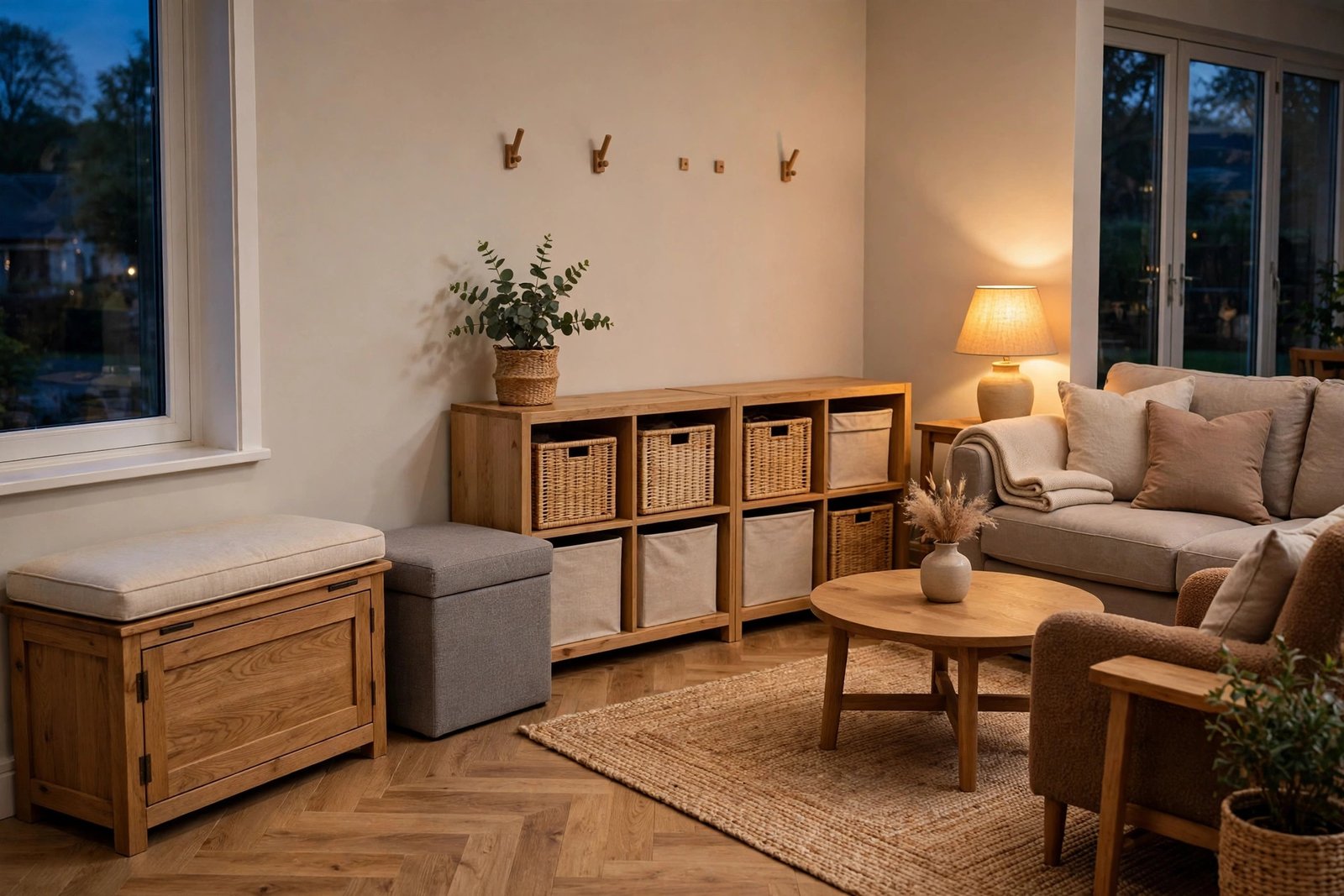
A zoned room still needs a daily reset, and the reset needs a finish line everyone can see: boxes filled, boxes in the zone, floor clear, one closed storage piece shut. Done together at the same time each day — before dinner, or before the evening bath — it takes five minutes because the geography does the heavy lifting: nothing travels further than the zone. A timer and a song turn it into a game for younger children; for older ones, the rule is simply that the room resets before screens.
That one closed piece of storage matters more than it looks. A lidded bench, a storage ottoman or one sideboard section reserved for the overflow — board games, the toy that does not fit its box, the craft project in progress — gives the reset somewhere to put the awkward remainder, so “done” is achievable every single day. If your living room also has to hold a work corner, the zones have to be planned together rather than compete: our guide to a home office in a corner shows how to give the desk its own boundary so the two zones stop invading each other.
Mistakes to Avoid
- One giant toy box for everything. A single deep chest guarantees digging, dumping and nothing being findable. One box per category, small enough to carry, is the unit that works.
- Storage only an adult can operate. Lids, latches, high shelves and stacked boxes all fail the same test: the child cannot reset the room alone, so the room does not get reset.
- Keeping every toy in the room. Storage cannot fix a quantity problem. If the zone’s boxes overflow at full tidy, the answer is rotation and removal, not another unit.
- A play zone where nobody sits. Children play near their people. A zone exiled from the family’s seats will be abandoned, and the toys will colonise the seats instead.
- No finish line for tidy-up. “Tidy the living room” is endless and arguable. “Boxes filled, floor clear, bench shut” is checkable in ten seconds — by the child.
- Buying storage furniture before zoning. Decide the zone and the categories first, measure what they need, then buy the unit that fits. A beautiful shelf in the wrong place is decor, not a system.
Frequently Asked Questions
How many toys should stay in the living room?
As many as fit, fully tidied, in the play zone’s storage — and not one more. For most families that works out at five to eight categories in open boxes: building toys, vehicles, figures or dolls, art supplies, puzzles and games, soft toys. If the honest tidy overflows, the collection, not the room, is too big — rotate some out.
What is the best storage for toys in a small living room?
A low, open-fronted shelf unit with removable boxes, placed inside the play zone. It keeps categories separate and visible, works at child height, and the boxes can be carried to the play spot and back. Add one lidded bench or ottoman for overflow and the evening reset, and the room needs nothing else.
How does toy rotation actually work in practice?
Pack two or three boxes of toys and store them out of the living room. Every one to two weeks, swap the room’s boxes with a stored box — five minutes with a list on the box lid of what is inside. Children greet returning toys like new ones, play concentrates, and birthdays become a swap decision instead of a storage crisis.
My child refuses to tidy up. Will zoning help?
Usually, yes — because most refusal is really confusion or scale. Zoning shrinks the job to a few boxes in one area, picture labels remove the “where does it go” argument, and a fixed finish line makes “done” reachable. Keep the ritual short, daily and together at first; a five-minute job with a clear end gets cooperation that an overwhelming room never will.
The Bottom Line
Toys take over living rooms that have no geography. Give play one real zone where the family actually sits, put category boxes at child height inside it, rotate most of the collection out of the room, and run a five-minute reset with a visible finish line every day. The children get a play space that works, the adults get their room back every evening, and tidy-up stops being a negotiation — because the plan, not willpower, is doing the work.