
Living in an apartment with no separate bedroom means living without a door you can close. You change clothes within sight of the sofa. Guests sit three steps from your pillow. A partner on an early shift gets dressed in the dark while you try to sleep in the same open space. It is the daily reality of studio and one-room living, and the hardest part is not the size — it is the feeling that there is nowhere in your own home that is fully, privately yours.
You cannot add a wall, and in a rental you usually cannot even drill for one. But privacy in a one-room apartment is not really about walls. It is about sightlines, zones, light, and a few honest agreements with the people you live with. This guide shows how to use layout and simple, reversible fixes to build real privacy — for sleeping, changing, and hosting — into a home that has no bedroom door.
Quick Answer
To create privacy in an apartment with no separate bedroom, put the bed in the corner farthest from the door and break the sightline between the entrance, the sofa, and the bed with an open bookshelf, the back of the sofa, a curtain on a track, or a folding screen. Create a small changing spot near the wardrobe with its own screen or curtain. Give each zone its own lamp so one person can read while the other sleeps. Finally, agree simple rules — bed zone is private space, headphones after a set hour — because in one room, manners do part of the work that walls do elsewhere.
Step 1: Understand Privacy as a Sightline Problem
Most one-room privacy failures are really sightline failures. Stand at your front door and look in: if you can see the bed, every visitor, delivery driver, and neighbour passing the open door can see it too. Sit on the sofa: if the bed fills your view, relaxing in the evening will always feel like sitting in a bedroom. The fixes in this guide all do the same job in different ways — they interrupt those sightlines so that each part of the room can be used without being on display to the others.
Mark three views: from the door, from the sofa, and from the kitchen or desk. Your layout is working when none of them has a clear, direct view of the pillow. The bed does not need to be invisible from everywhere — hidden from the door and screened from the sofa is enough. This is the same zoning logic that makes any open room feel calmer, so if your apartment still reads as one mixed space, start with our guide to a studio layout that creates separate living zones, then add the privacy layers below.
Step 2: Screen the Bed — Curtains, Shelves, and Screens
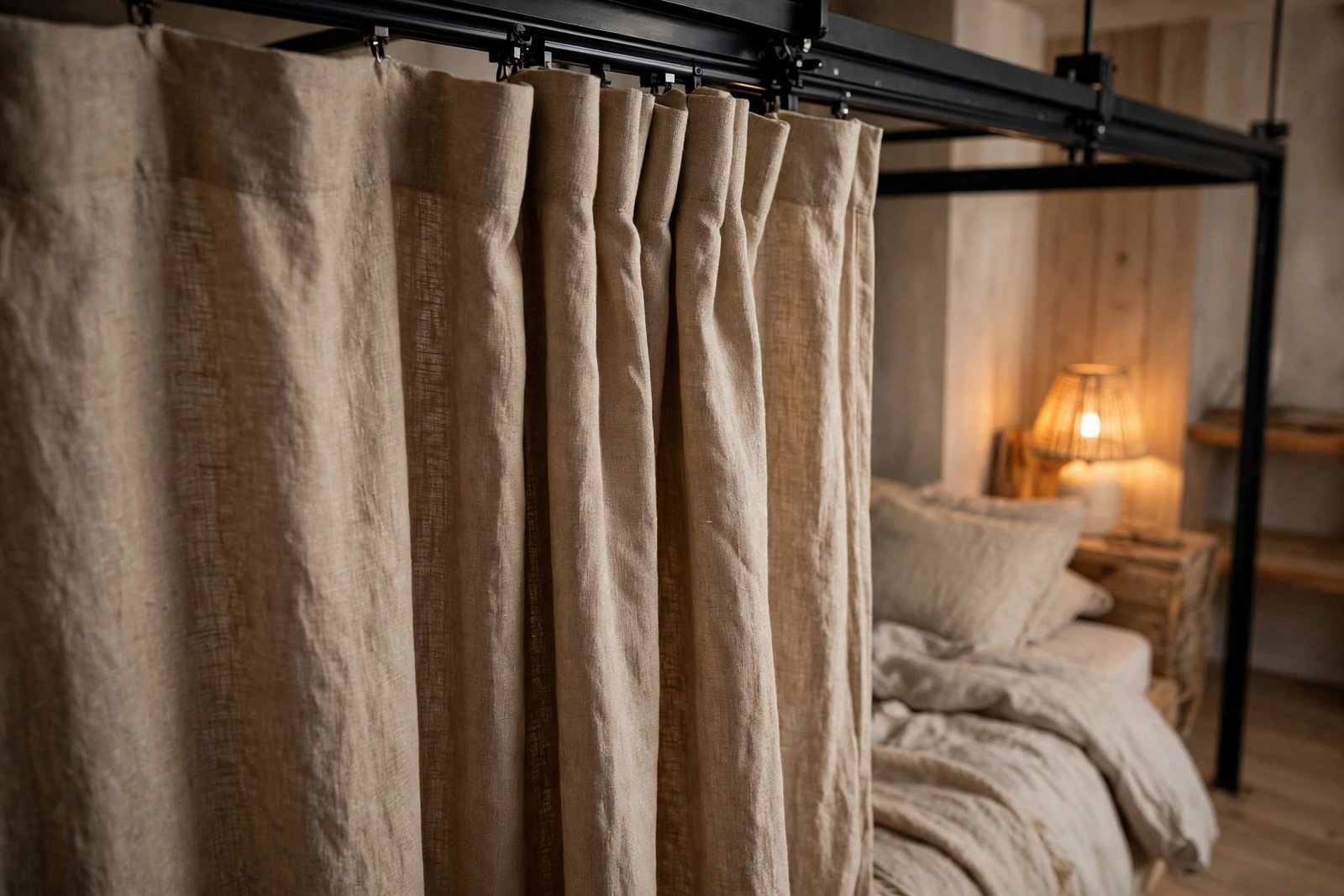
The strongest tool is a curtain on a ceiling track or a tension system. A ceiling track lets a fabric curtain run along the whole side of the bed zone: closed at night or when guests come, open in the morning so the room breathes again. Choose a curtain with some weight and opacity — a thin, sheer fabric shows silhouettes under lamplight, which is privacy on paper only. Renters who cannot fix a track can use a tension rod between two walls in a narrow corner, or a free-standing rail.
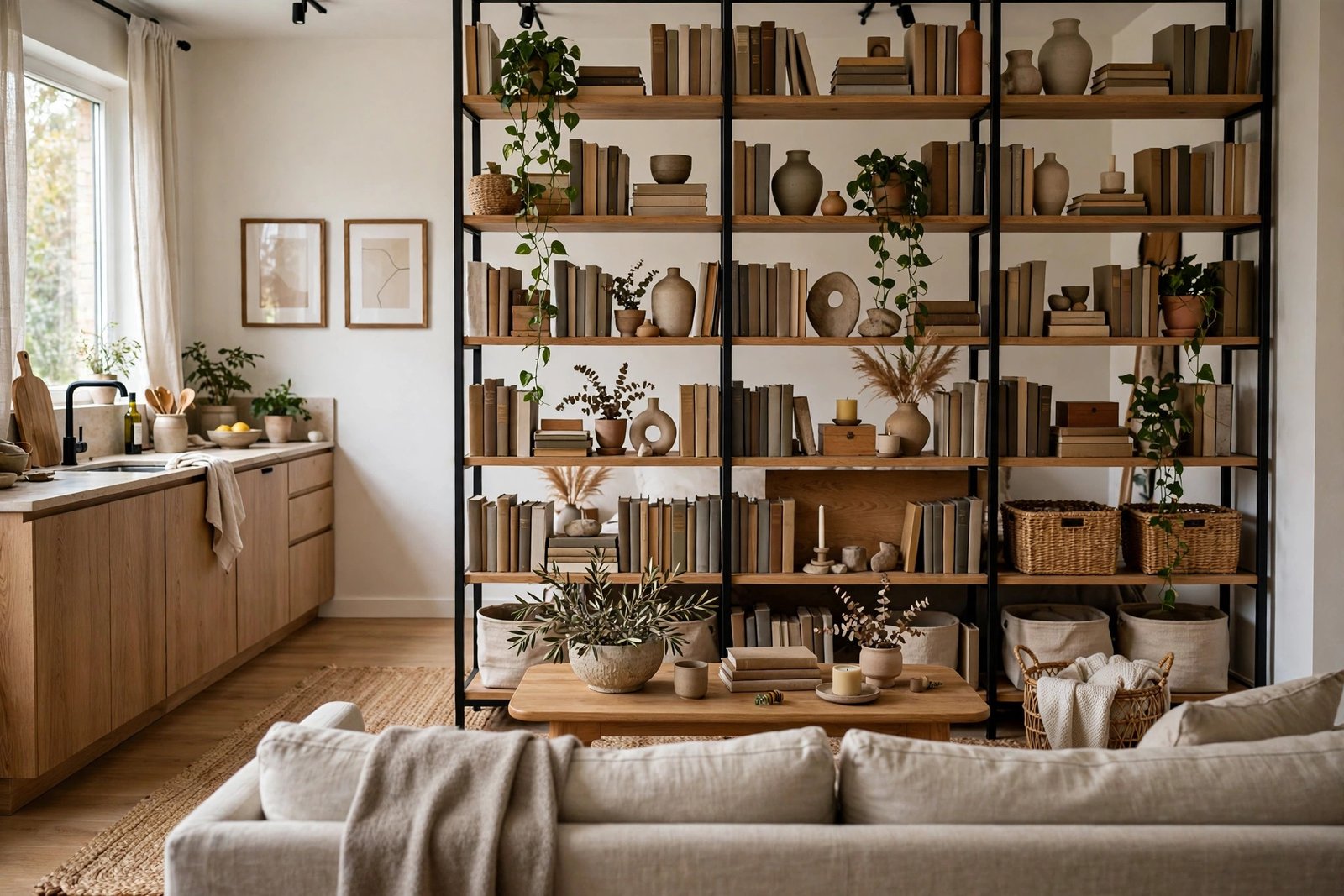
The second tool is the open bookshelf divider, around 120–150 cm high, placed beside the bed. It screens the lying-down view from the sofa, adds storage both sides, and lets light pass through the shelves — leave a few squares partly empty so the room does not darken. Third, the folding screen: the least permanent, most flexible option, ideal for the changing problem below, though it screens less completely than a curtain. Fourth, do not forget the free divider you already own: the back of the sofa, turned to face away from the bed, already hides more than most people realise. Where exactly the bed sits decides how well any of these work, so pair this step with our guide to studio bed placement to get the corner right before you screen it.
Step 3: Build a Changing Spot That Is Not the Bathroom
In a one-room home with a partner or flatmate, the daily pinch point is changing clothes. The bathroom becomes the default changing room, which works until someone is in the shower. Fix it properly instead: create a small dressing corner next to wherever your clothes are stored. A folding screen or a short curtain across a corner near the wardrobe gives a genuinely private two square metres where one person can change while the other is in the room.
Finish the corner like you mean it: a hook for tomorrow’s clothes, a basket for worn ones so they do not migrate to the bed, and a removable mirror if the wall allows one. Couples also benefit from a simple time agreement — the zone belongs to whoever is getting ready first. It sounds formal; within a week it is automatic and ends the morning dance entirely. A defined landing spot by the door helps too: hooks and a shoe tray contain coats and bags at the entrance, so they never invade the sleeping corner.
Step 4: Use Light, Sound, and Routine as Privacy Tools
Privacy is not only visual. Give each zone its own light: a low, warm lamp in the sleep zone, a brighter one by the sofa, a focused one at the desk. When one person reads in bed, a lamp with a shade that points down and away lets the other side of the room stay in evening mode — and a curtain plus separate lamps together do most of what a bedroom wall and door do in a bigger flat.
Sound needs honest tools, not hope: headphones are the house rule for videos and calls when the other person is resting, soft furnishings take the echo out of an open room, and a fan or white-noise app near the bed masks kitchen sounds for a light sleeper. Routine is the last layer. Agree the basics out loud: the bed zone is private space; work calls happen at the desk, not from the pillow; lights-out in the sleep zone is respected even if the other person stays up on their side of the curtain. Written down it sounds strict — lived, it is simply how one room serves two lives without friction.
Step 5: Host Guests Without Exposing Your Bedroom
Guests are the moment a no-bedroom apartment feels most exposed. Prepare the room the way you would prepare a guest room, because that is what it is: close the curtain or screen around the bed before people arrive, make the bed properly, and clear personal items — medication, laundry, chargers — into a basket inside the private zone. Turn the focus to the living side: sofa, chairs, a table ready for drinks. Guests take their cue from the room; a screened, tidy bed corner reads as “private area” and nobody feels awkward.
For overnight guests, be realistic about the layout: a folding mattress or sofa bed belongs on the living side, with the curtain giving both parties a changing and sleeping screen. Sharing meals is easier than most studio owners expect once the eating spot is planned rather than improvised — our guide to a small apartment dining space that fits a table without crowding the room shows how a small table on the living side seats guests properly, so nobody has to eat sitting on the edge of your bed.
Mistakes to Avoid
- Relying on a sheer curtain. Under lamplight it shows everything as silhouettes. Privacy fabric needs weight or a lining — test it at night before you trust it.
- Blocking the window with the screen or divider. You gain privacy and lose the room’s light. Keep tall screening on interior lines, not the window wall.
- Building a sealed box around the bed. Full-height solid dividers on all sides trap heat and air and make sleeping worse. Screen the sightlines, not the airflow.
- Changing in the living zone because there is no plan. A two-square-metre dressing corner near the wardrobe solves it permanently — improvising never does.
- Skipping the agreements. Curtains cannot fix a partner watching videos aloud at midnight. In one room, the rules are part of the layout.
- Leaving the bed unmade and on display all day. An unmade bed visible from the sofa makes the whole home feel like a bedroom you cannot leave.
Frequently Asked Questions
What is the best privacy divider for a studio apartment?
A ceiling-track curtain gives the most complete privacy and opens away fully, so it suits the bed zone best. An open bookshelf is best where you also need storage, and a folding screen is best for renters who need a changing corner with zero fixing. Many homes use two: curtain for the bed, screen for dressing.
How can a couple get privacy in a one-room apartment?
Screen the bed, create a separate changing corner near the clothes storage, give each zone its own lamp, and agree simple rules for headphones, lights, and work calls. Different schedules work surprisingly well once the sleep zone can go dark and quiet on its own side of a curtain.
Can I add privacy in a rental without drilling or fixing anything?
Yes. Tension rods, free-standing curtain rails, folding screens, bookshelf dividers, and the back of the sofa all break sightlines without a single hole. Everything can leave with you, and none of it touches the walls, ceiling, or floor.
How do I make a studio feel private when guests visit?
Close the screen or curtain around a made bed, move personal items out of sight into the private zone, and set up the living side properly with seating and a small table. Guests read the screened corner as private space automatically and relax on the living side.
The Bottom Line
No separate bedroom does not have to mean no privacy. It means privacy has to be built instead of inherited: a bed in the far corner, a curtain or shelf breaking the sightline, a small corner to change in, a lamp and a pair of headphones doing the quiet work, and two or three agreements everyone actually keeps. Build it layer by layer, starting with the screen for the bed, and your one room will start to behave like it has a door — even though it doesn’t.
