Your apartment is the size it is, and your budget for new furniture may be zero. That combination feels like a dead end: the rooms feel tight, the corners feel crowded, and every article about small spaces seems to end with a shopping list. But here is the honest truth from years of small-space layouts — most apartments do not feel small because of what is in them. They feel small because of where those things are standing, what is blocking the light, and how much visual noise the eye has to cross to find a wall.
That means the biggest wins cost nothing. Rearranging, removing, and revealing are free, and they change how a room feels more than a new sofa ever will. This guide works through the free changes in the order that matters, using only the furniture and things you already own.
Quick Answer
To make a small apartment feel bigger without buying anything: clear the floor so its edges are visible, pull the seating into one grouped zone instead of spreading it against the walls, open the sightlines from the door, move tall furniture off the window wall so light can travel, and cut the number of objects on show. Work in that order — floor, layout, sightlines, light, clutter — and most people feel the difference within one afternoon, without spending anything.
Step 1: Clear the Floor — Visible Floor Is Felt Space
Your brain judges a room’s size largely by how much floor it can see. A floor covered edge to edge with shoes, boxes, laundry baskets, plant stands, and charging cables reads as small no matter how large the room actually is. A floor with clear edges and one open path reads as generous, even in a genuinely tiny flat.
Start by walking the perimeter. Everything sitting on the floor that is not furniture should either move up (onto a shelf, into a cupboard, onto a hook) or move out (to storage, to donation, to the bin). Then look at the centre: if you cannot cross the room in a straight line, something is standing in the wrong place. Keep one main path of about 75–90 cm clear from the door to the window or the next room. This single change — a visible, walkable floor border — is the fastest free upgrade there is.
Step 2: Pull the Furniture Off the Walls and Group It
The classic small-room instinct is to push every piece flat against the walls to “save space”. It does the opposite. A ring of furniture around an empty middle makes the room feel like a waiting room, and your eye reads each object separately, which makes the room feel full and restless.
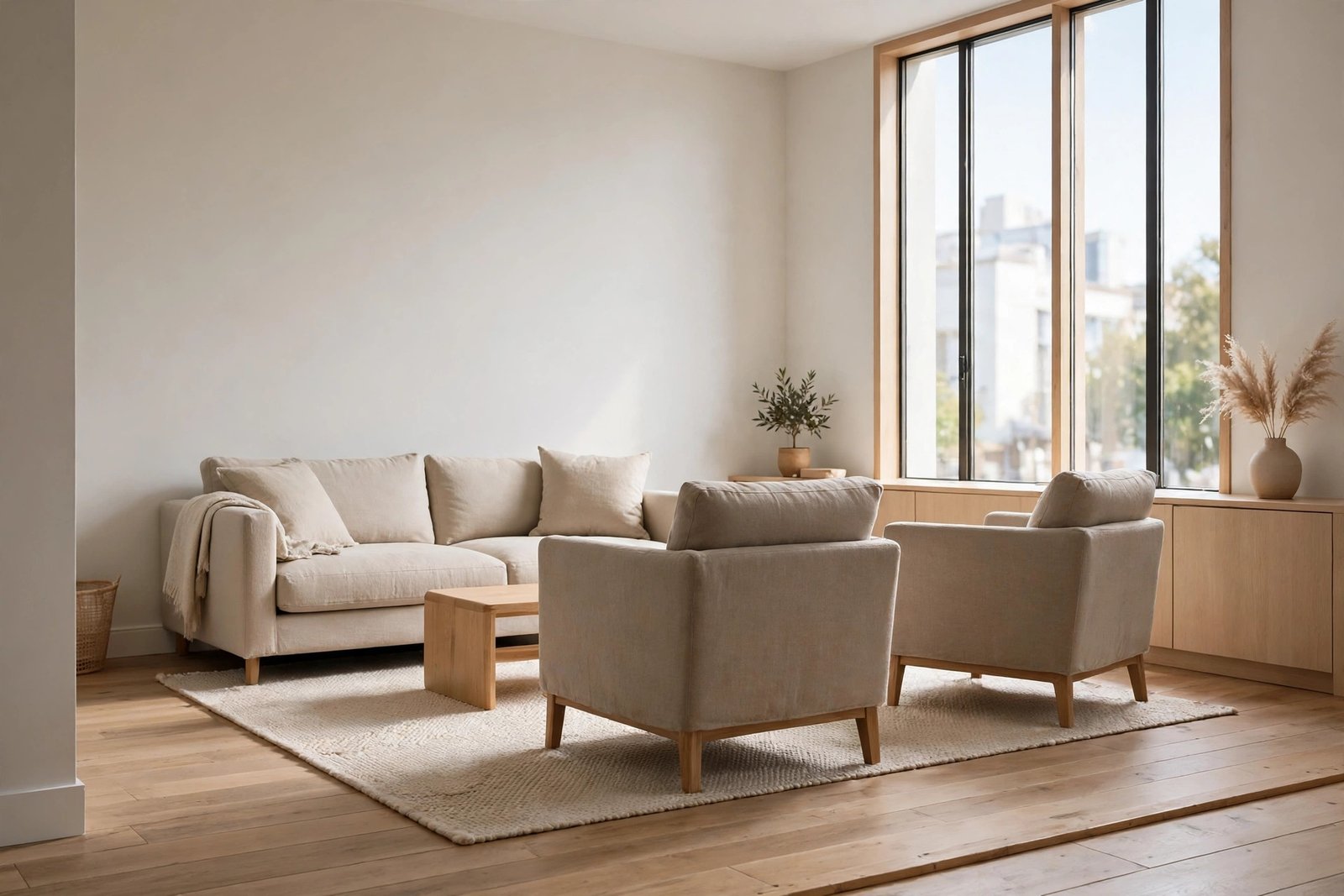
Instead, group the seating. Bring the sofa and chairs together onto one area — on a rug if you own one — with the front legs of the seats on the rug and small gaps of a few centimetres between pieces and the wall. A grouped zone reads as one calm place, and the freed edges of the room become walkways and breathing space. This is the same wall-ring problem that tops the list in our guide to rental apartment layout mistakes that make small spaces feel even smaller, and it is just as fixable in a home you own: nothing about grouping requires permission, tools, or money.
Step 3: Open the Sightlines From the Door
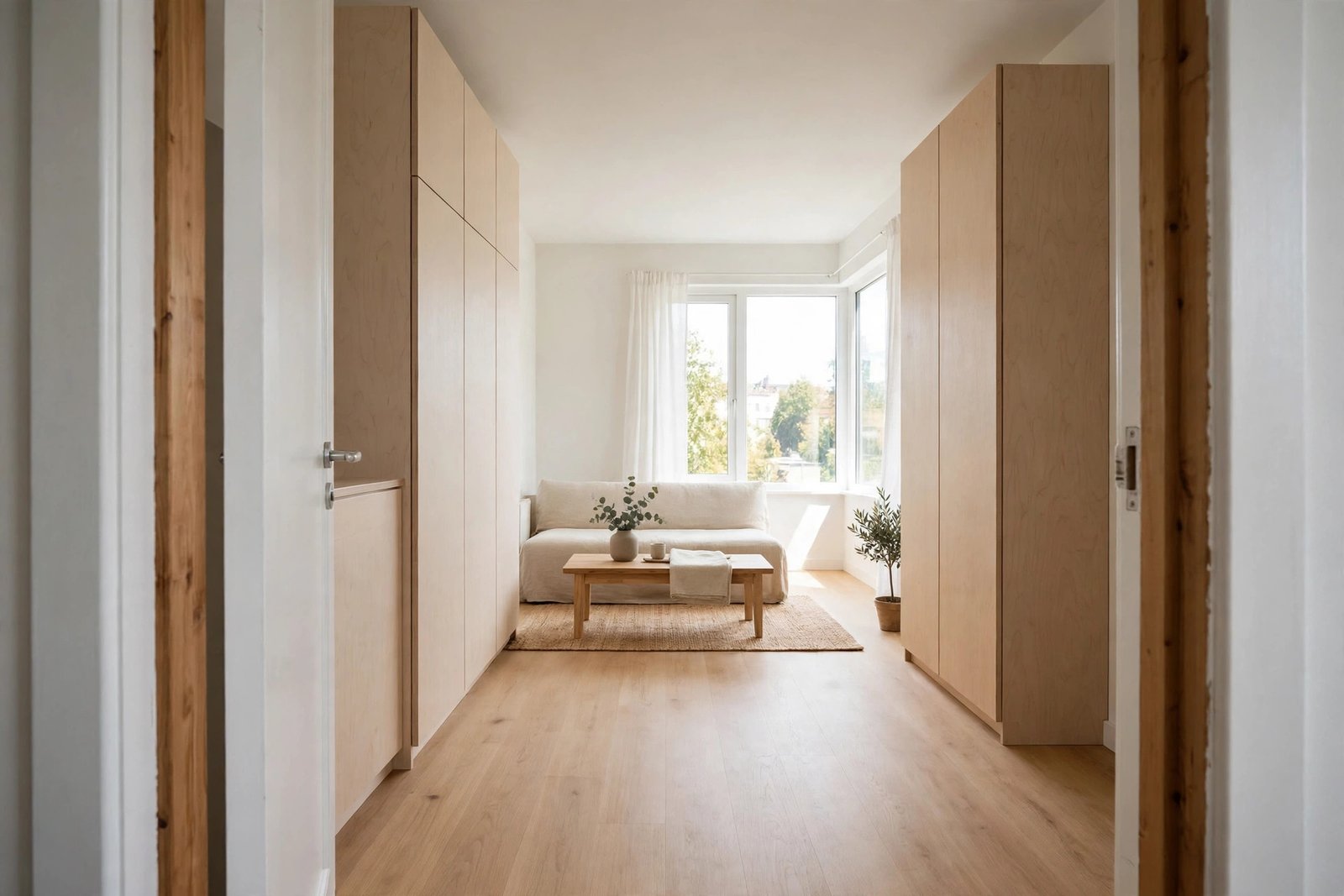
Stand in your doorway and look in. Whatever your eye hits first is what the room “feels like” — and if it hits the side of a wardrobe, the back of a sofa piled with coats, or a tall shelf two steps in, the room feels blocked before you even enter it. Long, unbroken views are what make a space feel large.
Work on the longest line in the room, usually the diagonal from the door to the far window corner. Move anything tall or bulky out of that line. Put low pieces — the sofa, a low bench, a coffee table — in the middle ground, and keep tall storage on the walls to the sides. The bed corner in a studio needs the same treatment: if the bed fills the doorway view, screen it or move it, because a room that opens onto a clear view feels twice the size of one that opens onto furniture. Our guide to a studio layout that creates separate living zones shows how to arrange those same pieces so each zone is visible but none of them blocks the entrance view.
Step 4: Let the Light Travel Further
Light is free square metres. A bright room feels bigger than a dim one of the exact same size, and most small apartments are wasting half their daylight. Begin at the window: open curtains fully so no fabric covers any glass, clean the inside of the glass, and check what stands on the window wall. Anything taller than the windowsill — roughly 75–90 cm — is stealing light from the whole room. Move tall pieces to an interior wall and put only low things under the window.
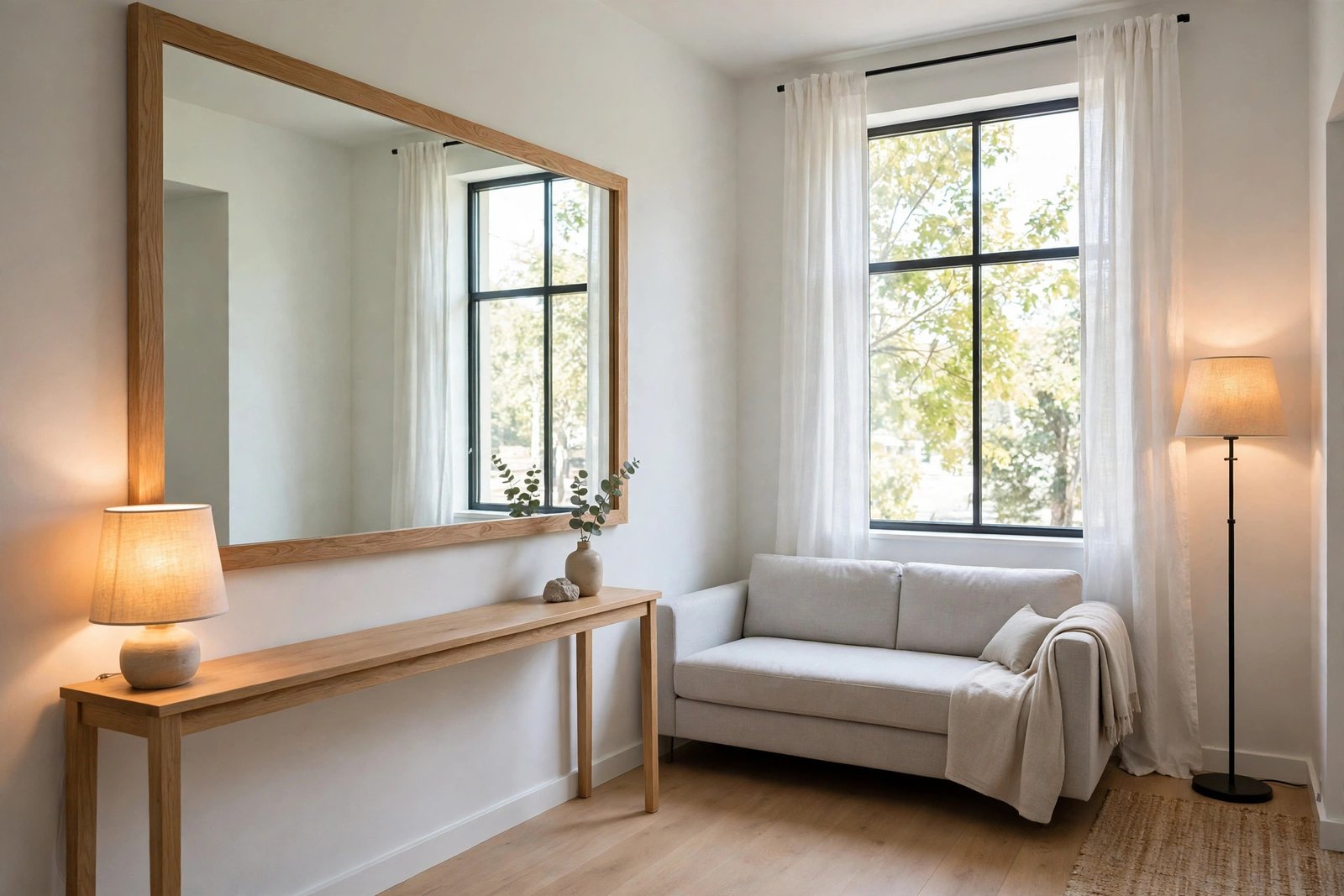
Next, use what you already own to move light around. If you have a mirror anywhere in the home, try it on the wall opposite or beside the window, where it can throw daylight deeper into the room. If your lamps are all in one corner, split them up: one near the sofa, one at the far end of the room. A room lit at two ends feels longer than a room lit at one. None of this needs a purchase — it is the same light and the same lamps, just placed where they work.
Step 5: Cut the Number of Objects on Show
Clutter shrinks a room by count, not by mess. Twenty small objects — stools, baskets, frames, ornaments, side tables — keep the eye busy and make even a tidy room feel crowded. The rule for a bigger-feeling room is fewer, calmer surfaces.
Go surface by surface: the coffee table, the shelf tops, the kitchen counter, the bathroom ledge. On each one, leave only what is used daily plus one object you genuinely like. Everything else goes into a cupboard, a drawer, or a box for a month — if you do not miss it, it does not come back. Group the small things that stay onto one tray or in one basket so the eye reads them as a single item. You are not throwing your life away; you are deciding what earns a place in the view, because the view is the room’s size.
Step 6: Make Each Zone Read Clearly
A room where one activity bleeds into another feels smaller than it is, because the eye cannot finish reading any part of it. Clear zones do the opposite: a defined sitting area, a defined sleeping corner, a defined work spot each read as a separate “room”, and three readable rooms feel larger than one muddled one.
You create zones with things you own: a rug under the seating, a lamp that belongs to one corner, a shelf turned to divide two areas, a chair angled to close a group. Keep the gaps between zones honest — even 30 cm of clear floor between the work desk and the living rug tells the eye where one room ends and the next begins. When several zones have to share a single room all day, the routine matters as much as the furniture; our guide to fitting work, sleep and living into one room shows how to run all three in one space without any of them taking over.
Mistakes to Avoid
- Pushing everything against the walls. The wall ring creates a dead centre and makes every object shout for attention. Group the seating instead.
- Buying storage to fix a layout problem. More boxes organise the crowding; they do not remove it. Rearrange and remove first — both are free.
- Blocking the window with tall furniture. A bookcase on the window wall costs the whole room its light and makes it feel half its size.
- Keeping every small object on display. Fifteen small things read as clutter even when perfectly tidy. Fewer objects, calmer room.
- Letting the doorway view stay blocked. If the first thing you see from the door is the side of a wardrobe, the room feels small before you walk in.
- Moving things around without removing anything. An afternoon of pure rearranging with no removal usually ends where it started. Take at least a few pieces out of the room.
Frequently Asked Questions
Can a small apartment really feel bigger without buying anything?
Yes. How big a room feels is decided by visible floor, clear sightlines, light, and the number of objects competing for attention — and all four can be changed with the furniture you already own. Rearranging and removing change the feeling of a room more than most single purchases do.
What is the first free change I should make?
Clear the floor. Move everything that is not furniture off the floor, and open one straight path of about 75–90 cm through the room. It takes under an hour, costs nothing, and it is the change people feel most strongly.
Should I remove furniture to make the room feel bigger?
Usually one piece, yes. Most small apartments have one item too many — an extra chair, a second side table, a stand with no real job. Removing the least-used piece frees the walkway and calms the whole room more than any rearrangement of the full set.
Where should I put a mirror to make the room feel bigger?
On the wall opposite the window or on the wall beside it, so it reflects daylight and the view rather than a cluttered corner. A mirror facing a messy shelf just doubles the mess. Use the mirror you already own; position matters far more than size.
The Bottom Line
Feeling bigger is not something you buy; it is something you reveal. The space is already in your apartment, hidden under floor clutter, spread-out furniture, blocked light, and too many small objects. Clear the floor first, group the seating, open the view from the door, free the window, and edit what is on show. One afternoon, no purchases — and the apartment you thought was too small turns out to have been badly arranged, which is the best kind of problem to have.
1 thought on “How to Make a Small Apartment Feel Bigger Without Buying New Furniture”