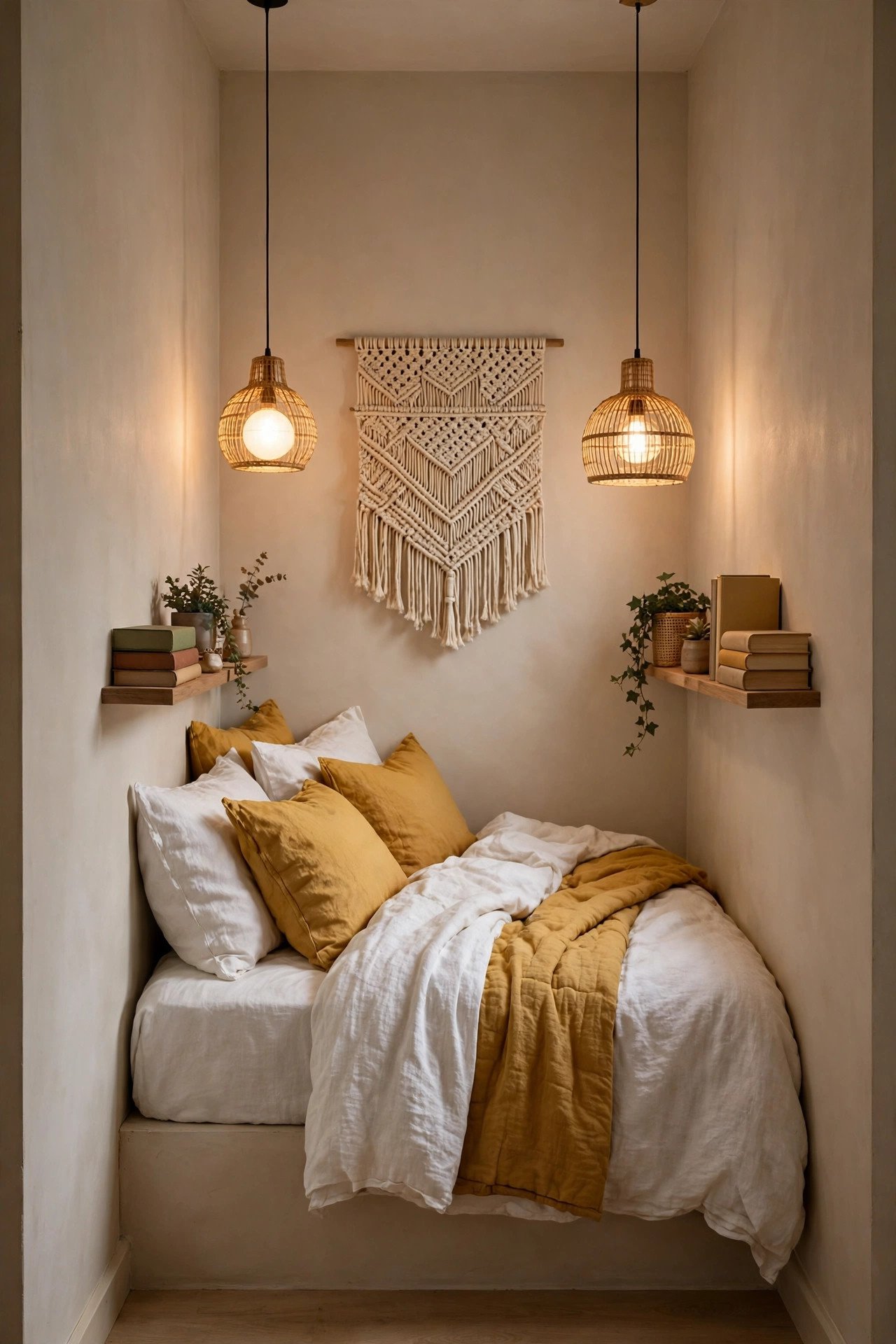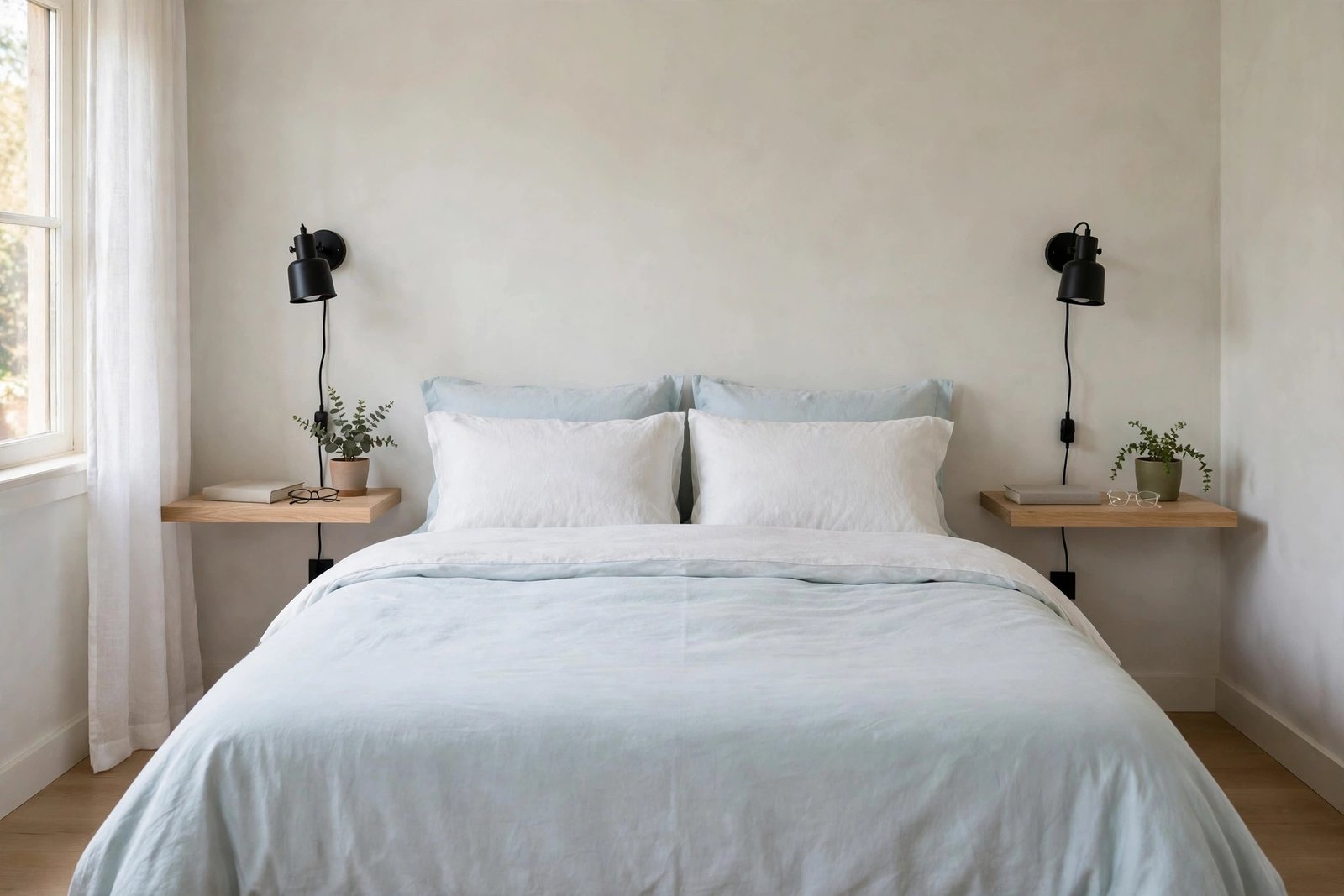
Nightstands are the first thing most small bedrooms lose. The bed fits — just — but the two neat little tables that complete the showroom picture need 40–50 cm on each side, and the room simply does not have it. What happens next is predictable: phones charge on the floor, glasses of water balance on windowsills, books live under pillows, and the morning alarm gets swatted onto the carpet. The room has not lost a luxury; it has lost three small jobs that still need doing.
The trick is to stop trying to fit a nightstand and start replacing its jobs one by one. A nightstand does only three things: it provides a flat surface at mattress height, a little closed storage, and a place for a lamp. Every one of those jobs can be done by something narrower, higher or thinner than a table — a wall shelf, a headboard ledge, a wall light, a stool. This guide works through the alternatives by job, so you can mix the ones your room can actually fit.
Quick Answer
When there is no room for nightstands, replace them job by job: a floating wall shelf or ledge at mattress height for the surface (a book, glasses, a glass of water), a wall-mounted lamp or a shelf with a small lamp for light, and under-bed boxes or headboard storage for the drawer contents. If even a shelf will not fit, use the windowsill, a narrow stool, a C-shaped side table that slides over the mattress, or the top of a low bookcase beside the bed. You need roughly 25 cm of width for most alternatives — and some need none at all.
Job 1: The Surface — Go Onto the Wall
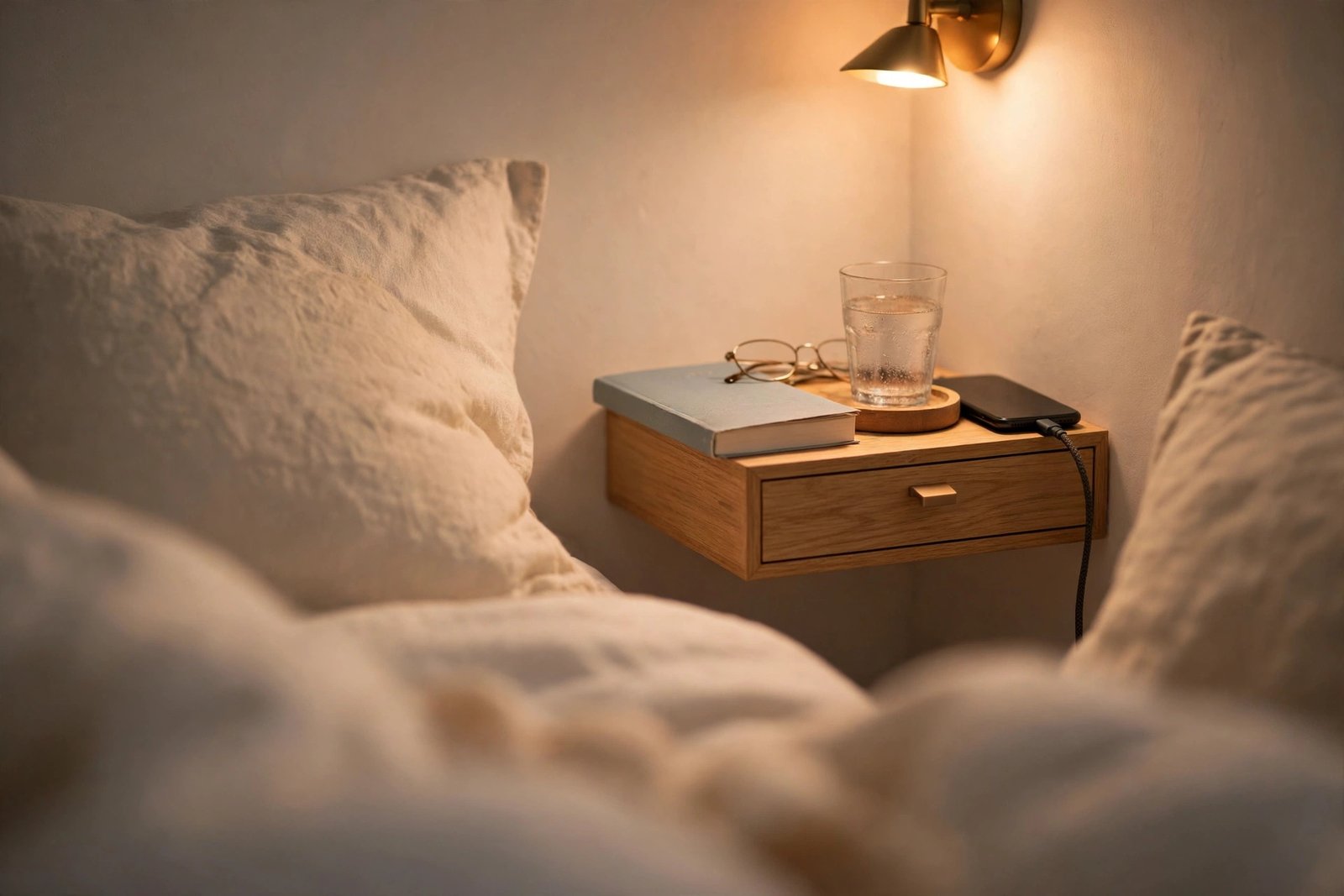
The highest-value nightstand alternative is a floating shelf, because it delivers the surface with zero floor footprint. Fit a shelf or a picture ledge on each side of the bed at the height of the top of the mattress (or up to 10 cm above it), deep enough for a book and a glass — 20–25 cm is plenty, and 15 cm works for just glasses, phone and alarm clock. Choose a shelf with a raised front lip or add a small tray: in the dark, half-asleep hands knock things off flat shelves, and a lip quietly prevents the 2 a.m. glass-of-water disaster.
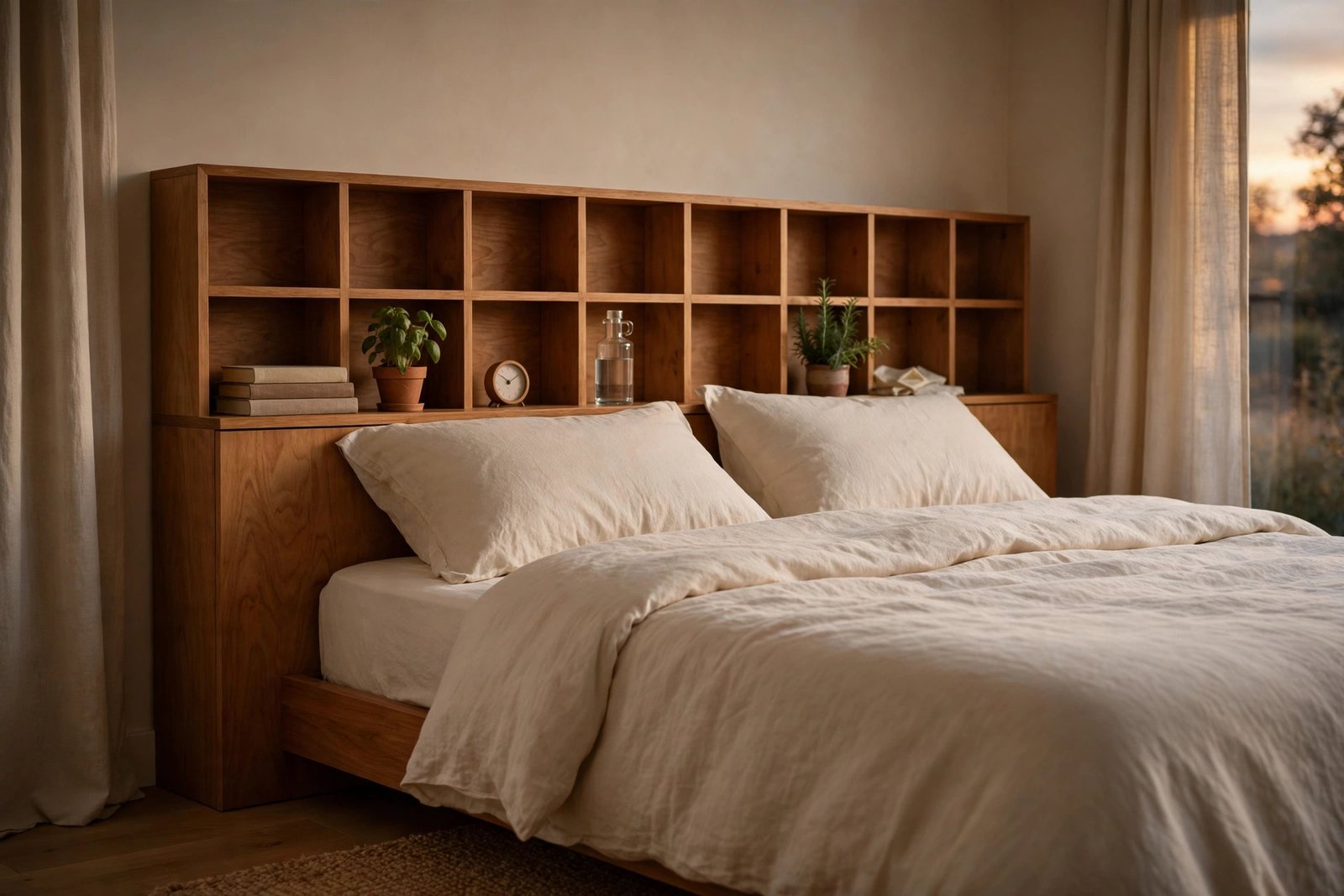
Box-style floating shelves — the kind with a small drawer or a cubby built in — replace some storage at the same time and keep chargers tidy with a cable hole at the back. If drilling is not allowed, a headboard with a built-in shelf ledge along its top or sides does the same job standing on the floor behind the bed, and a wide windowsill beside the bed, cleared and treated as a surface with a small tray, works better than most people expect. What matters is not the object; it is that the surface sits within arm’s reach of the pillow, at mattress height, stable enough for water.
Job 2: The Light — Move It Off the Surface Entirely
A table lamp eats most of a nightstand’s surface before anything else lands there. Wall-mounted reading lights free the whole shelf for the book, the glass and the phone — and they aim better, throwing light onto the page instead of into your partner’s eyes. Plug-in wall sconces with an inline switch avoid electrician costs and rental problems; fit them roughly 100–120 cm from the floor, or 50–60 cm above the mattress, far enough out that you do not crack your head sitting up.
Getting light right on both sides of the bed, warm and low enough not to wreck sleep, is a design topic of its own — see our guide to bedroom lighting that keeps you awake and how to fix it. The placement lesson that matters here: once the lamp leaves the table, the table’s job shrinks to a shelf’s job, and shelves fit in rooms that tables never could.
Job 3: The Storage — Use the Bed Itself
Nightstand drawers usually hold a predictable kit: chargers and cables, medication, lip balm, tissues, a notebook, spare glasses, and clutter with no home. None of it needs a drawer beside the bed specifically — it needs a small, reachable, closable space. Under-bed boxes on the pillow side of the bed hold the bulk of it within arm’s reach. A bedside caddy — the fabric pocket organiser that hangs between mattress and frame — holds phone, remote, book and glasses flat against the bed with literally zero footprint. Headboards with cubbies, sliding-door headboards and storage headboards built like shallow bookcases replace the drawer completely and add display space for the morning coffee besides.
What you are really doing is the standard small-bedroom discipline: audit what the nightstand held, keep the nightly handful within reach, and move the rest to proper storage. Our step-by-step bedroom space audit applies the same sort-and-measure method to the whole room — nightstand contents are usually its smallest and easiest category to rehome.
When One Side Has Space and the Other Has None
Asymmetry is normal in small bedrooms: 45 cm on one side, 12 cm on the other, because the bed is centred on a chimney breast, a window or a door swing. Do not force a matching pair into unequal gaps — matching is a showroom value, not a sleeping value. Give the wide side a slim nightstand or a small bookcase; give the tight side a wall shelf, a wall light and a hanging caddy. Each sleeper gets surface, light and storage; the room looks intentional rather than squeezed, especially if the two sides share a colour or material so they read as a planned pair.
Also steal width honestly: shifting the bed 10 cm towards the tight side (if it does not seal that side entirely) can turn the wide side from “almost a nightstand” into “definitely a nightstand”. And check the clash points before buying anything — a bedside solution that blocks a wardrobe door has just moved the problem; if your wardrobe doors already argue with the bed, our guide to wardrobe doors hitting the bed covers the layout and door fixes that solve both problems together.
Small Objects That Work Surprisingly Well
Beyond shelves and headboards, a family of skinny furniture earns its place beside small beds. A round stool or plant stand (25–30 cm across) holds a book, glass and phone and tucks anywhere. A C-shaped laptop table slides its base under the bed and floats its top over the mattress edge — surface on demand, gone in the morning. A narrow bookcase (20–25 cm deep) laid beside the bed gives three shelves of surface and storage in the footprint of one small table. A storage ottoman or a stack of two vintage suitcases adds a lidded box and a surface in one. Even a simple wall-mounted fold-down flap — a small hinged shelf that folds flat by day — suits rooms where the walkway passes the bed’s side and every centimetre of projection matters at shin height.
Mistakes to Avoid
- Squeezing in full-size nightstands anyway. Tables that leave a 15 cm shuffle-gap beside the bed make the room feel smaller and the bed harder to make. A shelf you can use beats a table you cannot walk past.
- Fitting the shelf at the wrong height. Too high and you sit up fully to reach your water; too low and you knock things off swinging an arm in your sleep. Mattress-top height, give or take 10 cm, is the target.
- No edge or lip on a wall shelf. Flat shelves beside sleepy people shed glasses and phones nightly. A lip, a tray or a box shelf is not decoration — it is the point.
- Charging phones on the floor. Cables across the walkway and a phone underfoot at 3 a.m. Route charging to the shelf or headboard with a short cable and a fixed charging point.
- Mismatched random clutter on each side. Asymmetry works when it looks chosen. Two different solutions in the same finish read as design; a stool, a crate and a pile of books read as surrender.
- Forgetting the wardrobe and door swings. Any bedside fix must survive the room’s moving parts. Test every door and drawer against the new shelf or stool before fixing it in place.
Frequently Asked Questions
What can I use instead of a nightstand in a very small bedroom?
The most space-efficient combination is a floating shelf at mattress height for the surface, a wall-mounted or plug-in sconce for light, and a hanging bedside caddy or under-bed box for storage. Together they replace all three nightstand jobs using no floor space at all. If you have 25–30 cm, a stool, plant stand or slim C-table adds a more furniture-like option.
How high should a floating shelf be beside a bed?
Level with the top of the mattress, or up to about 10 cm above it. That height lets you set down a glass and pick up a book without sitting up or reaching down in the dark. Measure from your actual mattress top — bed frames vary by 15 cm or more, so do not copy a number from a photo without checking your own bed.
Where do I put my phone, book and water without a nightstand?
Book and water go on the wall shelf or headboard ledge — that pairing is exactly what the shelf is sized for. The phone charges best on the shelf too, in a fixed spot with a short cable from a socket or a charging hub, rather than on the bed itself. If there is genuinely no shelf space, a hanging caddy keeps all three within reach and off the floor.
Do both sides of the bed need the same solution?
No — they need the same functions, not the same furniture. One side can have a slim table while the other has a wall shelf and sconce; both sleepers then have surface, light and storage. Tie the two sides together visually with a shared colour, wood tone or lamp style, and the asymmetry looks deliberate instead of accidental.
The Bottom Line
No room for nightstands is not a problem to endure — it is a prompt to split a piece of furniture into its three jobs and give each job a smaller home. A floating shelf or headboard ledge for the surface, wall-mounted light for reading, and caddies or under-bed boxes for the bits and pieces: together they do everything a nightstand does, in rooms a nightstand could never fit. Measure your gaps, work with asymmetry instead of against it, and the bedside stops being the place where small bedrooms give up.