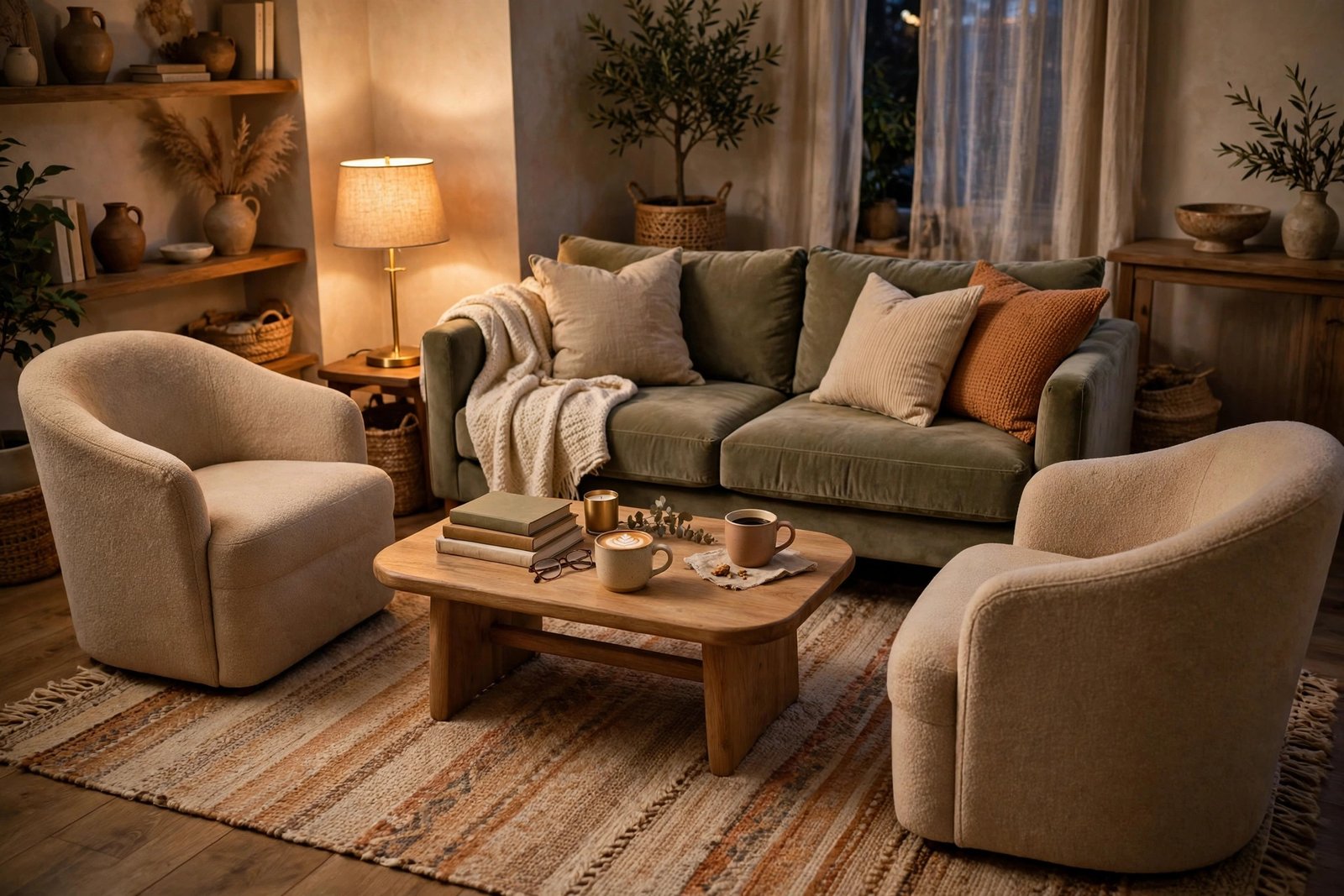
You know the feeling. Guests sit down, and within minutes everyone is slightly too far apart to talk naturally, angled toward a switched-off television, raising their voices across a coffee table the size of a landing strip. Someone perches on a chair that faces the wall. Someone else gets the seat with the lamp behind it, glowing like a halo while their face sits in shadow. The room is full of furniture, the people are friendly — and the conversation still dies.
Awkward conversation is almost never about the people. It is about geometry. Seats that face the same direction, sit too far apart, or leave one person outside the group make talk feel like a press conference. This guide explains the distances and angles that make conversation easy, and how to rearrange the seats you already have to get them.
Quick Answer
To fix awkward living room conversation, turn the seats to face each other in a loose U or L shape, keep the distance between facing seats at about 1.2–2.5 metres, and angle armchairs in by roughly 30–45 degrees instead of lining them up in a row. Put every seat inside one group on one rug, with a table within reach of each person, and stop aiming all the furniture at the television. When people can see each other’s faces at a comfortable distance without turning or shouting, conversation fixes itself.
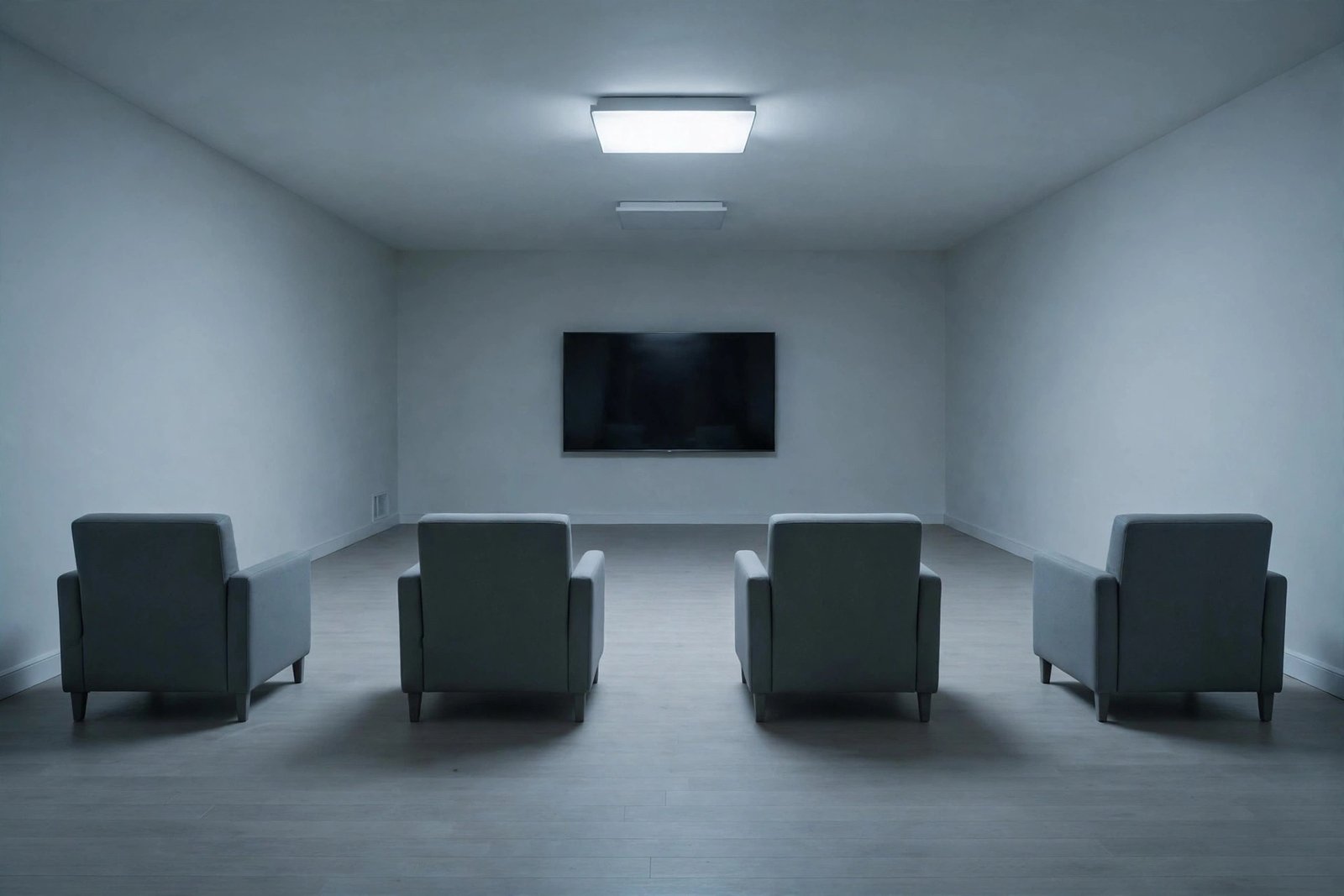
Why Conversation Fails: Seats in a Row, Facing the Screen
Most living rooms are arranged for watching, not talking: sofa and chairs in a row or a shallow arc, all pointing at the TV. Sitting side by side is the worst position for conversation — you talk to the side of someone’s head, eye contact takes a full body twist, and the person at the end of the row is effectively in another room. Add the distances that wall-to-wall layouts create — chairs pushed to the far wall, four metres from the sofa — and every exchange becomes a small public announcement.
The fix starts with one idea: conversation happens between faces. Seats should be arranged so faces point toward each other at conversational distance, the way chairs gather around a café table. The television can stay in the room — it just has to stop being the thing every seat is aimed at.
Rule 1: Turn the Seats Toward Each Other
Start with the armchairs. Instead of placing them beside the sofa in a straight line, move them to the ends of the seating group and angle them inward by about 30–45 degrees, so the people in them face partly toward the sofa and partly toward each other. If the room allows, place one chair opposite the sofa — a true facing seat is the single strongest conversation improvement there is, because it gives the group two sides instead of one row.
An L-shape (sofa plus chairs at a right angle) and a U-shape (sofa with a chair at each open end, angled in) are the two arrangements that work in most rooms. Both keep everyone inside one circle of attention. The decision about whether the sofa itself anchors the group from the wall or from the middle of the room comes first, though — if you are still unsure where the sofa belongs, start with our guide to sofa against the wall or floating, then arrange the remaining seats by the rules here.
Rule 2: Get the Distances Right
Distance is the invisible half of the problem. Between facing seats, about 1.2–2.5 metres from edge to edge is the comfort zone: close enough for a normal speaking voice and easy eye contact, far enough that nobody feels crowded. Beyond about 3 metres, voices rise, side conversations split off, and the group stops feeling like one gathering. Below about 1 metre, knees nearly touch and guests lean back instead of relaxing.
The coffee table lives inside that distance, so its size matters: leave about 40–45 cm between the table and each seat — reachable for a drink, clear for legs. If your current table forces the seats further apart than 2.5 metres, the table is too big for conversation duty; move it aside for gatherings or swap its role with a pair of small side tables. And every seat needs a surface within arm’s reach — a guest holding a cup for an hour is a guest whose hands are out of the conversation. If your room is so small that even one sofa strains these distances, the seating itself may need rethinking — our guide to a living room too small for a sofa shows the smaller pieces that seat the same people at kinder distances.

Rule 3: Close the Circle and Keep Everyone Inside It
Walk around your seating group and ask one question: is there any seat a guest could choose that leaves them outside the conversation? The lone chair by the bookshelf, the pouf stranded behind the sofa, the dining chair dragged in and left facing the group’s backs — those seats manufacture awkwardness no host can overcome. Every seat offered should sit inside the group’s shape, facing inward, at the shared distance.
A rug closes the circle visually: front legs of every seat on the rug means “in”, and anything off the rug reads as “out”. Keep one or two movable seats nearby — a light chair, a firm pouf, a stool — so the circle can grow without breaking. And protect the circle’s edges: if a walkway cuts through the middle of the group, every passer-by becomes an interruption and seated guests feel exposed. Reroute the path around the group when you can, the same circulation logic that governs our guide to rental layout mistakes that make small spaces feel smaller, where blocked and misplaced paths shrink rooms in exactly the same way.
Rule 4: Fix the Details That Quietly Sabotage Talk
Three small things decide whether a well-shaped group actually feels good. Light faces, not ceilings: one central ceiling light flattens faces and throws eye sockets into shadow. Lamps at seated eye level — a floor lamp beside the sofa, a table lamp on a side table — light faces warmly and make people readable to each other. Never place the group’s only lamp directly behind one seat; that guest becomes a silhouette.
Balance the heights: a guest sunk in a low pouf while everyone else sits at sofa height is literally talked down to. Keep seat heights within roughly 10 cm of each other. Give the group a centre: the coffee table with something low on it — books, a plant, drinks — gives eyes a natural resting point mid-conversation, which sounds minor and is not; groups without a centre drift their gaze to the dark television, and the talk follows it there.
Mistakes to Avoid
- Lining all the seats up facing the TV. Side-by-side seating is cinema seating. Conversation needs faces turned toward each other.
- Pushing chairs to the far wall “to make space”. Distance kills talk faster than closeness. Four metres apart is a lecture, not a conversation.
- One seat outside the group. The extra chair dragged in and pointed the wrong way creates an outsider. Bring it fully into the circle or do not offer it.
- A coffee table too big for the room. If the table pushes facing seats past 2.5 metres apart, the table — not the guests — is the problem.
- Lighting from behind or only from above. Silhouetted or shadow-faced guests stop talking. Aim lamps at the group’s faces at seated height.
- Mixing seat heights wildly. A floor cushion among armchairs breaks the eye line. Keep everyone at roughly the same level.
Frequently Asked Questions
How far apart should seating be for good conversation?
About 1.2–2.5 metres between the edges of facing seats. In that range people can talk at a normal volume, read faces easily, and reach the table between them. Beyond about 3 metres the group splits; below 1 metre it crowds.
Should armchairs face the sofa directly?
Directly facing works, but a slight angle is usually more relaxed — turn chairs in by about 30–45 degrees so guests face the group rather than one person head-on. Full head-on seating can feel like an interview; a row facing the same way feels like a bus. The angle is the middle ground.
How do I arrange seating when the TV is the main focus?
Keep the sofa facing the TV if that is how you watch, but angle the chairs in from the sides rather than lining them beside the sofa, and consider a swivel chair that turns to the screen for films and to the group for talk. For gatherings, turning one chair around to face the sofa changes the room’s mode in seconds.
What if my living room only fits one sofa?
Then the sofa is the group: seat guests along it and take the corner yourself, angled in with cushions, and add one movable seat — a light chair or firm pouf — at the open end, angled toward the sofa. Two directions of faces is enough; you do not need a full circle.
The Bottom Line
Conversation is furniture geometry wearing a disguise. Faces toward each other, one to two and a half metres apart, every seat inside one rug-defined circle, lamps on faces instead of ceilings, and a table everyone can reach — set those five things and the same guests in the same room will talk longer, louder, and happier. Rearrange the seats before you blame the company.

1 thought on “Living Room Conversation Feels Awkward? Fix the Seating Arrangement”