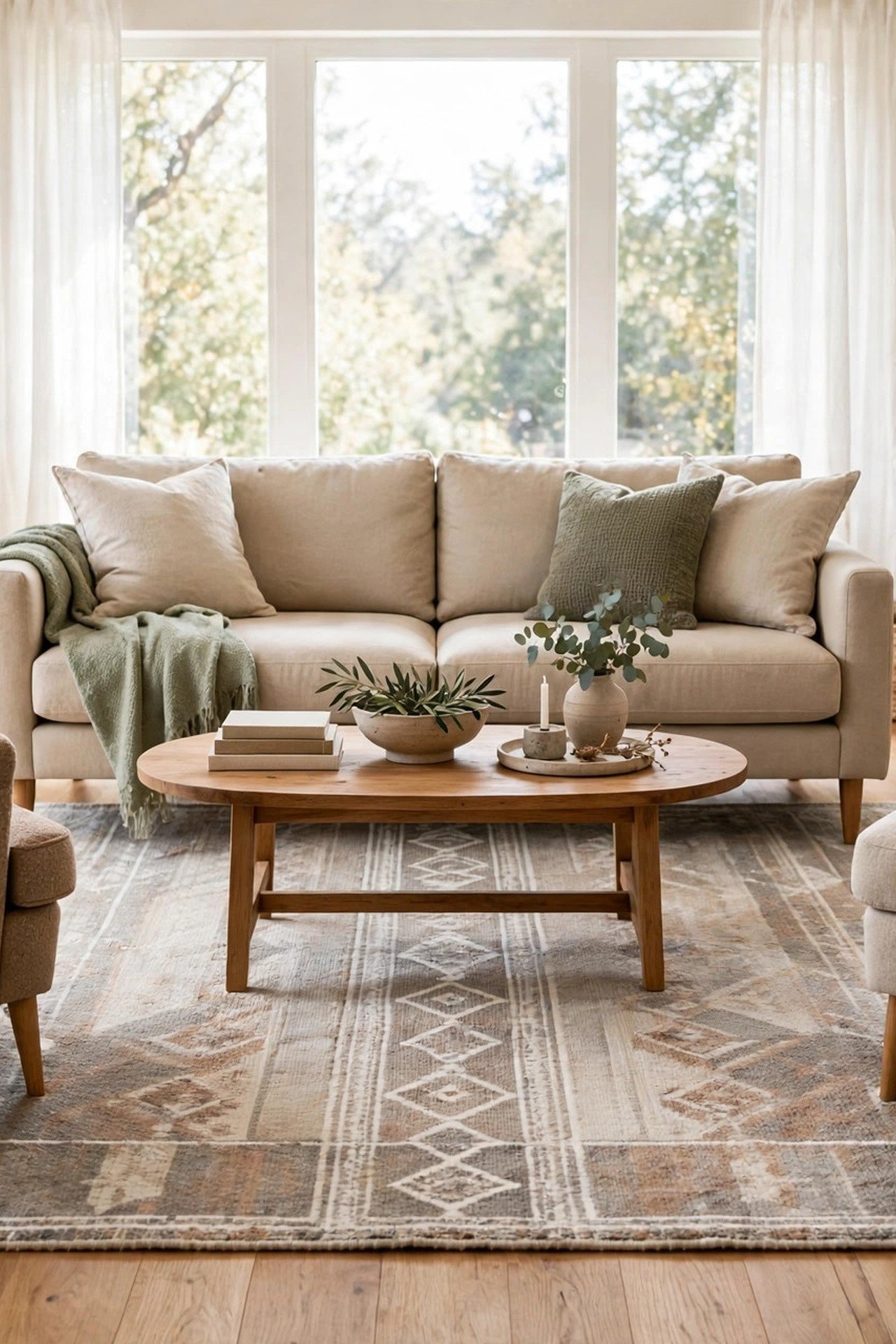
It is one of the most common sights in living rooms: a rug the size of a bath mat floating in front of a full-size sofa, touching nothing, anchoring nothing, looking vaguely apologetic. The furniture sits around it like it is avoiding a puddle. A too-small rug does not just look off — it shrinks the seating area visually, makes the furniture feel scattered, and leaves the room feeling unfinished no matter how good the pieces are.
The fix is sizing, not taste. Rug choice follows clear rules based on the furniture it serves, and most rooms need a bigger rug than their owners first buy. This guide explains the front-legs rule, the standard sizes and what each one actually covers, and how to handle the rooms where the “right” size seems impossible.
Quick Answer
A living room rug is the right size when at least the front legs of every seat in the group rest on it — sofa, armchairs and all. For a typical sofa-and-two-chairs group that usually means 230 × 160 cm as a starting point, and 290 × 200 cm in larger rooms; a rug under 160 × 120 cm almost never anchors a full seating group. Leave a border of bare floor of roughly 20–45 cm between the rug’s edge and the walls, and size up rather than down whenever you are between sizes — a slightly generous rug looks intentional, a slightly small one looks like a mistake.
The Front-Legs Rule: the One Rule That Decides Everything
Forget measuring the room for a moment and measure the seating group instead. A rug’s job is to define the island the conversation sits on, and an island only reads as an island when the furniture is standing on it. The minimum standard designers use is the front-legs rule: the front legs of the sofa and of every chair in the group sit on the rug, with the rug extending at least 15–20 cm under the sofa’s front edge. The ideal, when budget and room allow, is all legs on — the whole group standing fully on the rug, which looks the most settled and works best in bigger rooms.
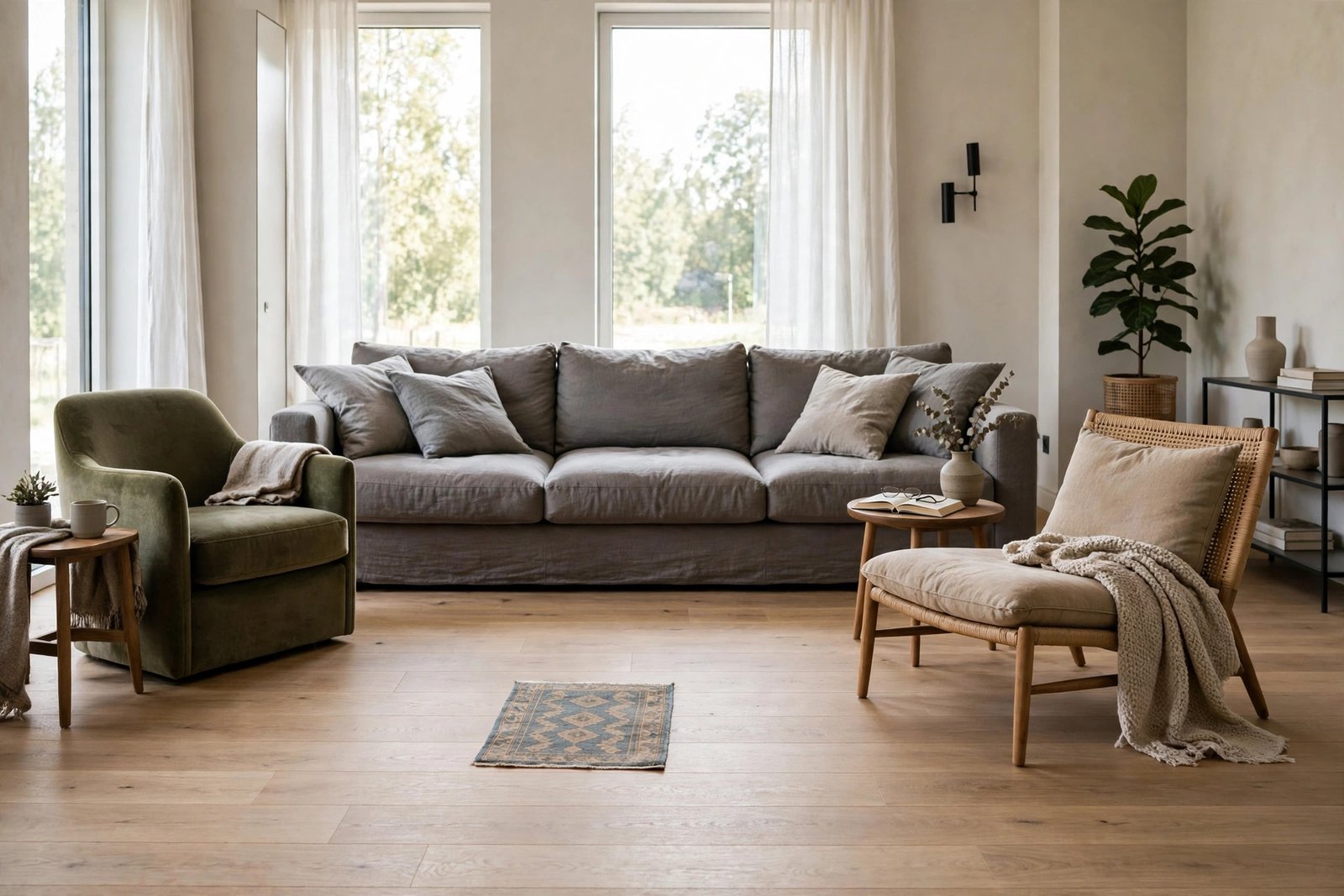
The failure mode is easy to recognise: a rug that sits entirely in front of the sofa, with all four legs of everything on the bare floor around it. That rug is not anchoring the group; it is decorating the gap. It also tends to drift and curl because nothing holds it down. If your current rug passes the coffee table but reaches no furniture at all, it is not a small-style choice — it is simply the wrong size, and upsizing it will do more for the room than any new accessory.
Standard Sizes and What They Honestly Cover
Rugs are sold in standard sizes, and it helps to know what each one can really serve. 160 × 230 cm is the workhorse: under a sofa of up to about 200 cm with the front-legs rule, it covers the group in most average rooms. 200 × 290 cm handles longer sofas, all-legs-on layouts, and groups with two armchairs flanking. 120 × 170 cm suits a compact loveseat-and-chair group in a genuinely small room, again with front legs on. Anything near 90 × 150 cm or smaller belongs in a hallway or beside a bed — in front of a sofa it will always read as a mat.
Work backwards from your furniture. Measure the width of your seating group — sofa plus the chairs that angle in at its ends — and add at least 20–30 cm beyond the group on each side. Then measure the depth: from the wall or the sofa’s back to at least 40 cm beyond the coffee table’s front edge. Those two numbers tell you the size to buy, and they regularly surprise people by landing one size up from the rug they already own. Whether the sofa in that group should sit against the wall or float also changes the depth you need — our guide to sofa against the wall or floating covers that decision; a floated sofa needs the rug to extend behind its front legs comfortably, never ending right at them.
Placement: Borders, Centring and the Coffee Table
With the right size in hand, placement follows three checks. First, the border: in most rooms, leave an even frame of visible floor around the rug — roughly 20–45 cm to the walls. A rug that nearly touches every wall reads as a wall-to-wall carpet that failed; a border reads as design. In very small rooms the rug can run closer to the walls, and running it under the sofa fully is better than shrinking it.
Second, centre the rug on the seating group, not on the room. If the sofa is off-centre on its wall, the rug follows the sofa. Third, the coffee table: it should sit fully on the rug, centred on the sofa, with the rug extending evenly around it — and getting the table’s own proportions right matters just as much, as our guide on how to place a coffee table sets out. When the seating group is floating in a large space, the rug becomes even more important: it is the zone’s floor plan, the same trick that lets a big room split into cosy areas in our guide to creating cosy zones in a large living room.
When the Right Size Seems Impossible
Some rooms fight the rules: a walkway crosses the seating area, the door swings over the rug’s corner, or the budget stops one size short. Honest workarounds exist. If a traffic path must cross the group, size the rug to the seating only and let the path run on bare floor beside it — a rug half under a walkway gets chewed edges and constant curling. If the door swing clips a corner, turn the rug or shift the whole group a few centimetres rather than downsizing.
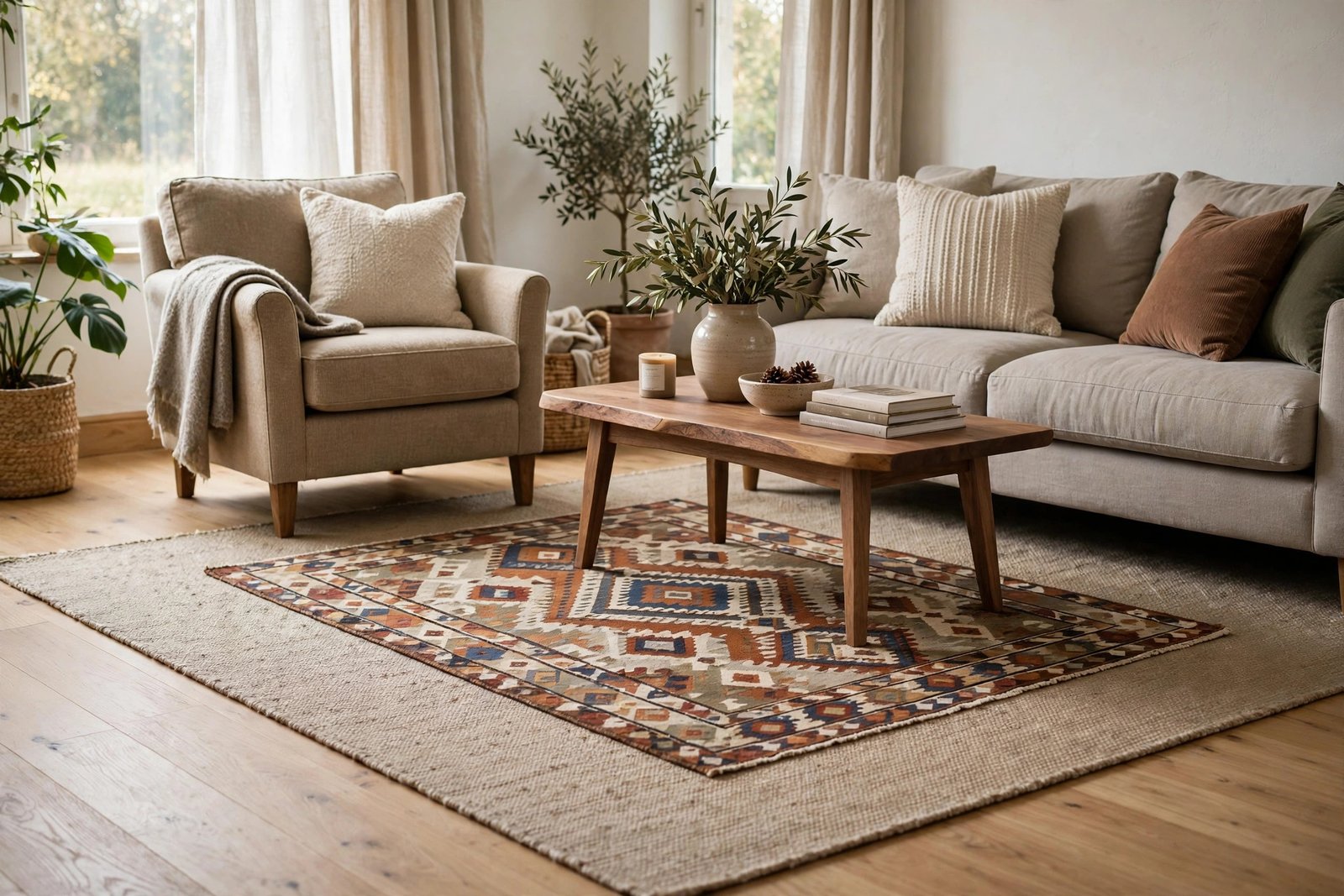
If budget is the limit, buy the larger size in a simpler, flat-weave style rather than the smaller size in a luxurious one — size changes how the room reads far more than pile depth does. And if you already own a too-small rug you love, layer it: put an inexpensive, correctly sized flat-weave down first and centre the loved rug on top. The eye reads the outer rug’s footprint as the zone, and the smaller one becomes a deliberate pattern layer instead of an accident.
Mistakes to Avoid
- Buying the rug before measuring the seating group. Guessing is how 120 cm rugs end up under 220 cm sofas. Measure group width and depth first, then shop sizes.
- The “postage stamp” — no legs on the rug at all. A rug floating in front of the furniture anchors nothing and shrinks the room visually. Front legs on, minimum.
- Sizing down to save money. One size too small looks wrong every day for years. A bigger rug in a plainer weave beats a smaller rug in a rich one, every time.
- Centring the rug on the room instead of the seats. The rug serves the conversation group. If it is aligned to the walls but the sofa’s legs miss it, it is in the wrong place.
- Letting the rug run under a walkway. Edges in a traffic path curl, trip and wear out fast. Keep main routes on bare floor and the rug inside the seating island.
- Matching the rug exactly to the sofa’s width. A rug the same width as the sofa leaves the end chairs off it and the group looking perched. Go wider than the group, not equal to it.
Frequently Asked Questions
Should all the furniture legs be on the rug?
Ideally yes in a larger room — all legs on looks the most settled. In most average rooms, the front-legs rule is the practical standard: front legs of the sofa and every chair on the rug, back legs off. What never works is no legs on at all; that is the too-small look this guide is about.
What rug size suits a three-seat sofa?
For a 200–220 cm sofa with two chairs, start at 160 × 230 cm with the front-legs rule, and go to 200 × 290 cm if you want all legs on or the chairs angle in at the ends. Measure your group’s full width and add 20–30 cm on each side to confirm.
How much floor should show around a living room rug?
About 20–45 cm of bare floor between the rug and the walls in a typical room, kept roughly even on all sides. In a small room the border can be narrower; in a large room it can be wider, because the rug is defining a zone rather than covering a floor.
My rug is too small but I cannot replace it — what can I do?
Layer it over a larger, inexpensive flat-weave rug in a plain colour. The big base gives the seating group its proper footprint, and your smaller rug becomes a centrepiece layer. Alternatively, move the small rug to a spot it fits honestly — a reading corner, a hallway, under a desk.
The Bottom Line
Rug sizing is furniture maths, not decoration instinct: front legs of every seat on the rug as the minimum, all legs on when the room allows, a visible border of floor around it, and a size chosen from the seating group’s measurements — not from the shop display. When in doubt, go one size up. A generous rug gathers a scattered room into one calm island; a stingy one makes good furniture look lost.