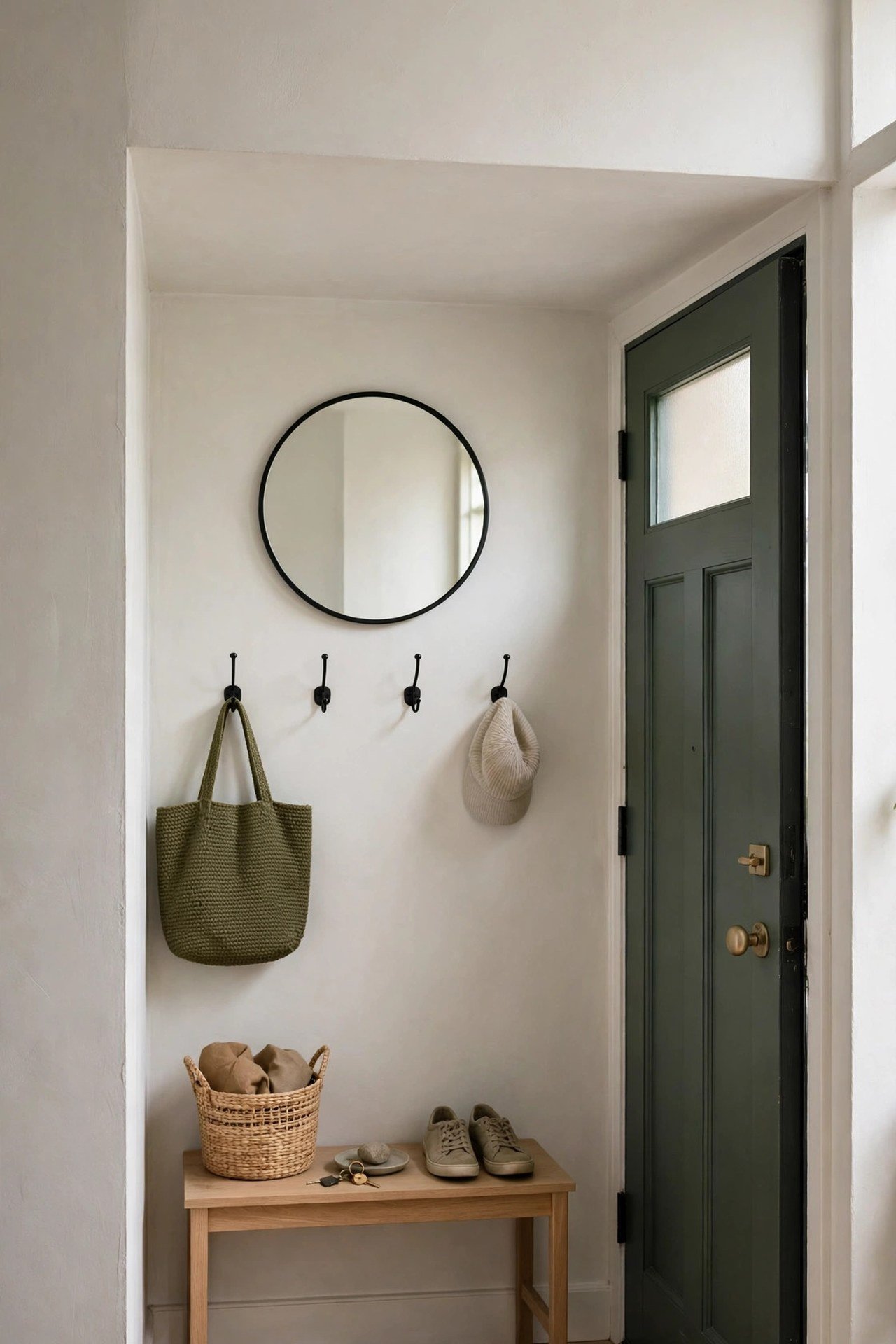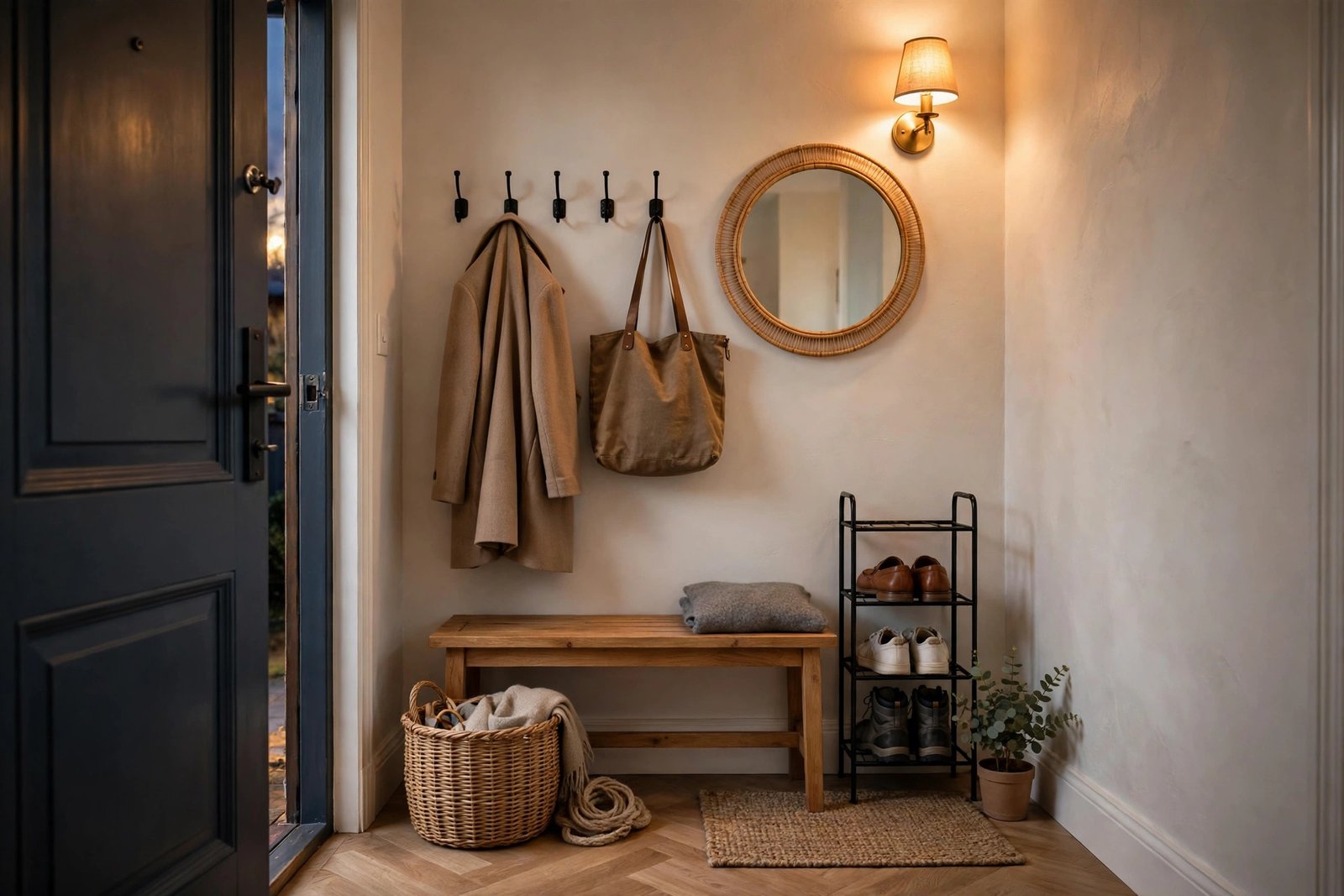
Many small apartments have no hallway at all. You unlock the front door and you are simply… in the living room. There is no pause, no transition, and nowhere for the everyday load you carry through that door — keys, mail, coat, shoes, bag, shopping — to land. So it lands anyway: on the sofa, on the dining chairs, in a growing pile on the floor by the door that you step over for weeks.
A house with a hallway gets this landing strip for free. A tiny apartment has to build one — and the good news is that a working drop zone needs less than a metre of wall and about 30 cm of depth. This guide shows how to create one step by step, even in a rental, so your door area catches the clutter before it spreads into your living space.
Quick Answer
To create a drop zone with no hallway, claim the wall space immediately beside or behind your front door and give it four jobs: hooks for coats and bags, a small shelf or tray for keys and mail, shoe storage that is closed or very tidy, and a mirror or picture to mark the spot as a place, not a pile. A narrow bench or stool to sit on while removing shoes completes it. Keep the whole zone within about 30 cm of the wall so it never blocks the door swing or your walkway.
Step 1: Claim the Right Patch of Wall
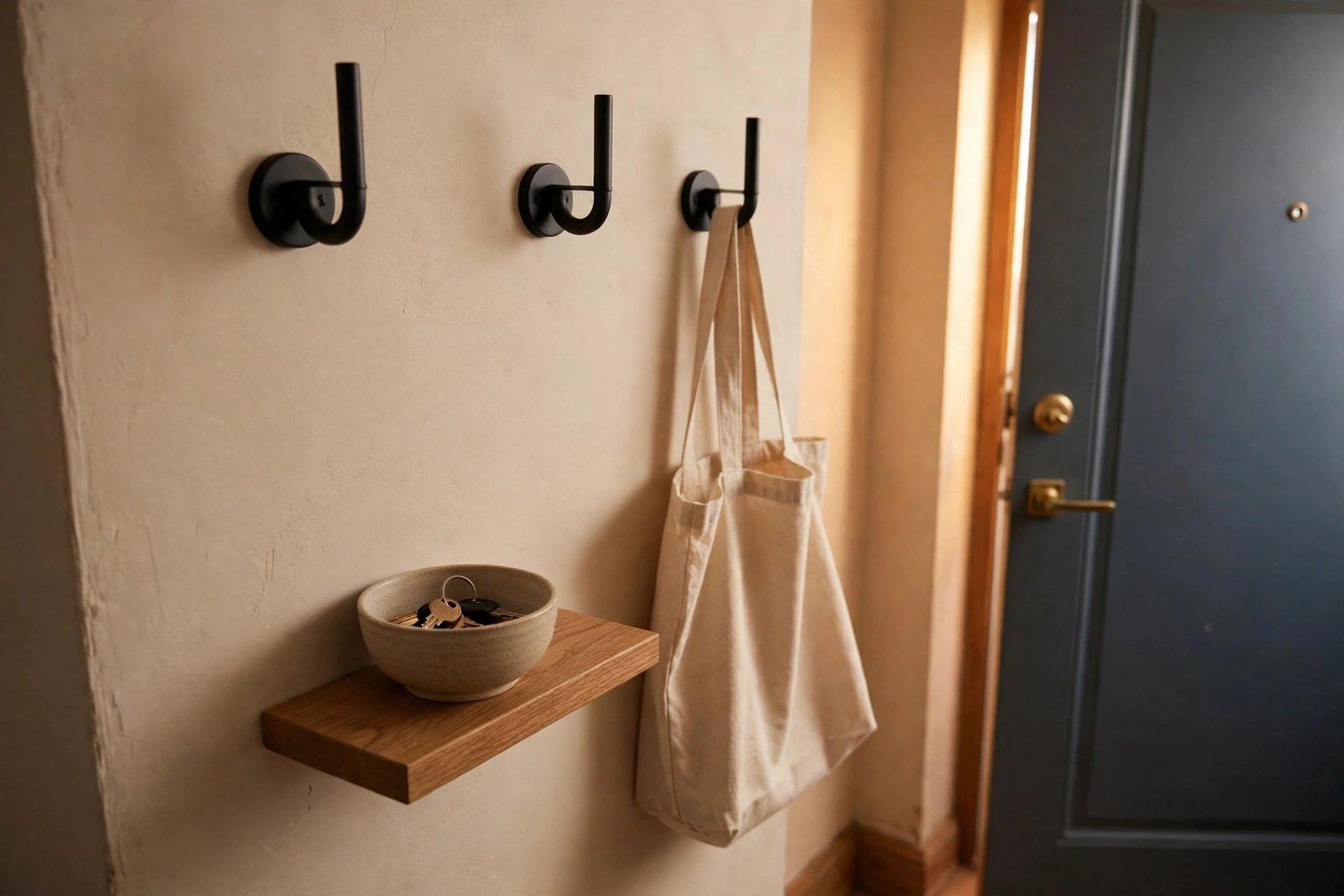
Your drop zone has exactly three possible homes: the wall the door opens against, the wall directly beside the door frame, or the back of the door itself. Walk in with your usual load and notice where your hands naturally want to go — that instinct is the correct location. A zone placed two metres away, however pretty, will lose to the floor every single day.
Measure two things before buying anything: the door’s swing (your zone must sit outside it, or on the door itself) and the depth you can spare. In most small flats, 25–35 cm of depth is the safe limit before the zone starts eating the walking route. That route matters more than the zone — if your apartment is a narrow studio, keep the clearances in our guide to arranging furniture without blocking walkways in mind as you measure, because the entry stretch is the first part of that route.
Step 2: Hooks First — Coats, Bags, and Everything That Hangs
Hooks do the heaviest work in a drop zone. Fit a row of three to five sturdy hooks at about 160–170 cm for coats and bags, and if children use the door, a second lower row at their height. One hook per person, plus one spare for a guest or a shopping tote, is the formula that prevents the famous single-hook mountain.
Renters have good options that leave no trace: over-door hook racks, adhesive hooks rated for real weight (check the kilogram rating, not the marketing), or a freestanding coat stand only if you genuinely have a spare corner — most tiny entries do not. Whatever you choose, test it with your heaviest winter coat and a full bag before you trust it. A hook that fails in week one teaches everyone in the home to go back to the floor.
Step 3: A Landing Strip for Keys, Mail, and Pockets
The second job is a surface — small, flat, and exactly where your hand lands as you close the door. A floating shelf 15–20 cm deep, a wall-mounted fold-down flap, or even a slim picture ledge works. On it goes one container, not five: a bowl or small tray for keys, a letter rack or upright file for mail, and a home for sunglasses and loose change inside the same tray.
The rule that keeps this surface alive is “one tray, emptied weekly.” Mail gets five days to be dealt with before it moves to recycling or a proper folder elsewhere. Keys never leave the tray, which quietly ends the morning key hunt for good. If your living zone starts right where the entry ends — common in studios — a shelf like this also acts as a subtle border between “outside” and “home,” the same zoning idea used in our guide to creating separate living zones in a studio apartment.
Step 4: Shoes — Contained, Closed, and Limited
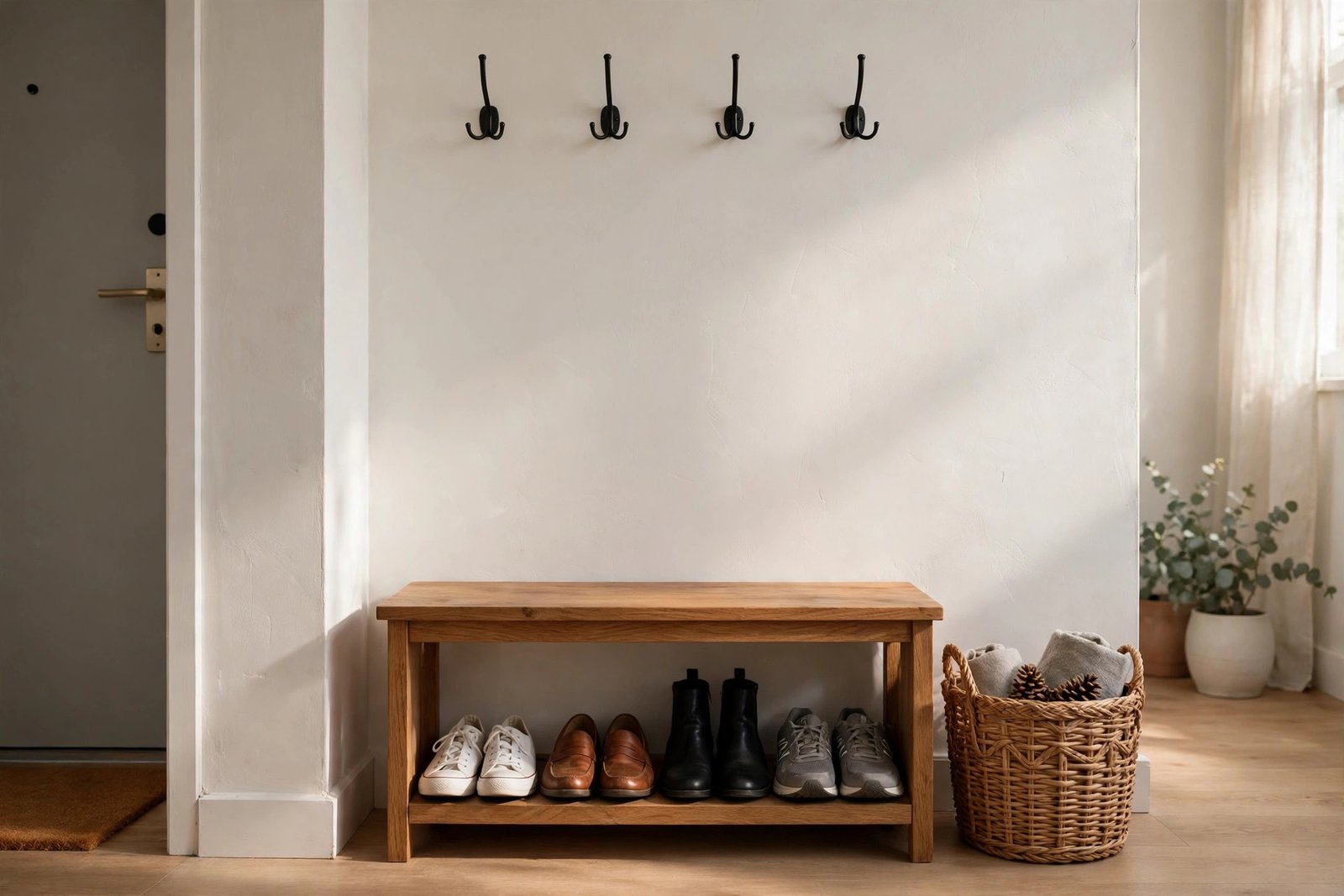
Shoes are where tiny entryways go to die. The fix is a container with a hard limit: a slim closed shoe cabinet (many are only 17–25 cm deep and hold eight to twelve pairs), a two-tier rack under a bench, or a single boot tray for wet-weather pairs. Closed storage is strongly recommended when the entry opens straight into the living room, because a wall of visible shoes makes the whole room read as a hallway.
Set a household rule the furniture enforces: only the pairs worn this week live at the door. Everything else belongs in a wardrobe or under the bed. If two people each keep six pairs by the door, no cabinet will save you — the limit is the system, and the cabinet is just its container.
Step 5: A Seat and a Finish That Makes It a Place
A small bench, a sturdy stool, or even a folding chair hung on the wall changes shoe removal from a balancing act into a two-second sit. Benches with storage underneath or a shoe shelf built in earn their floor space twice over. Keep the seat under 35 cm deep and no wider than your wall patch allows.
Finish the zone so it looks deliberate: a mirror (practical for the last check before leaving, and it bounces light into dark entries), a small washable rug or mat that catches wet and dirt before it reaches your floors, and one hook-side basket for umbrellas, dog leads, or reusable bags. If the living room beyond the door is short on seats, a bench that can be carried over as emergency guest seating is a bonus — the flexible-seating thinking in our guide to a living room too small for a sofa applies the same logic there.
Mistakes to Avoid
- Placing the zone away from the door. Convenience beats looks every time. If the hooks are not within one step of the door, coats will live on chairs.
- One hook for everything. A single overloaded hook is just a vertical pile. Plan one hook per person plus a spare.
- Open shoe piles. A heap of shoes at the door makes the entire apartment feel like a corridor. Use a closed cabinet or enforce a strict two-pair limit on a rack.
- Blocking the door swing or walkway. Anything deeper than about 35 cm, or placed in the swing arc, will annoy you daily and can be unsafe in an emergency exit.
- No limit on mail and paper. A landing strip without a weekly emptying habit becomes an archive. One tray, emptied weekly, or the system collapses.
- Weak adhesive hooks for heavy coats. Check weight ratings and test with your heaviest load. A fallen hook at 2 a.m. is louder than you think.
Frequently Asked Questions
How much space do I need for a drop zone?
Surprisingly little: about 80–120 cm of wall width and 25–35 cm of depth covers hooks, a shelf, and shoe storage for one or two people. Even a 60 cm patch beside the door can hold hooks and a key shelf, which solves the worst of the clutter. Depth is the measurement to protect, not width.
Can I create a drop zone in a rental without drilling?
Yes. Use an over-door hook rack or the back of the door itself, adhesive hooks within their weight rating, a freestanding slim shoe cabinet, and a picture ledge that leans or sticks rather than screws. Everything listed in this guide has a no-drill version, and all of it leaves with you when you move.
What if my front door opens directly into my living room sofa area?
Then your drop zone doubles as a room divider, which is a gift. A slim closed shoe cabinet or a bench placed at a right angle beside the door creates a small visual wall that separates “entry” from “living” — the sofa stops being the coat rack because a better, closer option exists.
How do I keep the drop zone tidy with several people in the home?
Give each person exactly one hook and one shoe slot, label nothing but make the limits physical. Overflow goes to bedrooms, not to a bigger pile at the door. A two-minute weekly reset — mail out, stray items home — keeps the system working. Zones fail when limits are suggestions; containers make them rules.
The Bottom Line
You do not need a hallway; you need one honest metre of wall by the door with four jobs: hooks, a landing strip, contained shoes, and a seat if it fits. Build it where your hands naturally reach, keep it within 35 cm of the wall, and give everything a hard limit. Within a week, the coat pile on the sofa disappears, the morning key hunt ends, and walking into your small apartment starts to feel like arriving home instead of tripping over it.